
Physiognomy
Face reading is an ancient practice that holds the belief one can interpret a person’s character and fortune by observing their five facial features. For instance, individuals with smooth, well-groomed and shiny eyebrows are usually quick-witted and have good interpersonal relationships. Those with large and bright eyes tend to be optimistic, cheerful, emotionally rich, and possess strong intuition and insight.
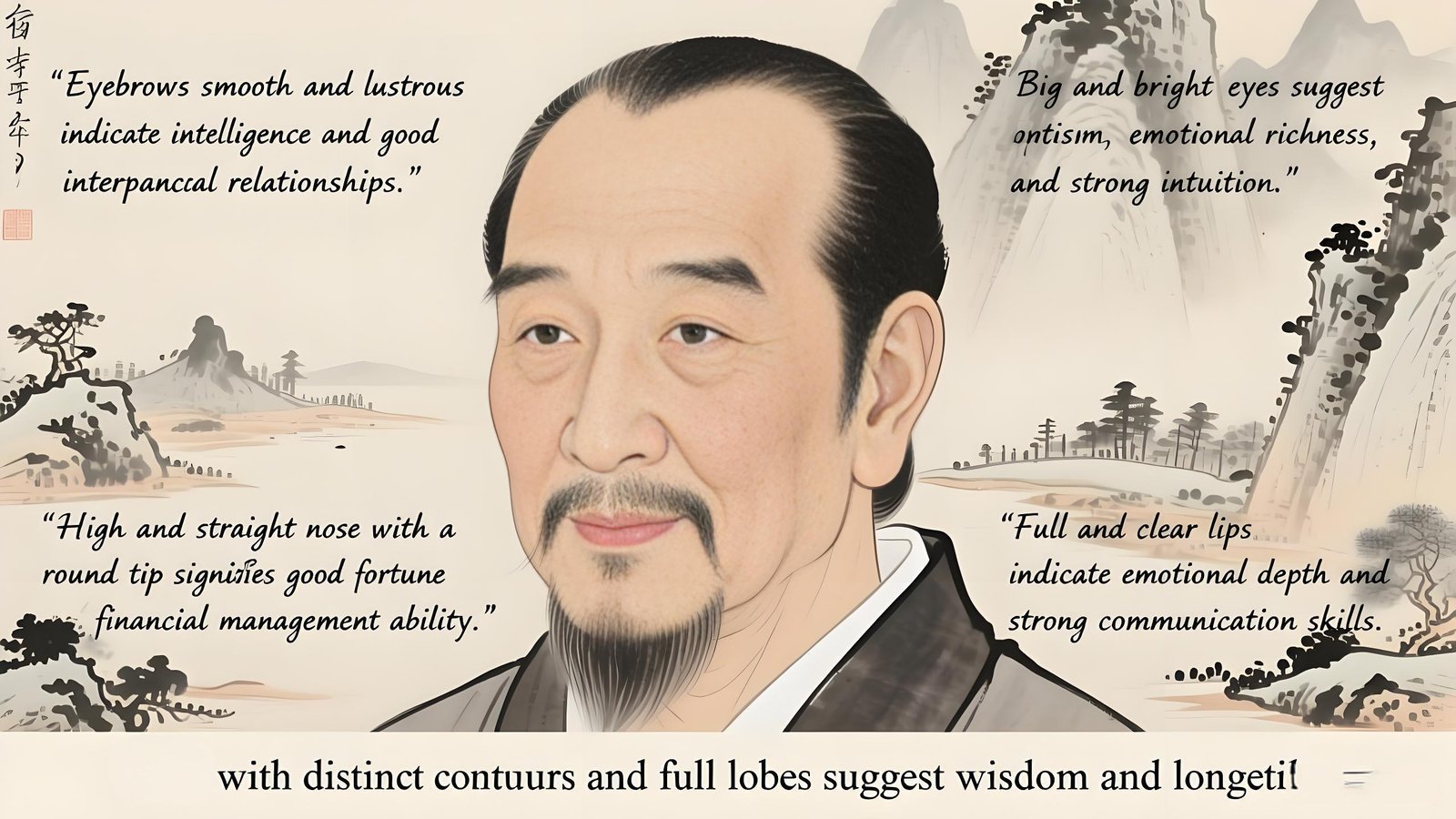
People with a straight nose bridge and a round nose tip often enjoy good financial and career fortunes, along with strong ability in wealth management. Those with full lips and clear lip lines are emotionally rich, have strong expressive skills, and maintain good interpersonal connections. Individuals with well-defined ear contours and plump earlobes are typically intelligent and clever, and likely to live a long and healthy life.
I. Core Interpretation of Facial Divisions
First, divide the entire face into three parts: the upper face, middle face, and lower face. Each region corresponds to different core attributes and serves as a basic framework for quick judgment:
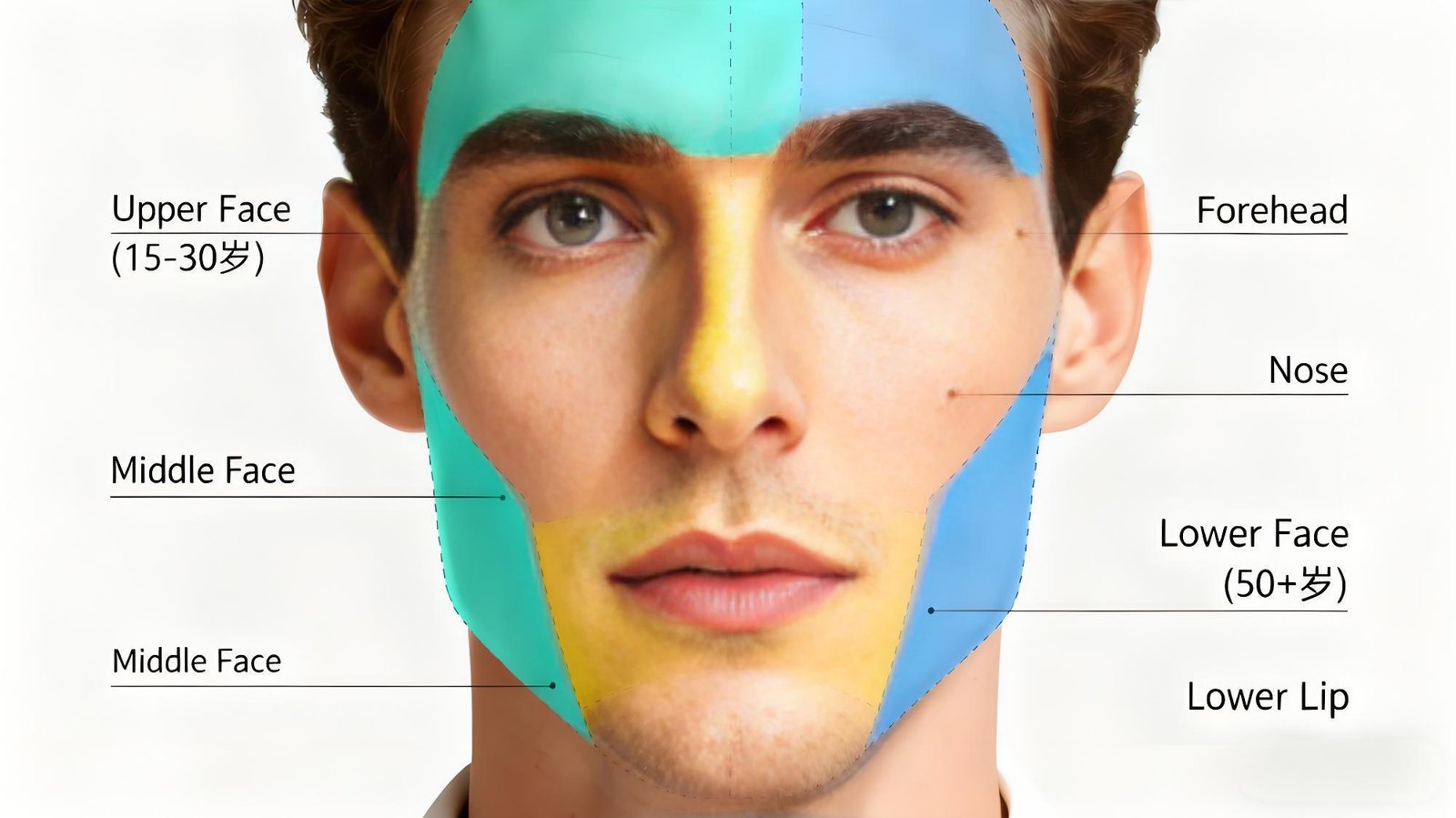
- Upper Face: Centered on the forehead, it represents intelligence and fortune between the ages of 15 and 30. It is also associated with one’s early family environment and the stage of learning and growth.
- Middle Face: Centered on the nose (the “Wealth Palace”), it represents wealth and fortune between the ages of 31 and 50. It relates to career development and the ability to accumulate wealth.
- Lower Face: Centered on the mouth and chin, it represents blessings and fortune after the age of 50. It is linked to late-life blessings, children’s conditions, and longevity. Among these, the “mouth is the gateway to good and bad fortune”—the shape of the mouth directly affects interpersonal relationships and risk avoidance.
II. Upper Face: Detailed Analysis of Forehead, Ears, and Eyebrows
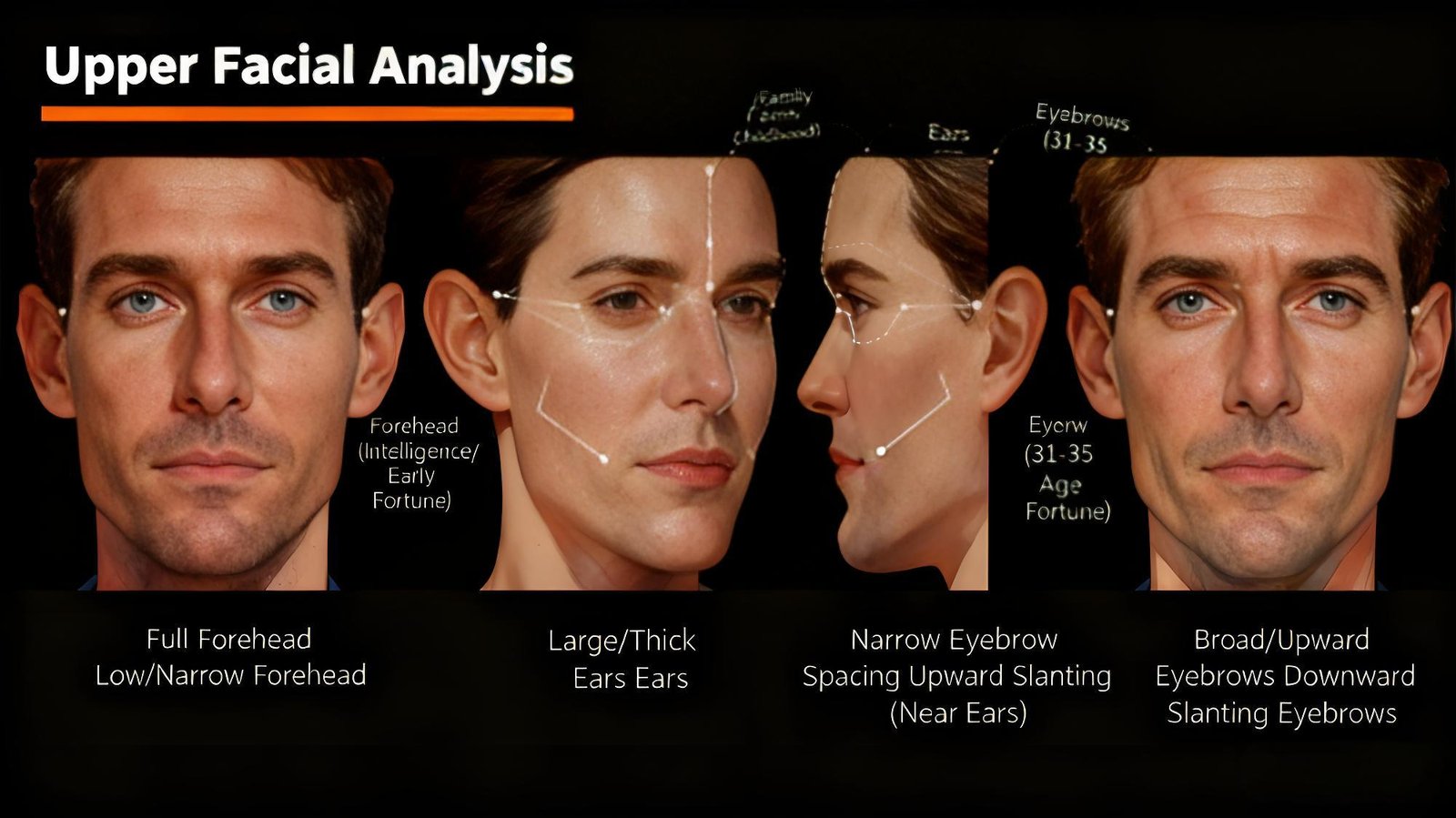
The upper face is the “period of wisdom absorption,” governing one’s cognition, personality, and early fortune before the age of 30. The key parts to observe are the forehead, ears, and eyebrows.
(1) Forehead: A Direct Reflection of Intelligence and Early Fortune
The fullness, height, width, and hairline shape of the forehead directly reflect a person’s intelligence level, personality tendencies, and fortune between 15 and 30:
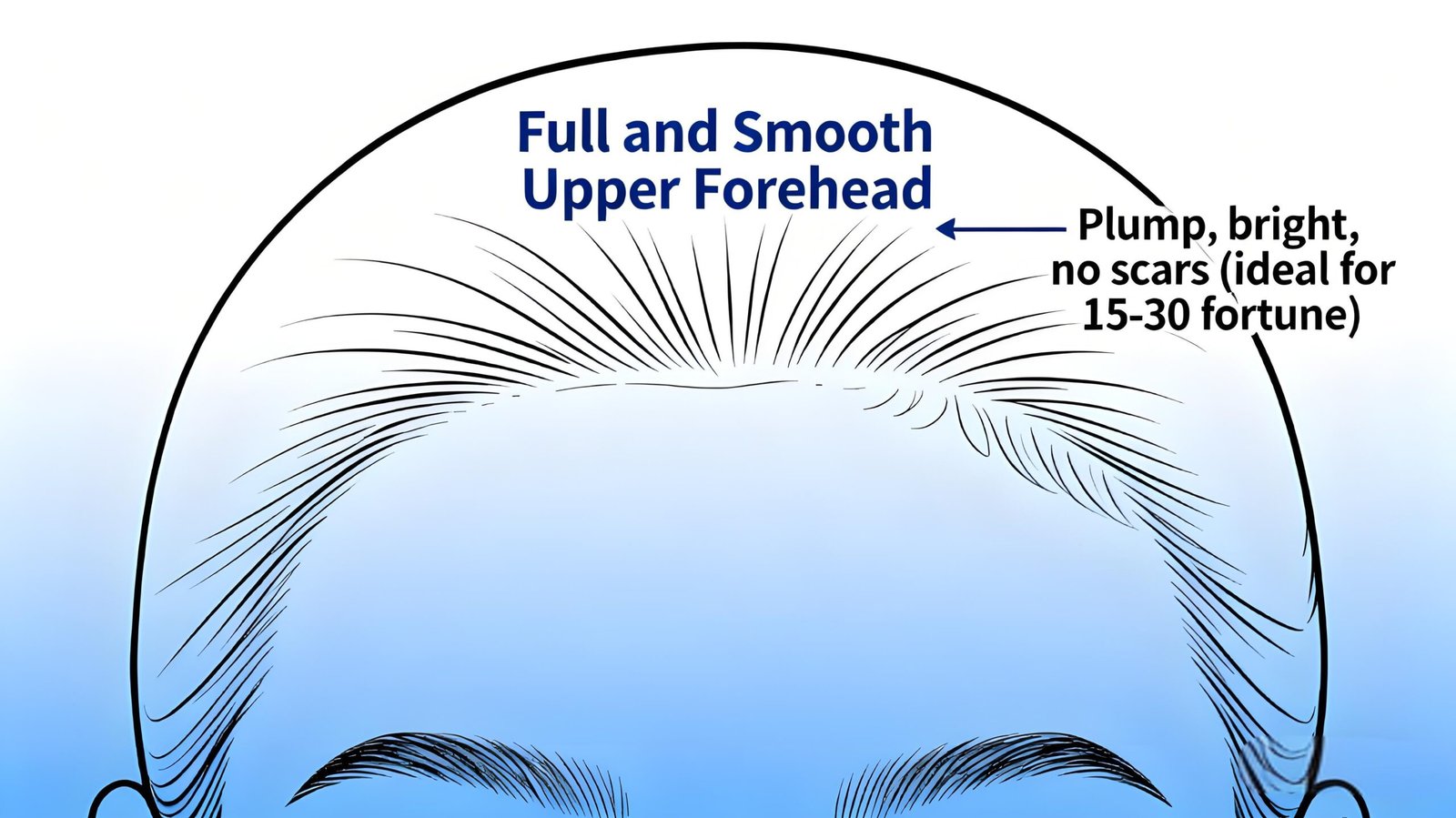
- General Standard: A “full and smooth upper forehead” is ideal. It should be plump, bright, and free of scars (scars or wounds may affect early fortune).
- Height Judgment:
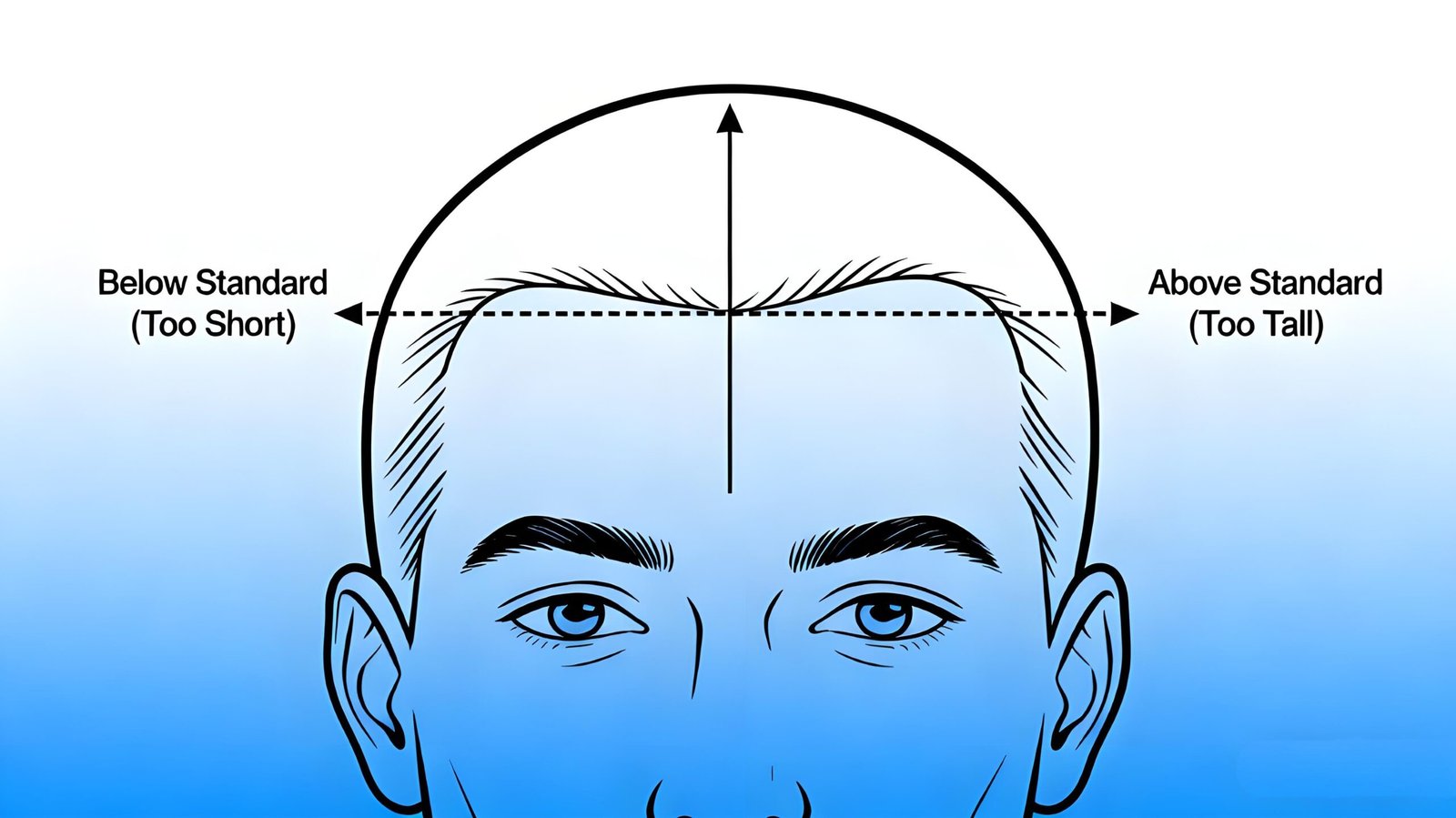
- Measurement method: The distance from the hairline to the eyebrows.
- Gender difference: The standard height is four fingers’ width for men and three and a half fingers’ width for women.
- Personality correlation:
- Below the standard (too short): Prone to impulsive behavior and incomplete thinking before 30; hard to take others’ advice.
- Above the standard (too tall): High emotional intelligence and thoughtful in doing things. However, women with overly tall foreheads tend to be “strong-willed,” mostly career-oriented, with high standards for relationships and uncontrolled spending—they are likely to marry late.
- Width Judgment:
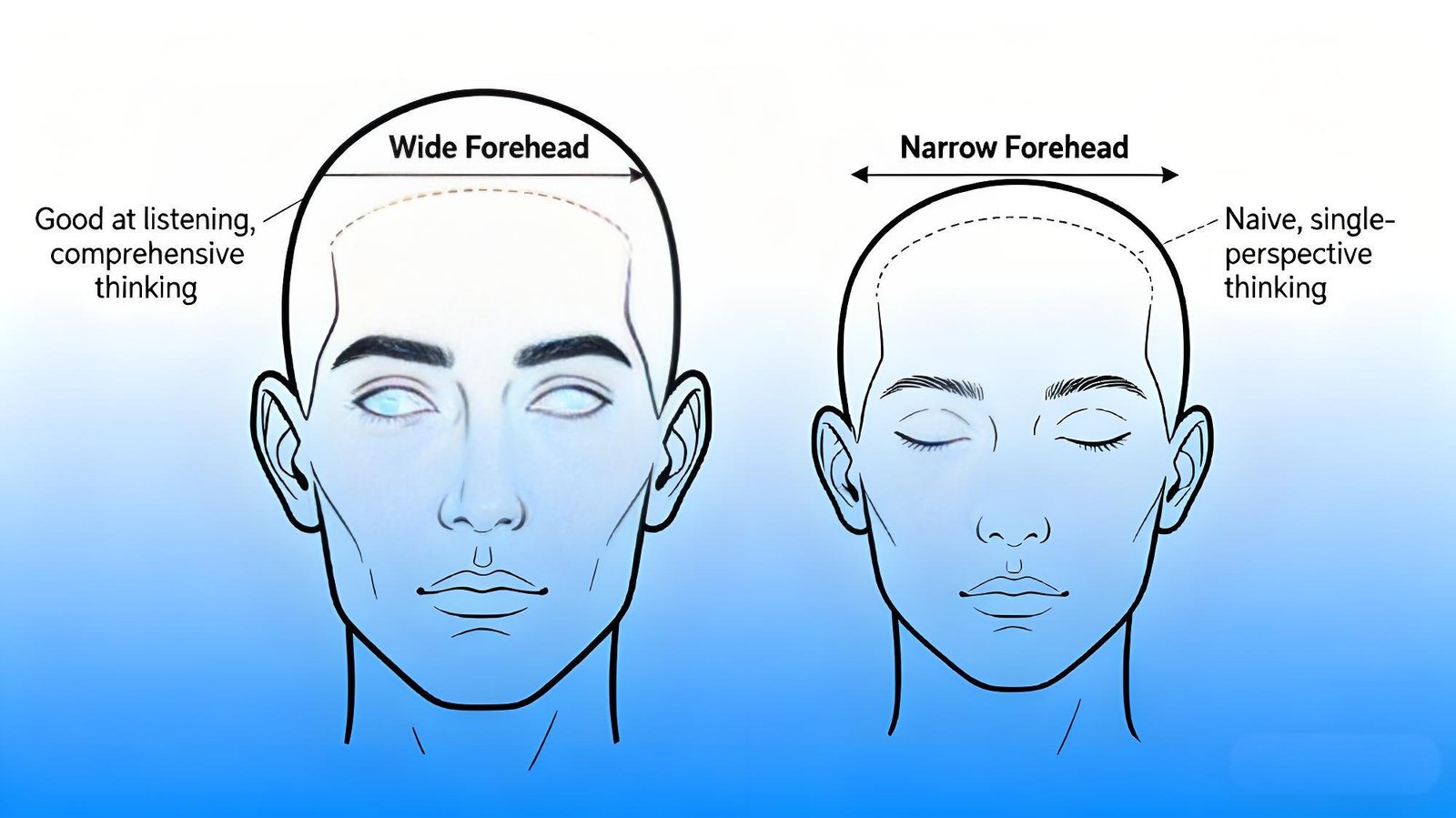
- Wide forehead (no inward contraction of the frontal bones): Both men and women are good at listening to advice, correcting mistakes promptly, and considering things comprehensively.
- Narrow forehead: Naive in thinking, easily limited to a single perspective.
- Hairline Shape:
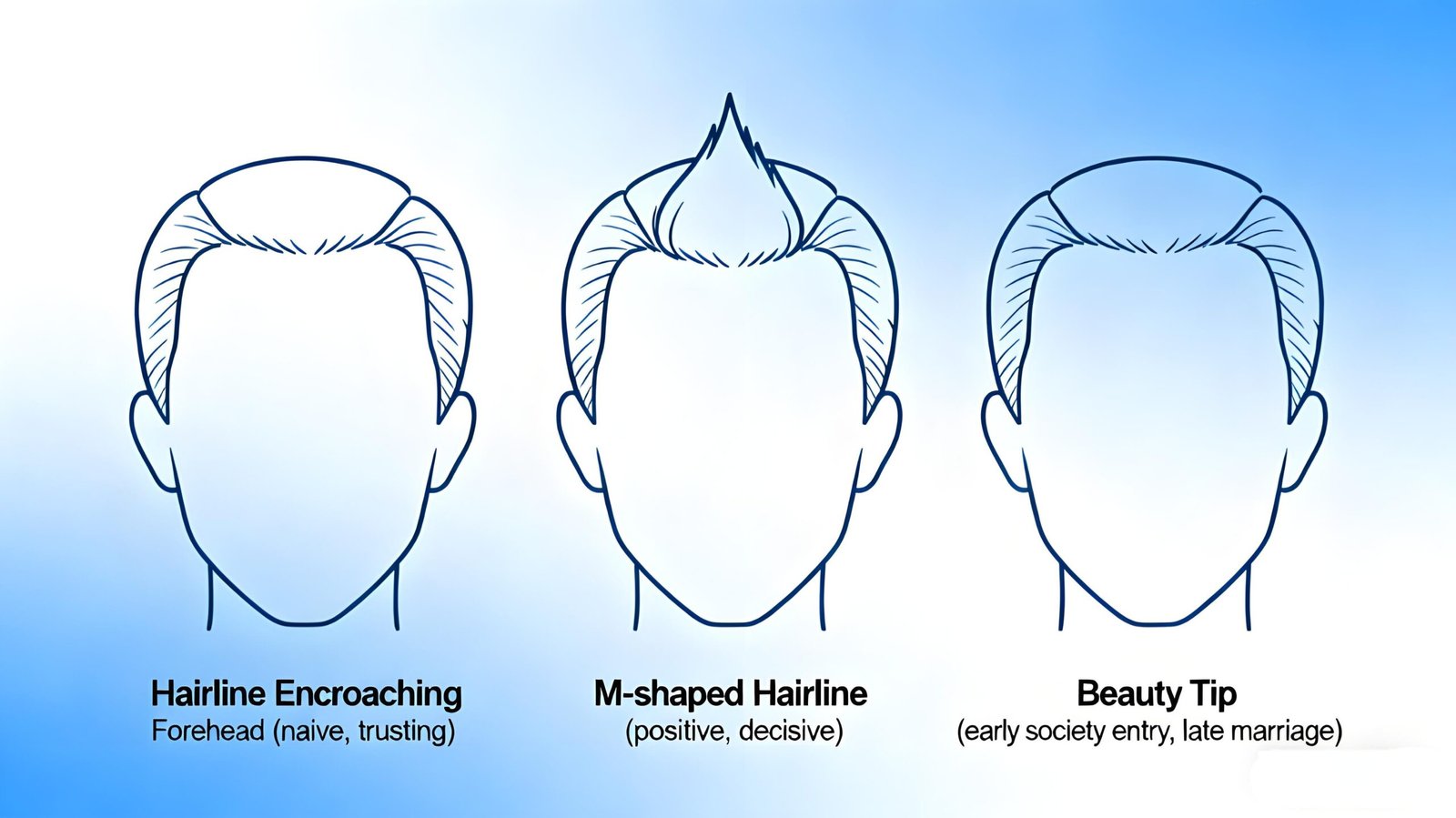
- Hairline encroaching on the forehead (hair growing into the forehead on both sides): Common in women; naive and simple, especially prone to trusting others in relationships.
- M-shaped hairline: Positive personality, capable, decisive, and strong sense of autonomy.
- “Beauty tip” (a sharp hairline in the center of the forehead, literally “golden rooster pecking the Yintang”): Enters society early, has weak ties with family members; women with this feature start dating early but marry late.
- Fortune Tip: For those with a short or narrow forehead, properly trimming the hairline to expose more of the forehead can slightly improve fortune.
(2) Ears: Early Family and Fortune Aged 1–15
Ears are associated with the original family environment and early childhood fortune. The key factors to check are size, hardness/softness, color, and height:
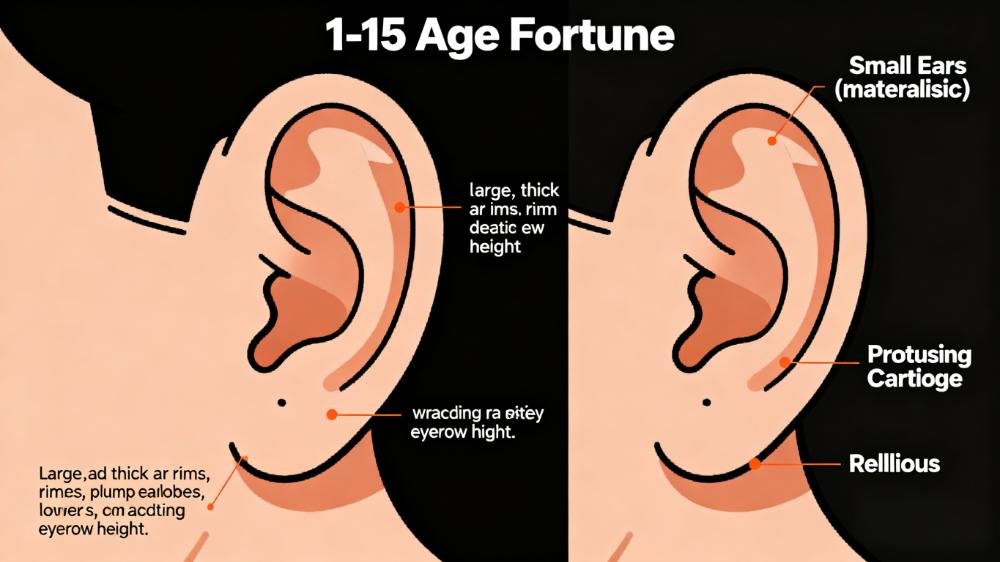
- General Standard: “Large ears, thick ear rims, and plump earlobes” are ideal. Ears should be relatively hard (hard ears indicate sufficient vitality) and pale in color (the ancient saying “ears paler than the face bring fame far and wide” meant easier success in imperial exams in ancient times; today, it reflects strong memory).
- Height Judgment:
- Up to standard: Ears reaching the height of the eyebrows indicate strong self-discipline and focus on self-improvement.
- Below standard (shorter than the eyebrows): Overly focused on material enjoyment, lack of self-discipline, and prone to laziness.
- Special Ear Shape: Protruding Ear Cartilage:
- Traditional view: Frequent family changes in childhood, weak ties with parents, and even considered “prone to rebellion.”
- Modern interpretation: Strong rebellious tendencies, stubborn personality, and unconventional in doing things—prone to making unexpected decisions. This is not “negative” but a unique personal style.
(3) Eyebrows: Fortune Aged 31–35 and Personality Details
Eyebrows govern fortune between 31 and 35 and reflect the delicacy of one’s personality. The key aspects to observe are eyebrow spacing, brow shape, Yintang (the area between the eyebrows), eyebrow bones, and the thickness and direction of the eyebrows:
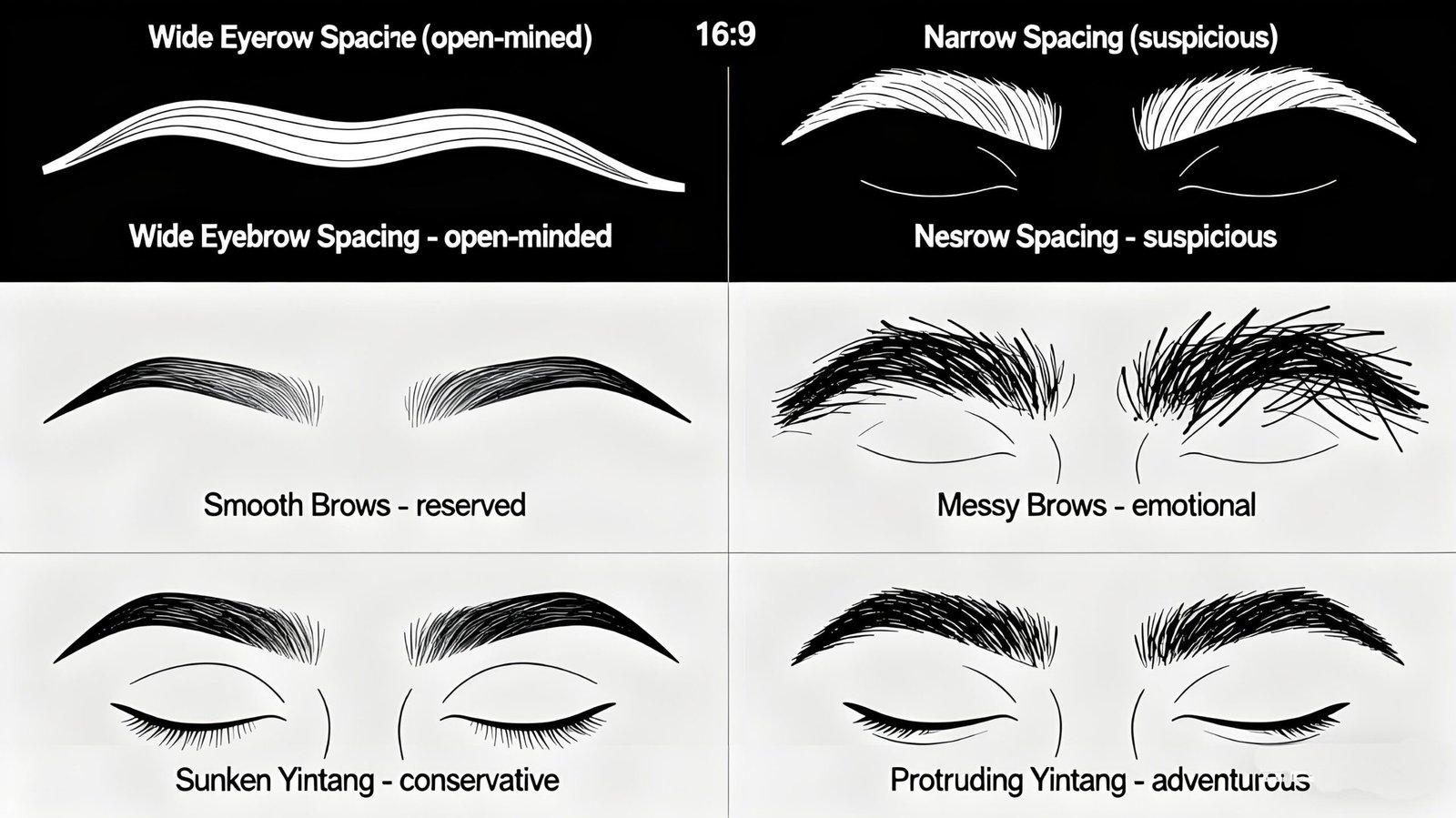
- Eyebrow Spacing (distance between the two eyebrows):
- Narrow spacing (less than two fingers’ width): Suspicious, prone to guessing others’ intentions when interacting; “connected eyebrows” (eyebrows growing together) indicate overthinking, pettiness, and a tiring life.
- Wide spacing: Open-minded, less anxious, and lives a relaxed life. However, overly wide spacing means weak vigilance and susceptibility to deception.
- Brow Shape:
- Messy and outward-growing brows: Active in expressing emotions, with rich romantic experiences.
- Smooth and thin brows: Not good at showing emotions, hides feelings, and has few romantic experiences.
- Yintang (area between the eyebrows):
- Slightly sunken: Weak ability to accept new things, dislikes changes, and has a conservative personality.
- Protruding: Optimistic, adventurous, and willing to接触 new things, usually paired with wide eyebrow spacing. If narrow eyebrow spacing presses on the Yintang, trimming the eyebrows to widen the spacing can “gather positive energy.”
- Eyebrow Bones:
- High eyebrow bones: Advantages include strong analytical and observational skills; disadvantages include tendency to extremism if too high—impulsive, unyielding, and overbearing. Men with this feature may easily show male chauvinism.
- Thickness and Direction of Eyebrows:
- Thickness: Thick eyebrows in men often mean gentleness; thick eyebrows in women often mean courage.
- Direction: Upward-curving (ambitious, unwilling to be subordinate to others); downward-curving (pessimistic, always thinking of the worst outcomes first).
III. Middle Face: In-Depth Analysis of Eyes, Nose, and Cheekbones
The middle face is the “period of wisdom application,” governing career and wealth between the ages of 30 and 50. The key parts to focus on are the eyes (window to the soul), nose (Wealth Palace), and cheekbones (power and decisiveness).
(1) Eyes: A “Perspective Mirror” of Personality and Emotions
Eyes are called the “window to the soul.” The key factors to observe are size, single/double eyelids, eyeballs (iris/white of the eye), and special eye shapes:
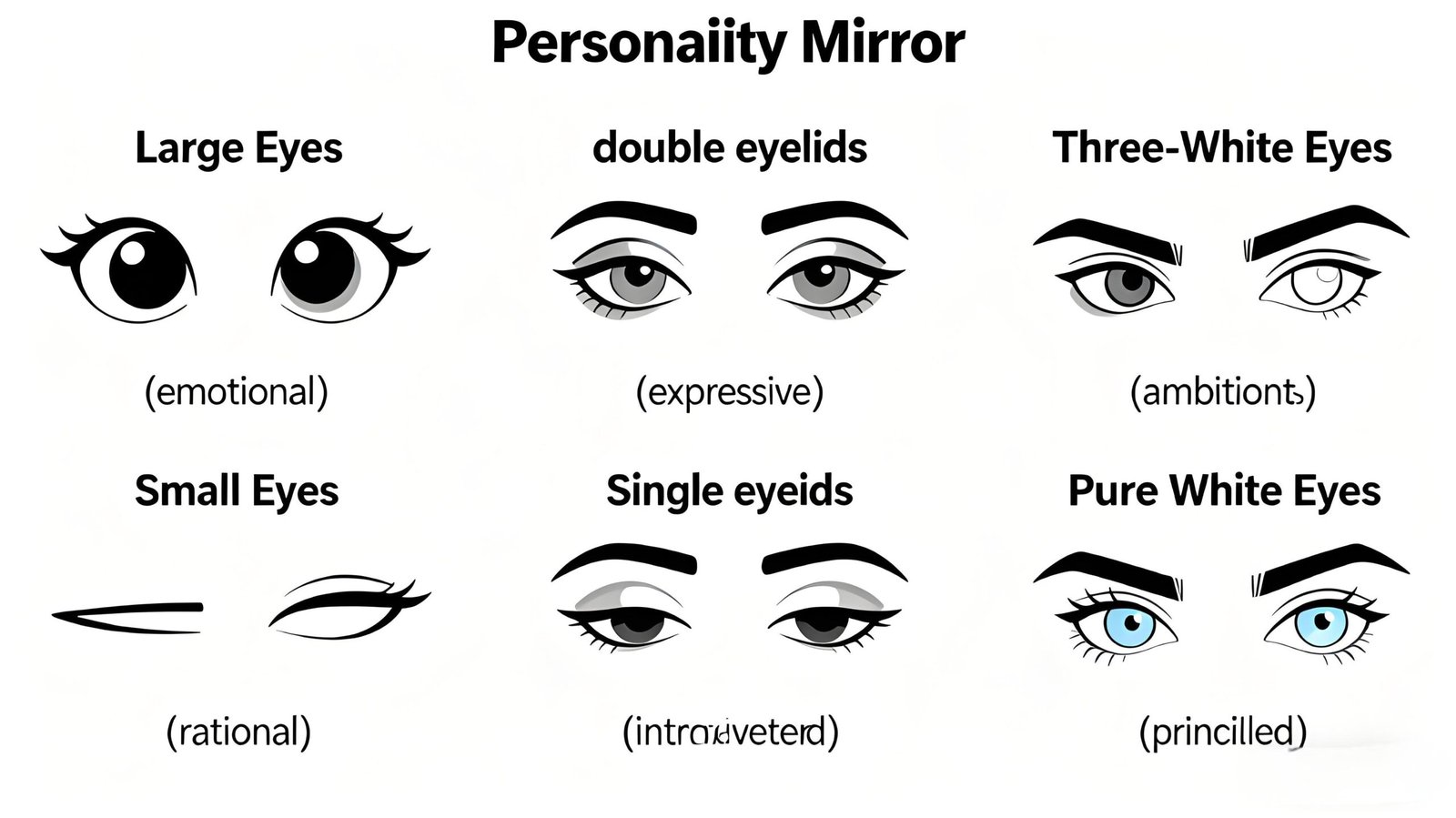
- Eye Size:
- Large eyes: Emotional and expressive.
- Small eyes: Rational and calm in doing things.
- Uneven eye size (one large, one small): Sensitive personality; parents usually have very different personalities.
- Single/Double Eyelids:
- Double eyelids: Good at expressing emotions, with better romantic appeal than single eyelids.
- Single eyelids: Introverted in emotions, not easily expressive.
- Mixed eyelids (one single, one double) or inner double eyelids: Mixed eyelids mean “half emotional, half rational”; inner double eyelids mean “calm on the surface, turbulent inside.”
- Eyeballs (Iris and White of the Eye):
- Iris:
- Large iris: Caring, sincere, and kind-hearted.
- Small iris (three-white eyes/four-white eyes): “Three-white eyes” (small iris with white visible on three sides) indicate an “ambitious person”—ruthless in achieving goals, fragile in relationships (hiding emptiness behind arrogance), and weak ties with family. “Four-white eyes” (rare) mean more extreme personality—strong revenge, cold to others, and prone to greed and jealousy.
- White of the eye:
- Pure white (clear distinction between black and white): Able to tell right from wrong and hold firm positions.
- Impure (yellowish, bloodshot, or dull eyes): Regardless of age, this usually means emotional instability, susceptibility to external influences, and difficulty controlling one’s life and relationships.
- Iris:
- Special Eye Shapes:
- Protruding eyeballs: Short-tempered, impulsive, and self-centered.
- Tadpole-shaped eyes (large at the outer corner, small at the inner corner): Prone to “starting strong but finishing weak” and lacking persistence.
(2) Nose: Wealth Palace and Career Motivation
The nose is the core “Wealth Palace,” governing wealth accumulation and attitude toward work. The key parts to observe are the nasal tip, nasal alae, nasal root, and nasal bridge:
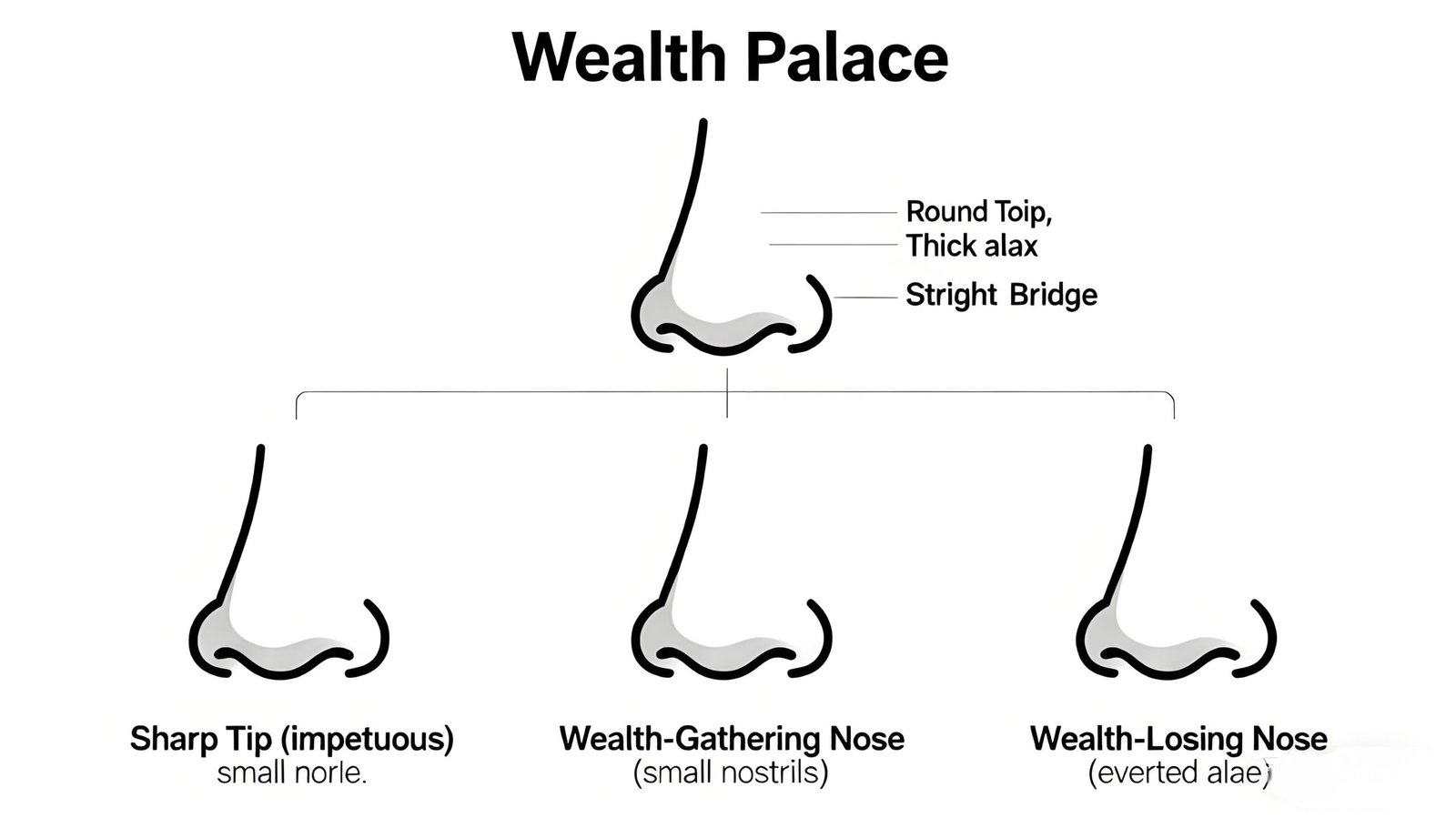
- Nasal Tip:
- Standard shape: Round like a bead or egg; “plump flesh is ideal”—the plumper the nasal tip, the better the positive fortune.
- Special shape:
- Sharp and pressing on the philtrum: Strong desire for money and career ambition, but impetuous and prone to ignoring others’ feelings—life is rarely easy.
- Nasal Alae (the “grain store”):
- Windfall nose: Large and thick nasal alae with wide nostrils—easy to gain big wealth and generous in spending.
- Wealth-gathering nose: Nostrils not visible from the front and small, must be paired with thick nasal alae (thin alae make it hard to retain wealth).
- Wealth-losing nose: Thin and everted nasal alae with exposed nostrils (“the grain store door is open”)—uncontrolled spending; exposed nose hair is also a “wealth-losing sign” and should be trimmed promptly.
- Nasal Root (starting point of the nasal bridge, connecting to the Yintang):
- Function: Connects fortune before and after the age of 30, known as the “fortune bridge.”
- Standard: A nasal bridge naturally extending from the Yintang is a “sign of great nobility.” If a pen is placed against the nasal root and one can open the eyes normally, the height is up to standard—those who meet this standard have strong willpower.
- Below standard (low nasal root): Lack of self-confidence, short attention span in work, ambition but no career fortune, and prone to being overweight. However, a short nose with thick nasal alae is also a “sign of great blessings.”
- Taboo: The nasal root should be free of defects (horizontal lines, scars, moles). Moles on the nasal root often indicate ups and downs in marriage.
- Nasal Bridge:
- Meaning: Represents motivation, opinions, and perseverance in work.
- Special shapes:
- Too high and straight: Stubborn personality, prone to being “obstinate.”
- Sharp nasal bridge (visible bones, no flesh, tall and thin): Cold-hearted and harsh to others.
- Small and delicate nose (common in women): Lively and cheerful personality, good at socializing, and pursuit of perfection.
(3) Cheekbones: Power and Decisiveness
Cheekbones are not a “negative symbol”—those with standard cheekbones are more likely to have leadership skills. The key factors to observe are height and flesh coverage:
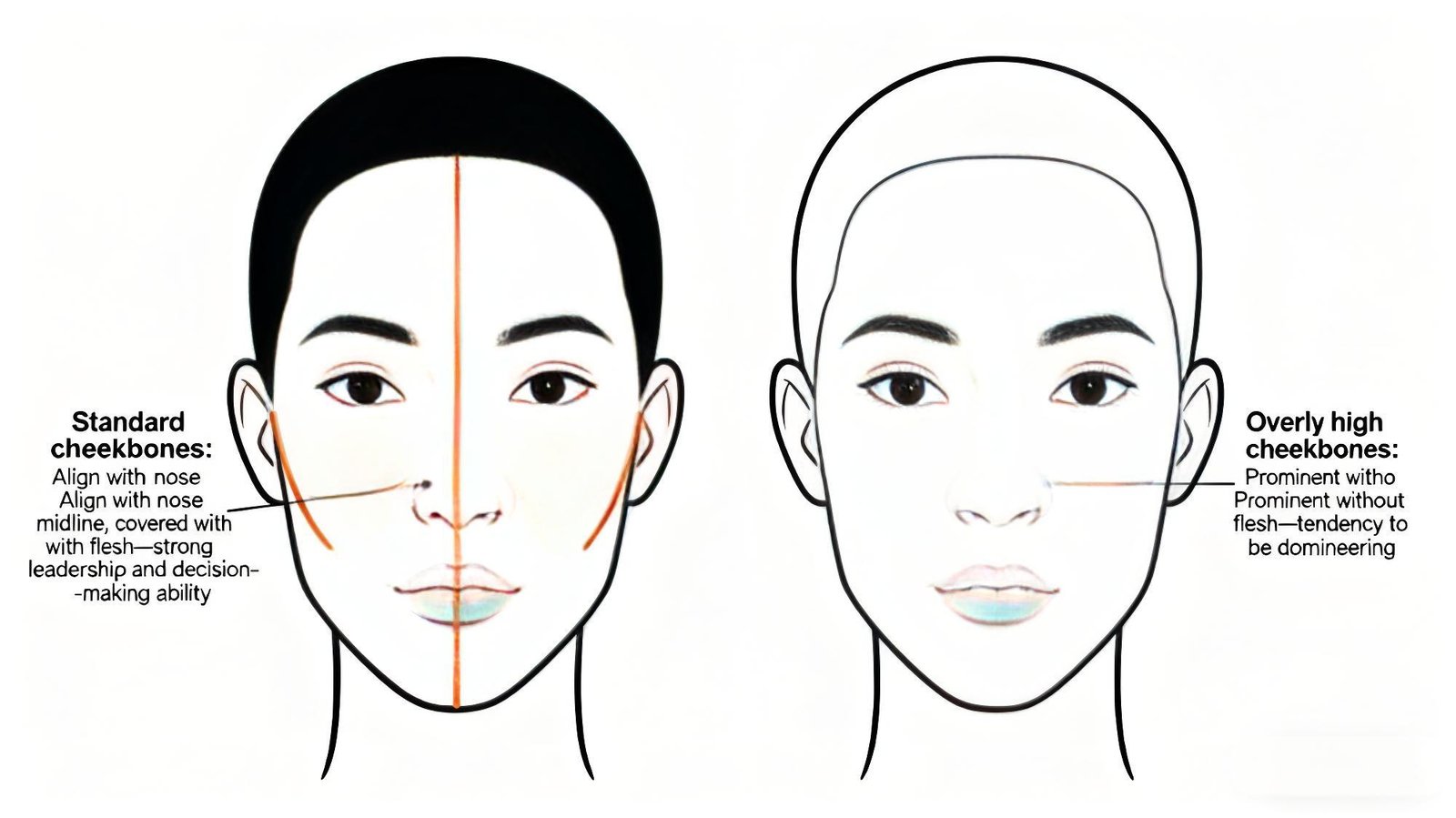
- Standard Height: Aligning with the midline of the nose and covered with flesh, this indicates “ability to hold power and make decisions.” If paired with wide nasolabial folds, decisiveness is even stronger (when making decisions, eyes have the greatest influence, followed by cheekbones).
IV. Lower Face: Practical Interpretation of Philtrum, Mouth, and Facial Moles
The lower face is the “period of wisdom harvest,” governing fortune after the age of 50. The key parts to focus on are the philtrum (health and children), mouth (good/bad fortune and personality), and facial moles (health connections).
(1) Philtrum: Health, Children, and Late-Life Transition
The philtrum is the starting point of the lower face, associated with physical health, children’s conditions, longevity, and the transition of fortune after 50:
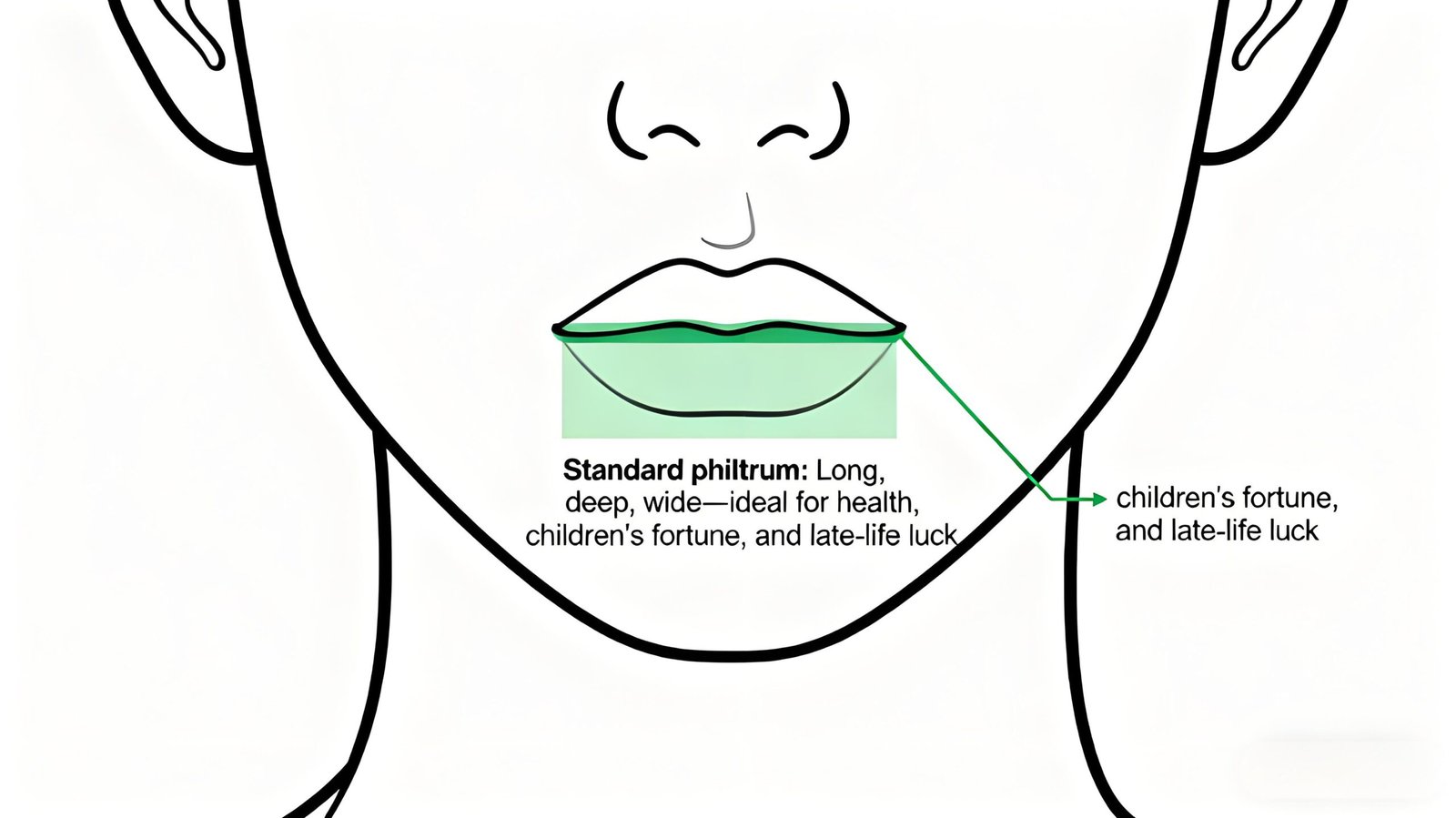
- Standard Shape: Long, deep, and wide is ideal. It should be free of moles and horizontal lines (which affect health and late-life fortune).
(2) Mouth: Gateway to Fortune and Personality Tendencies
The “mouth is the gateway to good and bad fortune.” The size, lip thickness, and special shapes of the mouth directly affect interpersonal relationships and risk:
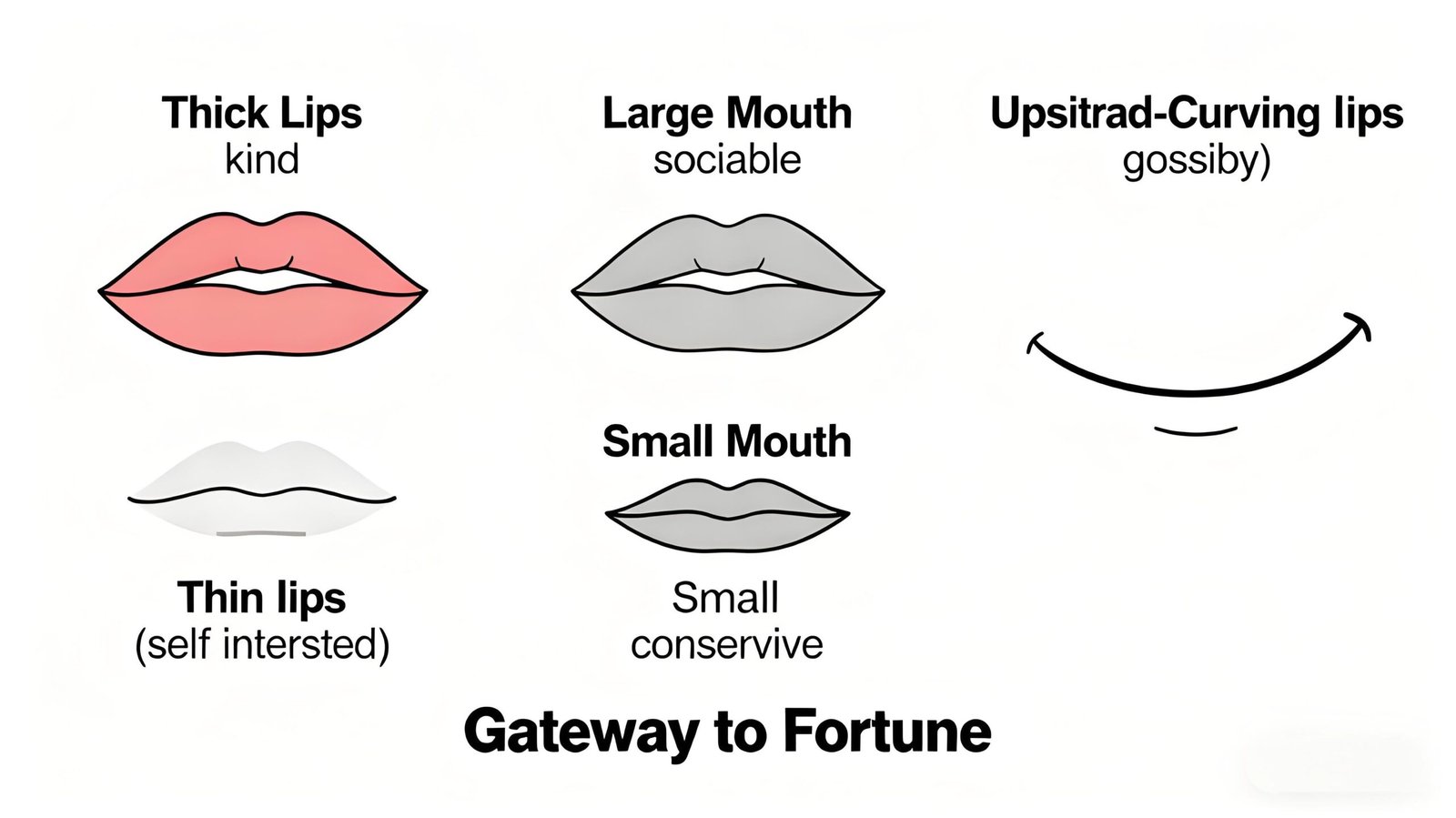
- Lip Thickness:
- Thick upper lip: Values relationships (the upper lip governs emotions).
- Thick lower lip: Strong desire for material things and making money (the lower lip governs desires).
- Both lips thick: Kind and down-to-earth in doing things.
- Too thin lips: Overly self-interested, focusing more on one’s own needs.
- Mouth Size:
- Large mouth: The saying “a man with a large mouth can achieve success anywhere” means good social skills, many friends, and decisive actions. However, such people have no concept of money, are not good at saving, and are skilled at arguing (especially if paired with a lip bead—”can argue against three to five people alone”).
- Small mouth: Conservative personality, hides emotions, poor social skills, and lacks courage. A small mouth with thick lips indicates the most stable personality—caring but not good at expressing.
- Special Mouth Shapes:
- Loose lips (lips cannot cover teeth): Unable to keep secrets.
- Upward-curving upper lip: Likes to gossip and speak ill of others behind their backs.
- Fortune Tip: Keeping the corners of the mouth turned up can boost a positive mindset and indirectly bring good fortune.
(3) Facial Moles: Health Connections (Combined with the Later Heaven Bagua)
There’s no need to memorize the exact positions of moles. Instead, you can link them to the health of internal organs through the “Later Heaven Bagua Palaces”:
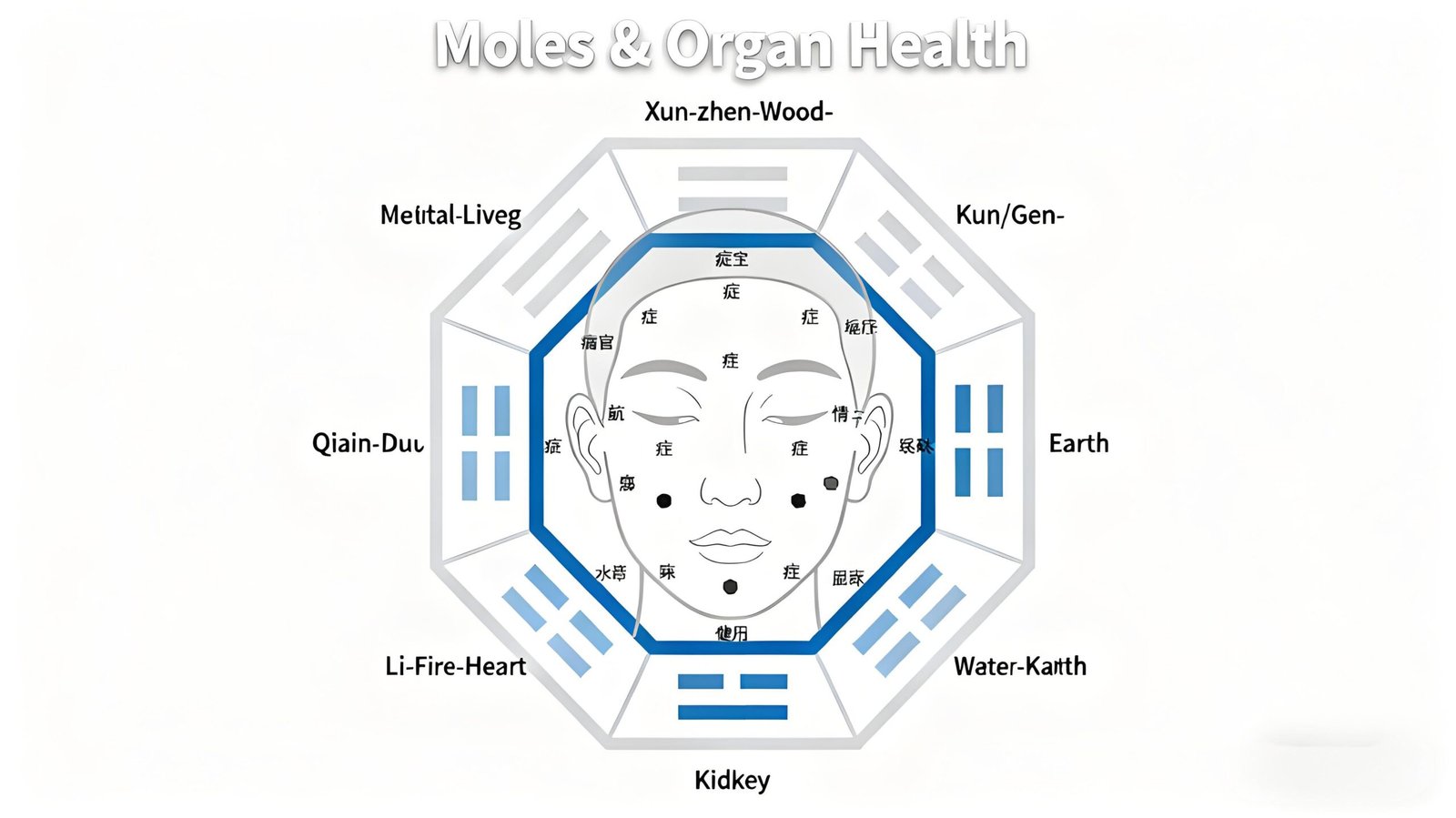
| Bagua Palace | Corresponding Five Elements | Related Organs |
| Xun, Zhen | Wood | Liver, Gallbladder |
| Kun, Gen | Earth | Spleen, Stomach |
| Dui, Qian | Metal | Lungs, Respiratory Tract |
| Kan | Water | Kidneys |
| Li | Fire | Heart, Cardiovascular System, Eyes |
- Note: Acne and age spots are not included in this category. If there are multiple moles in a certain palace, pay attention to the health of the corresponding organs.
V. Summary and Fortune Suggestions
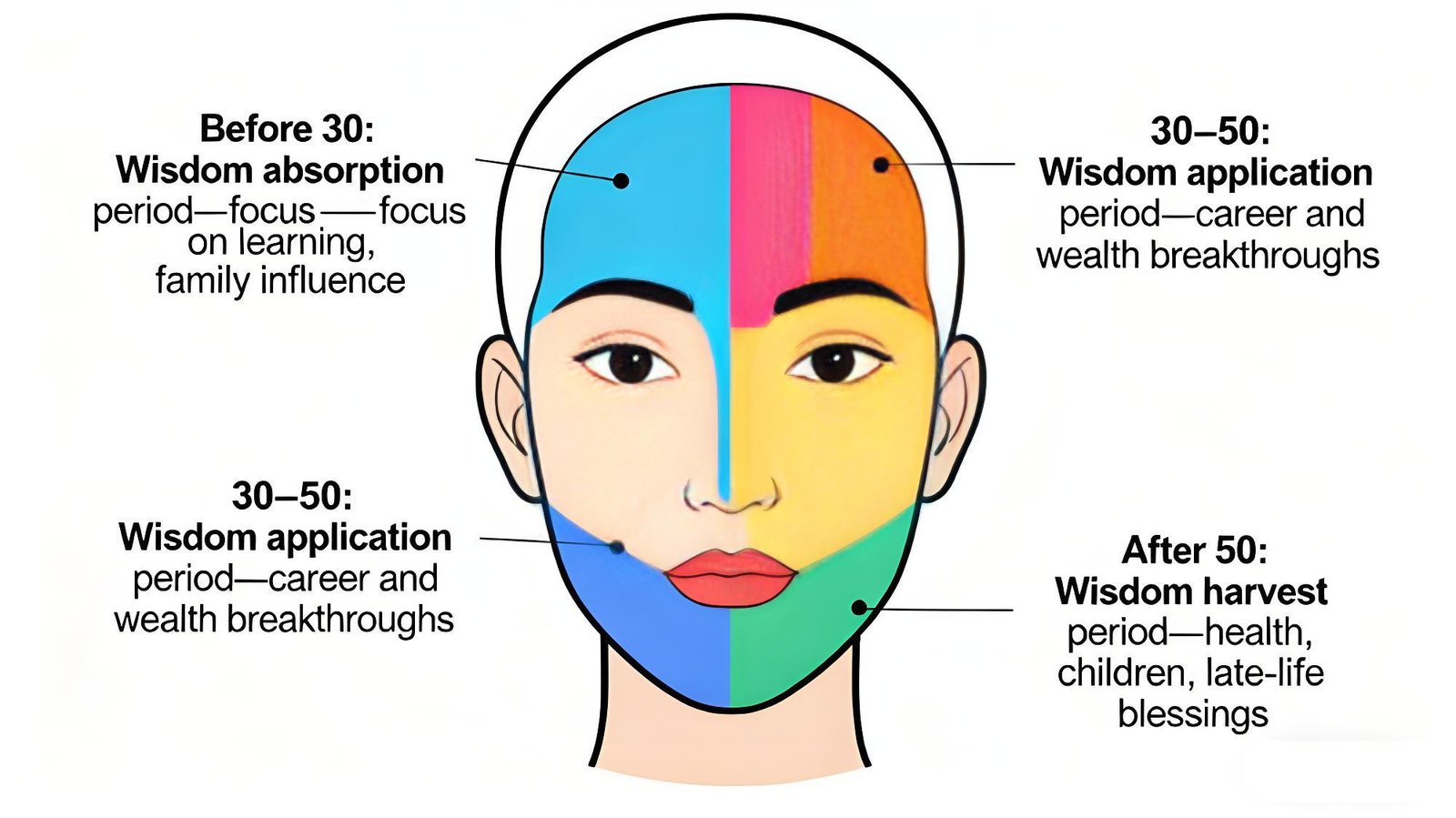
- Age and Fortune Stages:
- Before 30 (upper face): The “period of wisdom absorption,” dominated by family and parents. Confusion is normal; the focus should be on learning and accumulation.
- 30–50 (middle face): The “period of wisdom application,” where you can take control of your life. The core is to make breakthroughs in career and wealth.
- After 50 (lower face): The “period of wisdom harvest,” focusing on late-life blessings, health, and children.
- Reminder for the “Nine Sons Li Fire” Fortune Cycle: The current era is “externally prosperous but internally lacking”—surface glory may hide traps and falsehoods. Be alert to “villains achieving success” and avoid being deceived by external prosperity.