Ming Dynasty Clothing: The Peak of Han Ethnic Costume System and Its Cultural Connotations
Introduction: Ming Dynasty Clothing – A Cultural Epitome of a Resurrected Han Civilization
The Ming Dynasty (1368–1644), as the last feudal dynasty ruled by the Han ethnic group in Chinese history, witnessed the comprehensive resurgence and maturity of Han traditional culture after the Mongol-dominated Yuan Dynasty. Among its numerous cultural achievements, clothing culture stands out as a brilliant milestone, embodying the dynasty’s political ideals, ethical norms, aesthetic pursuits, and technological prowess. Unlike the costumes of previous dynasties that underwent frequent changes due to dynastic upheavals and ethnic integration, Ming Dynasty clothing established a systematic, standardized, and distinctive costume system based on reviving Han ethnic traditions, absorbing the essence of Tang and Song costumes, and eliminating the influence of Mongol attire.
The prosperity of Ming Dynasty clothing was rooted in the dynasty’s unique social background. Politically, the founding emperor Zhu Yuanzhang emphasized the restoration of Han etiquette, regarding clothing as a tool to “uphold hierarchy and regulate ethics”; culturally, Confucianism served as the dominant ideology, permeating every aspect of costume design from style to decoration; economically, the highly developed textile industry – represented by Yunjin (cloud brocade) in Nanjing, Songjin (Song brocade) in Suzhou, and embroidery techniques in various regions – provided solid material and technical support. From the imperial dragon robes adorned with twelve imperial emblems to the plain linen clothes of commoners, from the elegant aoqun (jacket and skirt) of noble women to the practical short robes of craftsmen, every piece of Ming clothing carried clear hierarchical marks and rich cultural connotations.
Archaeological discoveries, such as the well-preserved costumes unearthed from the Ming Tombs (especially the Dingling Mausoleum of Emperor Wanli) and the tombs of nobles in Jiangsu, Zhejiang, and Shandong, have provided tangible evidence for the study of Ming Dynasty clothing. These artifacts, combined with historical documents like Daming Huidian (Collected Statutes of the Ming Dynasty) and Ming Shi·Yufu Zhi (History of the Ming Dynasty·Treatise on Costumes), enable us to reconstruct the grand picture of this ancient costume culture. This article explores the historical evolution, core categories, craftsmanship, cultural implications, classic works, and contemporary inheritance of Ming Dynasty clothing, aiming to reveal the profound connection between this costume system and Chinese traditional civilization.
I. Historical Evolution of Ming Dynasty Clothing: From Restoration to Maturity
The development of Ming Dynasty clothing spanned nearly 300 years, closely intertwined with the dynasty’s political changes, economic fluctuations, and cultural shifts. Its evolution can be divided into three distinct stages: the early Ming (1368–1435) of system establishment and tradition restoration, the middle Ming (1436–1572) of prosperity and aesthetic innovation, and the late Ming (1573–1644) of diversification and folk localization. Each stage reflected the unique social atmosphere and aesthetic trends of the time.
1. Early Ming: System Establishment and Han Tradition Restoration (1368–1435)
The early Ming Dynasty marked a critical period for the reconstruction of Han ethnic costume traditions. After over a century of Mongol rule in the Yuan Dynasty, Han costumes had been severely impacted by Mongol attire – men commonly wore narrow-sleeved short robes and leather boots, while women’s clothing adopted Mongol-style loose gowns. Zhu Yuanzhang, the founding emperor, regarded the restoration of Han etiquette and costumes as a symbol of legitimate rule. As early as 1367, before the official founding of the Ming Dynasty, he issued an edict: “All officials and commoners shall discard Yuan costumes and revert to the styles of the Tang and Song dynasties”, laying the foundation for Ming costume system.
The core task of early Ming costume construction was to formulate a strict hierarchical system. In 1370, the court promulgated the first set of costume regulations, which detailed the styles, colors, patterns, and materials of costumes for emperors, nobles, officials, and commoners. For emperors, the dragon robe (longpao) was finalized with twelve imperial emblems (shierzhang) – sun, moon, stars, mountains, dragons, phoenixes, algae, fire, ritual vessels, grains, ax, and fu (a symmetrical pattern) – inheriting the imperial costume tradition of the pre-Yuan Han dynasties. For officials, the rank badge system (bupu zhidu) was established, with different birds and beasts embroidered on the front and back of official robes to distinguish administrative ranks, a system that became a hallmark of Ming official costumes.
In terms of style, early Ming clothing pursued simplicity and solemnity to align with the dynasty’s initial advocacy of frugality. Men’s formal wear, such as the chaofu (court dress) and gongfu (official uniform), adopted wide sleeves and straight cuts, reflecting the elegance of Tang and Song costumes. Women’s clothing, especially that of noble women, was mainly characterized by the jijupao (gathered robe) and aoqun (jacket and skirt), with high collars and narrow cuffs to emphasize modesty and decorum. The materials were relatively simple compared to later periods – commoners mostly wore linen and coarse silk, while officials and nobles used plain silk and low-grade brocade, as the textile industry was still recovering from wartime damage.
Archaeological evidence from early Ming tombs confirms this simplicity. The costumes unearthed from the tomb of Marquis Wu in Nanjing (dated to 1395) include a official robe made of plain silk, with only simple cloud patterns on the cuffs and a rank badge embroidered with a lion (symbolizing the third-rank official). The women’s costumes from the same period, such as those from the tomb of Lady Xu in Suzhou, are mostly dark-colored aoqun with minimal decoration, embodying the frugal ethos of the early Ming.
2. Middle Ming: Economic Prosperity and Aesthetic Innovation (1436–1572)
The middle Ming Dynasty, particularly during the Chenghua, Hongzhi, and Zhengde reigns, witnessed unprecedented economic prosperity and social stability. The textile industry achieved remarkable development – Nanjing’s Yunjin (cloud brocade), Suzhou’s Songjin (Song brocade), and Hangzhou’s silk became renowned nationwide for their exquisite craftsmanship. The expansion of the commodity economy led to the emergence of specialized clothing workshops and markets, while the relaxation of some costume regulations allowed for greater aesthetic innovation. This period marked the peak of Ming Dynasty clothing in terms of both craftsmanship and style diversity.
One of the most significant changes was the enrichment of costume styles and decorations. Men’s official costumes became more luxurious: the chaofu was made of high-quality Yunjin with gold thread embroidery, and the rank badges were more exquisitely crafted, with lifelike birds and beasts. The changfu (everyday official wear) evolved into a more comfortable style with slightly narrower sleeves, suitable for daily office work. For nobles and literati, the lanshan (blue shirt) and baidiao (white jacket) became popular, with subtle patterns such as bamboo, plum, and orchid embroidered on the collars and sleeves, reflecting the literati’s pursuit of elegance.
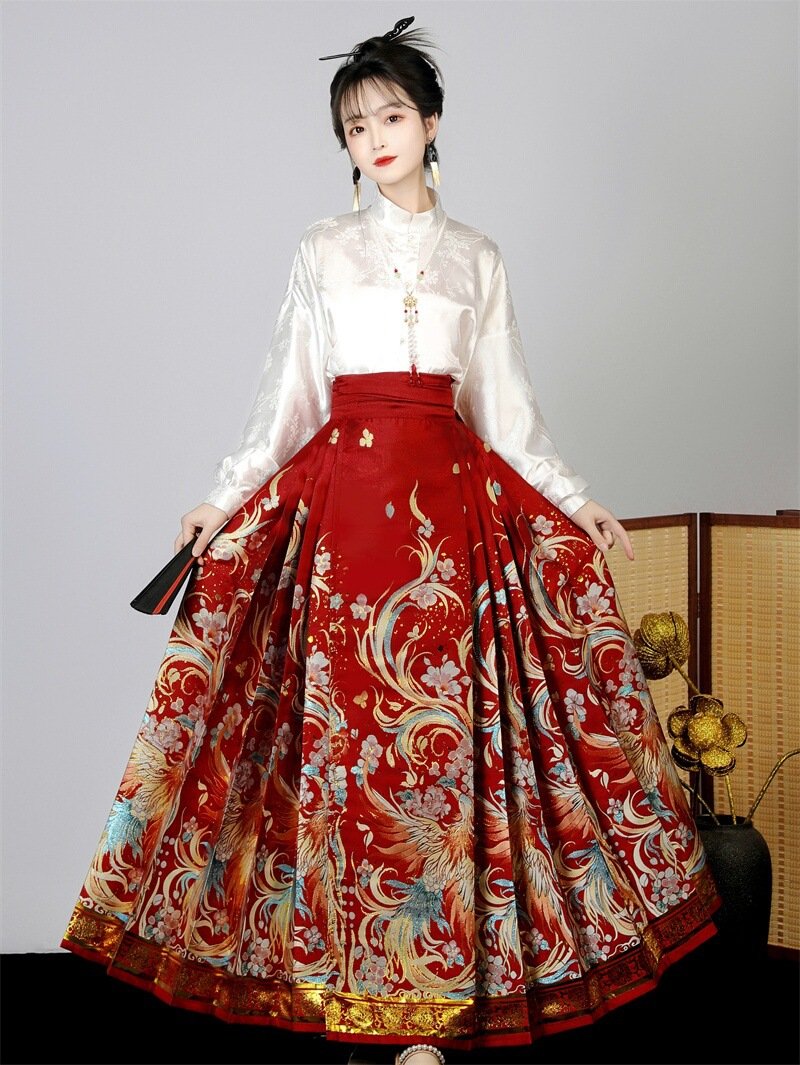
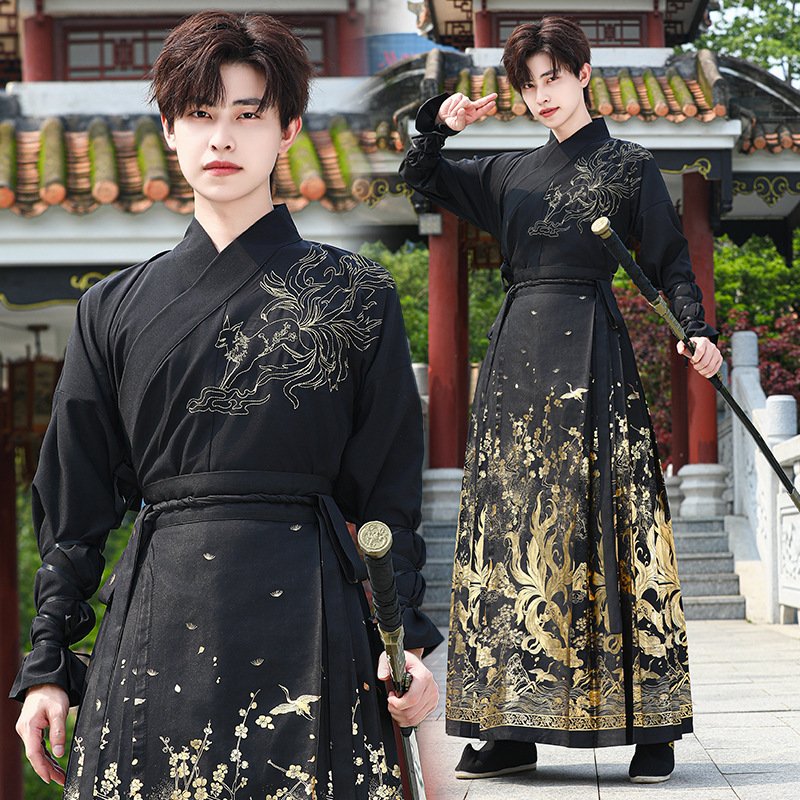
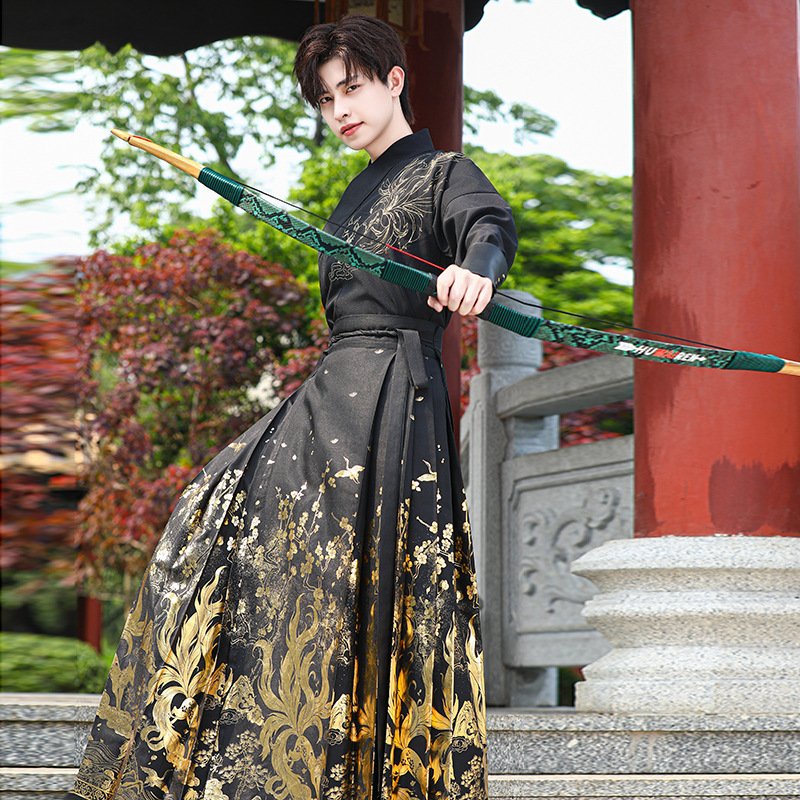
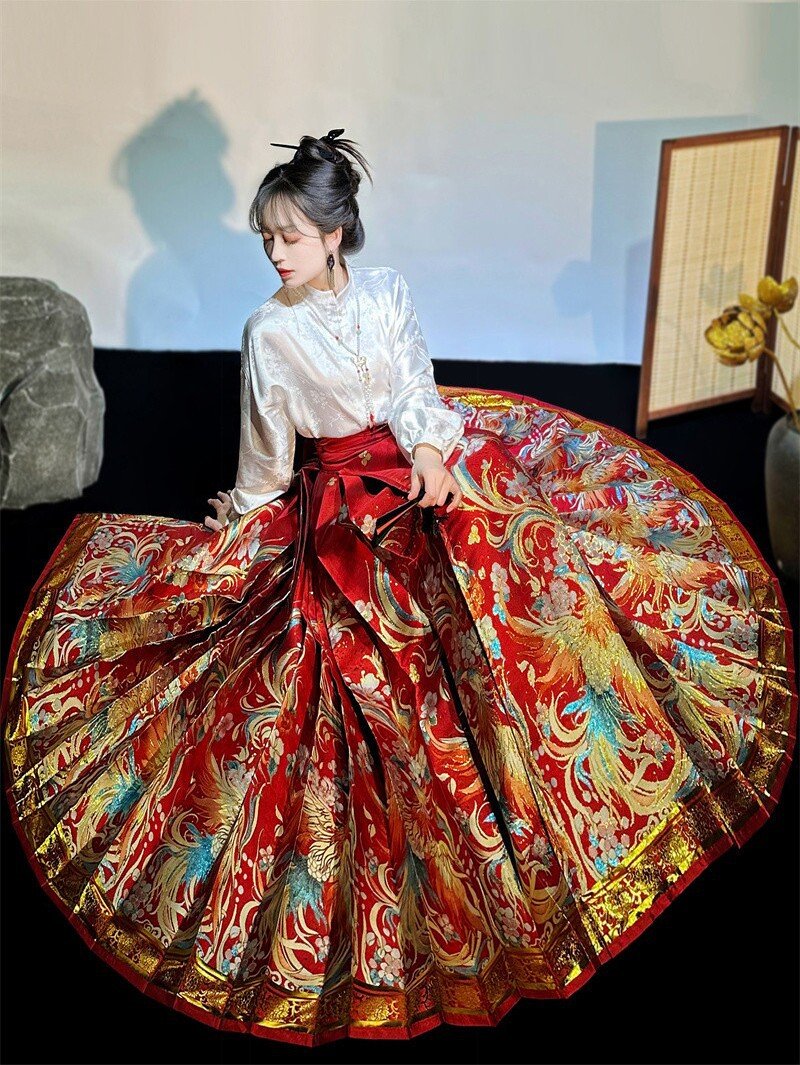
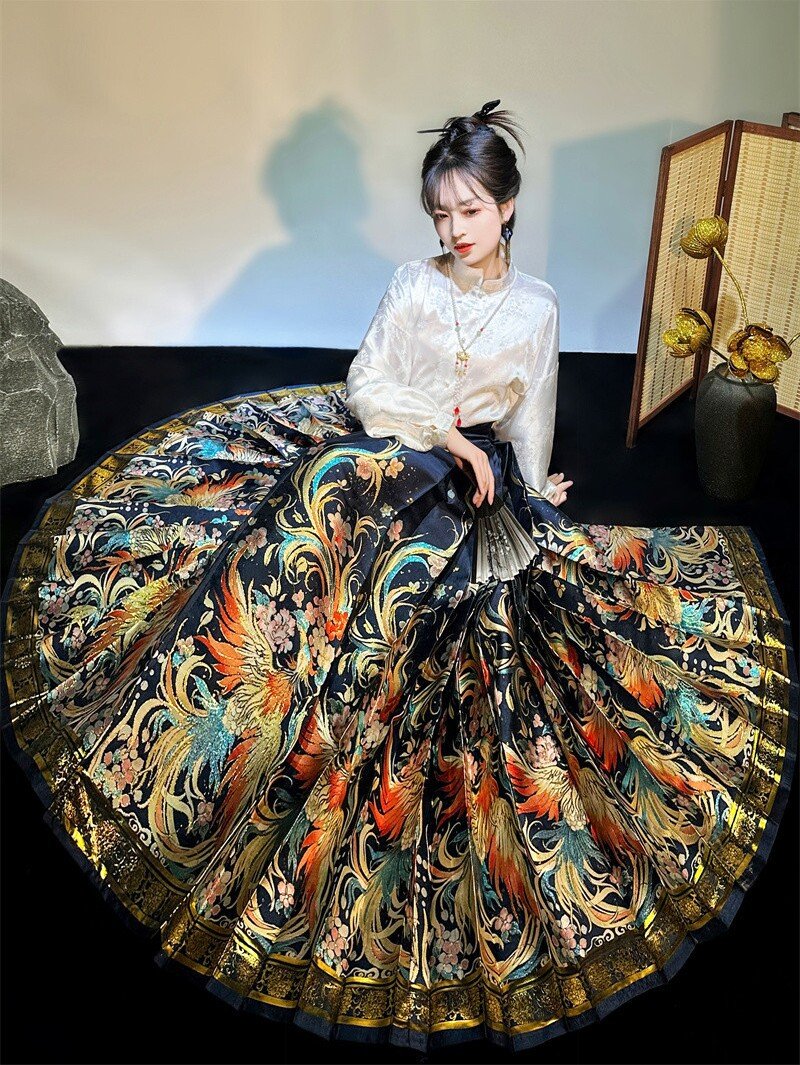
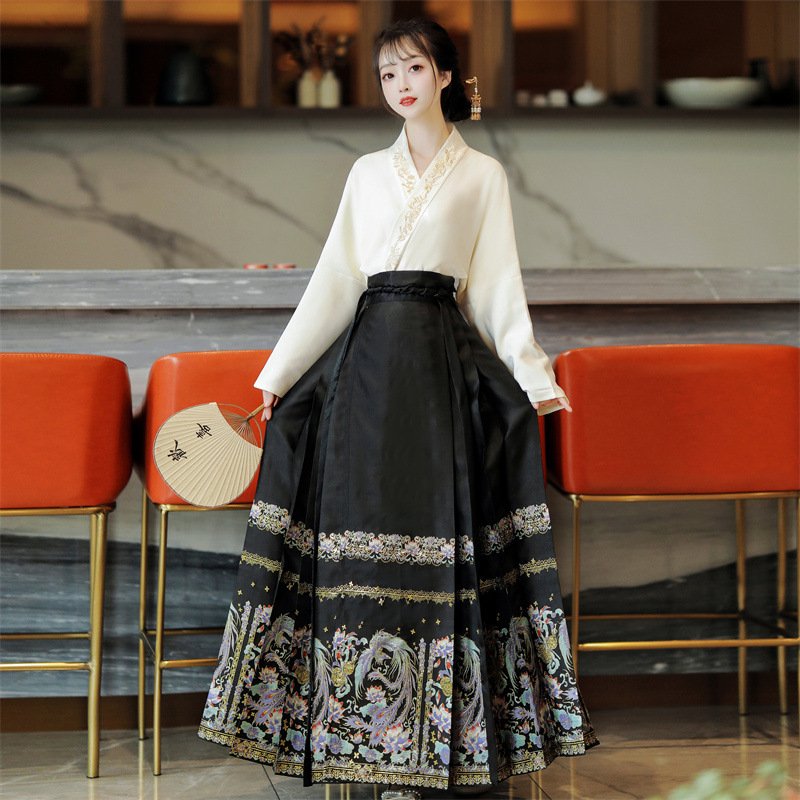
Women’s clothing in the middle Ming Dynasty showed greater creativity. The aoqun remained the mainstream, but with more varied designs: the jacket (ao) became shorter, and the skirt (qun) became longer, forming a “high-waisted” effect by tying the skirt waist above the chest. The mamianqun (horse-face skirt), a iconic Ming women’s skirt, was finalized during this period – it featured two overlapping pleats in the front and back, resembling a horse’s face, with decorative borders (jiaoxian) on the sides, combining practicality and aesthetics. Noble women also favored the beizi (a loose overcoat with wide sleeves), which was made of light gauze or brocade and worn over the aoqun, creating a graceful silhouette.
The prosperity of the textile industry drove the innovation of fabrics and patterns. Yunjin, with its intricate gold and silver thread weaving, became the preferred material for imperial and noble costumes – the dragon robes of Emperor Chenghua, now preserved in the Palace Museum, are made of Yunjin with five-clawed dragons embroidered in gold thread, surrounded by cloud and wave patterns. Embroidery techniques such as Suzhou embroidery and Guangdong embroidery were widely applied to clothing decoration, with motifs ranging from traditional dragons and phoenixes to auspicious patterns like “peony and peacock” (symbolizing wealth and nobility) and “pine, bamboo, and plum” (symbolizing integrity).
The relaxation of costume regulations also led to the blurring of some hierarchical boundaries. Wealthy merchants, despite their low social status, began to wear silk and brocade clothing, and even imitated the styles of lower-ranking officials. To curb this trend, the court issued several edicts prohibiting commoners from wearing noble costumes, but these edicts were often ignored due to the thriving commodity economy. This phenomenon reflected the rising social status of merchants and the gradual diversification of costume consumption in the middle Ming.
3. Late Ming: Social Turmoil and Folk Localization (1573–1644)
The late Ming Dynasty was a period of political turmoil, including the decline of imperial power, the rise of eunuch cliques, and frequent natural disasters. The costume culture, accordingly, showed a trend of simplification in formal wear and diversification in folk wear. The strict hierarchical regulations gradually collapsed, and folk clothing absorbed local ethnic elements and foreign influences, forming a vibrant and down-to-earth style.
Formal wear became more simplified due to political and economic crises. Imperial dragon robes retained the twelve emblems but used less gold thread and simpler patterns compared to the middle Ming. Official costumes also became more practical – the wide sleeves of the chaofu were narrowed to save fabric, and the rank badges were smaller and less detailed. Some local officials even wore plain robes without rank badges to avoid unnecessary expenses, reflecting the dynasty’s declining financial situation.
In contrast, folk clothing flourished with creativity. Men’s casual wear was dominated by the duanpao (short robe) and kuzhe (trousers and jacket), which were convenient for labor and daily activities. Literati and scholars favored the zhishen (straight robe) made of plain cotton or linen, with a simple belt around the waist, embodying a hermit-like aesthetic. For women, the aoqun and mamianqun remained popular, but with more colorful patterns and varied decorations – common women used printed fabrics with floral and bird motifs, while wealthy women added bead and tassel decorations to their skirts.
The influence of foreign cultures, especially from Europe and Southeast Asia, was evident in late Ming clothing. With the arrival of European missionaries such as Matteo Ricci, some noble families began to adopt Western-style collars and buttons in their casual wear. The import of Southeast Asian cotton also promoted the popularity of cotton clothing among commoners, as cotton was more durable and cheaper than silk. The costumes unearthed from the tomb of Li Wei in Shandong (dated to 1620) include a cotton duanpao with a Western-style stand-up collar, a rare example of Sino-Western cultural integration in clothing.
Another notable trend was the rise of “fashion” in urban areas. In cities like Nanjing, Suzhou, and Hangzhou, clothing styles changed rapidly – new styles of aoqun and hair accessories would become popular within months, driven by the consumption demands of urban residents. The novel Jin Ping Mei, written in the late Ming, describes in detail the diverse clothing styles of urban women, such as “red silk ao with white mamianqun” and “green gauze beizi with pearl decorations”, reflecting the vibrant fashion culture of the time.
II. Core Categories of Ming Dynasty Clothing: Hierarchy and Diversity
The Ming Dynasty established a comprehensive clothing system covering all social classes and occasions, with clear distinctions between formal wear and casual wear, male and female clothing. This system not only maintained social hierarchy but also met the diverse needs of daily life, rituals, and work. Below is a detailed introduction to the core categories of Ming Dynasty clothing, focusing on their styles, functions, and cultural connotations.
1. Male Clothing: Hierarchy Embodied in Ritual and Daily Wear
Male clothing in the Ming Dynasty was highly hierarchical, with strict regulations on styles and decorations for different identities and occasions. It can be roughly divided into four categories: chaofu (court dress) for imperial ceremonies, gongfu (official uniform) for administrative duties, changfu (everyday wear) for daily activities, and bianfu (casual wear) for leisure and labor.
a. Chaofu (Court Dress): Imperial Ritual and Supreme Authority
The chaofu was the most solemn formal wear for emperors and officials, worn during important rituals such as the Winter Solstice Sacrifice, New Year’s Ceremony, and imperial coronation. For emperors, the chaofu, also known as the “twelve-emblem dragon robe”, was the ultimate symbol of imperial authority. It was a round-collar robe with wide sleeves, made of yellow Yunjin (yellow was exclusive to the emperor) and embroidered with twelve imperial emblems arranged in a specific order: the sun, moon, and stars on the back; mountains, dragons, and phoenixes on the front; and algae, fire, ritual vessels, grains, ax, and fu on the lower part. The cuffs were decorated with “sea-water and cliff” (haishuiyan) patterns, symbolizing the emperor’s rule over the world.
Emperor’s chaofu was also accompanied by a set of accessories, including the yupei (jade pendant), xiapei (silk sash), and dian (ceremonial crown). The dian, called the “nine-dragon crown” (jiulong guan), was made of gold and inlaid with pearls and jade, with nine dragons winding around it, further enhancing the imperial majesty. The costumes unearthed from the Dingling Mausoleum of Emperor Wanli include a well-preserved twelve-emblem dragon robe, made of Yunjin with gold and silver thread embroidery, weighing over 3 kilograms, which is a masterpiece of Ming imperial costume craftsmanship.
For officials, the chaofu was also a round-collar wide-sleeved robe, but with colors and patterns differing by rank. First-rank to third-rank officials wore purple robes, fourth-rank to sixth-rank wore crimson robes, and seventh-rank to ninth-rank wore green robes. The twelve imperial emblems were exclusive to the emperor, so officials’ chaofu only had cloud and wave patterns. The most distinctive feature was the “rank badge” (bupu) – a square piece of fabric sewn on the front and back of the robe, embroidered with different birds and beasts: civil officials with birds (e.g., crane for first-rank, golden pheasant for second-rank) and military officials with beasts (e.g., lion for first-rank, tiger for second-rank). This system made the official’s rank instantly recognizable, embodying the strict hierarchical order of the Ming bureaucracy.
b. Gongfu (Official Uniform) and Changfu (Everyday Wear): Administrative Duties and Daily Life
The gongfu was the uniform worn by officials during daily administrative work, less solemn than the chaofu but still regulated by hierarchy. It was a round-collar robe with narrow sleeves (more convenient for writing and handling official documents) and a belt with a jade buckle to distinguish rank. The color system was the same as the chaofu, and the rank badge was also used, but the embroidery was simpler. For example, the rank badge of a first-rank civil official was a crane embroidered with plain silk, while that on the chaofu was embroidered with gold thread.
The changfu, or everyday wear, was worn by nobles, literati, and officials in non-official occasions. The most common style was the lanshan (blue shirt) and zhishen (straight robe). The lanshan, a long robe with a cross collar and wide sleeves, was favored by literati and scholars, often made of plain blue silk with bamboo or plum patterns embroidered on the collars. The zhishen, a straight-cut robe with side slits, was more versatile, worn by both officials and nobles. It was usually made of silk or brocade, with colors ranging from white, blue to gray, depending on personal preference and season.
A unique style of changfu for literati was the “four-gong robe” (sigong pao), which had four pleats on the front and back, symbolizing the “four virtues” of Confucianism (benevolence, righteousness, propriety, wisdom). This robe reflected the integration of literati’s moral pursuit and clothing design, becoming a symbol of Ming literati’s identity.
c. Bianfu (Casual Wear): Practicality for Leisure and Labor
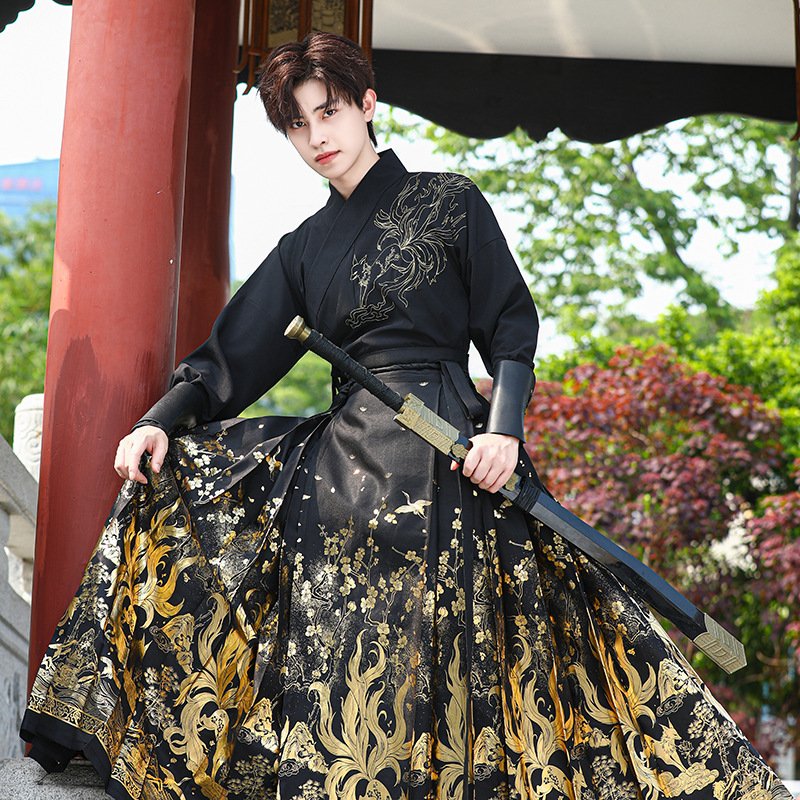
The bianfu was the casual wear for men of all classes, focusing on practicality and comfort. For nobles and literati, the casual wear mainly included the duanpao (short robe) and beizi (loose overcoat). The duanpao, a knee-length robe with narrow sleeves, was worn with trousers and boots, suitable for riding and hunting. The beizi, a loose overcoat with wide sleeves and no buttons, was worn over the duanpao during cool weather, made of light gauze or cotton.
For commoners, craftsmen, and farmers, the casual wear was even simpler, mainly consisting of the kuzhe (trousers and jacket) and short duanpao. The jacket was short-sleeved and close-fitting, and the trousers were wide-legged to facilitate labor. The materials were mostly linen and cotton, with colors limited to white, gray, and brown (bright colors were prohibited for commoners by early Ming regulations). However, in the middle and late Ming, with the relaxation of regulations, commoners began to wear light blue and green clothing, and some wealthy craftsmen even wore silk duanpao.
2. Female Clothing: Modesty, Elegance, and Folk Creativity
Female clothing in the Ming Dynasty was equally diverse, with styles varying by identity (noble women, literati’s wives, common women) and occasion. It emphasized modesty and elegance in line with Confucian ethical norms, while also showing rich creativity in folk designs. The main categories included lifu (ritual dress), changfu (everyday wear), and bianfu (casual wear).
a. Lifu (Ritual Dress): Noble Women’s Solemnity and Hierarchy
The lifu was the formal wear for noble women, worn during weddings, imperial banquets, and sacrifice ceremonies. The most important style was the jijupao (gathered robe), also known as the “phoenix robe” (fengpao) for noble women. It was a long robe with a cross collar and wide sleeves, gathered at the waist to form a slim silhouette. The color and decoration varied by the husband’s or father’s rank: imperial concubines wore yellow robes embroidered with phoenixes and cloud patterns; the wives of first-rank officials wore crimson robes embroidered with peonies and phoenixes; and lower-rank noble women wore blue or green robes with simpler floral patterns.
The lifu was accompanied by a set of accessories, including the “phoenix crown” (fengguan), xiapei (silk sash), and jade pendants. The fengguan was a ceremonial headdress made of gold and inlaid with pearls and jade, with phoenixes and other auspicious motifs, which was the most iconic accessory of Ming noble women. The fengguan and xiapei unearthed from the tomb of Marquis Wu’s wife in Nanjing are exquisitely crafted, with gold phoenixes inlaid with rubies and sapphires, reflecting the luxury of noble women’s ritual dress.
b. Changfu (Everyday Wear): Aoqun and Mamianqun – The Mainstream of Ming Women’s Clothing
The changfu was the everyday wear for women of all classes, with the aoqun (jacket and skirt) as the most popular style. The ao (jacket) was a short cross-collar garment with narrow or wide sleeves, usually worn over the skirt. The length of the ao varied by age: young women wore shorter ao (reaching the waist) to show vitality, while married women wore longer ao (reaching the hips) to emphasize modesty. The decoration of the ao was concentrated on the collar, cuffs, and placket, with embroidery or printed patterns of flowers, birds, and clouds.
The skirt paired with the ao was mainly the mamianqun (horse-face skirt), which became the iconic skirt style of the Ming Dynasty. The mamianqun had a straight waistband and two overlapping pleats in the front and back, forming a “horse-face” shape when worn. The pleats were neatly stitched and could be expanded when moving, combining practicality (allowing free movement) and aesthetics (creating a slim silhouette). The skirt was usually made of multiple layers of fabric, with decorative borders (jiaoxian) on the sides and bottom, embroidered with patterns such as “sea-water and cliff” or “auspicious clouds”.
Noble women’s aoqun was made of high-quality silk and brocade, with gold thread embroidery and bead decorations. For example, the aoqun unearthed from the tomb of Lady Shen in Suzhou (dated to 1520) is a red silk ao with peony patterns embroidered in gold thread, paired with a green mamianqun with cloud patterns. Common women’s aoqun, on the other hand, was made of plain silk or cotton, with printed floral patterns, simple but elegant.
c. Bianfu (Casual Wear): Practicality and Folk Style
The bianfu for Ming women was mainly worn for household chores and leisure activities, focusing on comfort and practicality. The most common style was the “short ao and trousers” (duanao he ku) – a short-sleeved ao paired with wide-legged trousers, suitable for cooking, weaving, and other housework. For rural women, the casual wear was even simpler, made of coarse linen, with the ao and trousers dyed in dark colors to resist dirt.
In the late Ming, urban women’s casual wear became more fashionable, with the beizi (loose overcoat) becoming popular. The beizi for women was a long overcoat with wide sleeves and a cross collar, worn over the aoqun. It was made of light gauze in spring and summer and cotton in autumn and winter, with patterns such as plum blossoms, orchids, and bamboo embroidered on the cuffs and hem. Some fashionable urban women even added lace-like decorations to the beizi, reflecting the integration of folk creativity and fashion trends.
III. Craftsmanship and Material Aesthetics of Ming Dynasty Clothing
The brilliance of Ming Dynasty clothing was not only reflected in its hierarchical system and diverse styles but also in its exquisite craftsmanship and advanced material technology. The Ming Dynasty was a golden age of Chinese textile industry, with innovations in weaving, embroidery, dyeing, and pattern design that pushed the aesthetic value of clothing to new heights. The combination of high-quality materials and superb craftsmanship made Ming clothing a masterpiece of traditional Chinese handicraft.
1. Textile Materials: From Yunjin to Cotton – The Foundation of Costume Aesthetics
The quality of clothing largely depends on textile materials, and the Ming Dynasty had a diverse range of high-quality fabrics, including silk, brocade, gauze, and cotton, each with unique characteristics and uses. The development of the textile industry, especially the rise of regional specialty fabrics, provided a solid material foundation for Ming clothing.
a. Silk and Brocade: Luxury for Imperial and Noble Clothing
Silk was the most important fabric for Ming clothing, with different varieties such as plain silk (pingsi), silk gauze (sisha), and brocade (jin) to meet different needs. Plain silk, with its smooth texture and subtle luster, was used for everyday clothing of officials and nobles. Silk gauze, light and breathable, was the preferred material for summer clothing – the “thousand-layer gauze” (qianceng sha) produced in Suzhou was so thin that a piece of gauze the size of a square meter weighed only a few grams, making it ideal for summer beizi and ao.
Brocade, especially Yunjin (cloud brocade) from Nanjing, was the most luxurious fabric of the Ming Dynasty. Yunjin was woven with gold and silver threads, creating intricate patterns with a brilliant luster. Its production process was extremely complex, requiring over 100 procedures and the cooperation of multiple craftsmen. The patterns of Yunjin mainly included dragons, phoenixes, clouds, and flowers, with the “cloud dragon” pattern being the most popular for imperial dragon robes. The Yunjin used in Emperor Wanli’s dragon robe from Dingling had a warp density of 140 threads per centimeter and a weft density of 60 threads per centimeter, with gold threads accounting for 30% of the total threads, showing the top level of Ming weaving technology.
Other famous brocades included Songjin from Suzhou and Zhuangjin from Guangxi. Songjin, inheriting the weaving technique of the Song Dynasty, was characterized by delicate patterns and soft colors, suitable for literati’s changfu. Zhuangjin, produced by the Zhuang ethnic group, had bold and vivid patterns, influencing the clothing of southern Ming women.
b. Cotton: The Rise of Folk Clothing Material
Cotton, which was introduced to China during the Yuan Dynasty, became widely popular in the Ming Dynasty and gradually replaced linen as the main fabric for commoners’ clothing. The Ming government promoted cotton cultivation nationwide, and areas such as Shandong, Hebei, and Jiangsu became major cotton-producing regions. The development of cotton spinning technology, such as the improvement of spinning wheels by黄道婆 (Huang Daopo) in the late Yuan and early Ming, greatly increased cotton fabric production and reduced costs.
Ming cotton fabrics had various varieties, including plain cotton (pingmian), printed cotton (yinhua mian), and embroidered cotton (xiuhua mian). Plain cotton was used for daily clothing of commoners, while printed and embroidered cotton was used for festive clothing. The printed cotton from Songjiang (modern Shanghai) was famous for its vivid patterns, with motifs such as “peony and butterfly” and “fish playing in lotus” being popular. The rise of cotton clothing not only improved the living standards of commoners but also enriched the material diversity of Ming clothing.
2. Embroidery and Decoration: The Art of Needle and Thread
Embroidery was an important decorative technique for Ming clothing, used to enhance the aesthetic value and symbolize identity. Ming embroidery techniques inherited the essence of Song and Yuan embroidery and developed new styles, with regional schools such as Suzhou embroidery (Suzhou), Guangdong embroidery (Guangdong), and Shu embroidery (Sichuan) forming their own characteristics. These techniques were widely applied to clothing decoration, from imperial dragon robes to common women’s aoqun.
a. Imperial and Noble Embroidery: Luxury and Symbolism
Imperial and noble clothing used the most exquisite embroidery techniques, with gold and silver thread embroidery being the most prominent. Gold thread embroidery included flat gold (pressed gold foil wrapped around silk thread) and coiled gold (gold wire coiled around silk thread), creating a three-dimensional and brilliant effect. The dragon patterns on imperial dragon robes were embroidered with coiled gold thread for the dragon’s body and flat gold thread for the scales, making the dragon look lifelike and majestic.
The rank badges of officials also used high-quality embroidery. First-rank civil officials’ crane badges were embroidered with silk thread and gold thread, with the crane’s feathers layered to create a sense of depth. The embroidery of noble women’s phoenix robes used “double-sided embroidery” (shuangmian xiu) technique, with the same pattern and color on both sides of the fabric, showing the superb skill of Ming embroiderers.
b. Folk Embroidery: Simplicity and Vitality
Folk embroidery, while less luxurious than imperial embroidery, was full of vitality and regional characteristics. Suzhou embroidery, known for its delicate stitches and vivid patterns, was used to decorate literati’s wives’ aoqun, with motifs such as bamboo, plum, and orchid. Guangdong embroidery, with bold colors and thick threads, was popular in southern China, used for rural women’s skirt borders. Shu embroidery, with its gradient color technique, was used to embroider flower patterns on casual wear.
Folk embroidery also reflected the daily life and auspicious beliefs of commoners. The patterns often included “five bats surrounding a longevity symbol” (wufu pengshou) for birthday clothing, “mandarin ducks playing in lotus” (yuanjia youhe) for wedding clothing, and “multiple sons and grandchildren” (duozi duosun) for women’s maternity clothing. These embroidery patterns not only decorated the clothing but also conveyed people’s yearning for a better life.
3. Dyeing Technology: Natural Colors and Durability
Ming Dynasty clothing was famous for its rich and durable colors, thanks to advanced natural dyeing technology. Ming dyers used mineral dyes and plant dyes to produce a variety of colors, and mastered complex dyeing techniques such as gradient dyeing and tie-dyeing, creating colorful and layered clothing effects.
Mineral dyes, such as cinnabar (for red), azurite (for blue), and malachite (for green), were used for noble clothing due to their vivid and long-lasting colors. Plant dyes, such as indigo (for blue), safflower (for red), and gardenia (for yellow), were more widely used for common clothing and daily wear. The combination of mineral and plant dyes allowed for a wide range of colors, from bright yellow and crimson to soft green and light blue.
A notable dyeing technique in the Ming Dynasty was “xuanse” (soaking dyeing), which involved soaking the fabric in dye multiple times to achieve different shades. For example, to dye a deep red color, the fabric was soaked in safflower dye up to 10 times. Gradient dyeing was used for the “sea-water and cliff” patterns on imperial robes, with the color gradually changing from dark blue at the bottom to light blue at the top, creating a sense of depth.
The durability of Ming clothing colors was also remarkable. The costumes unearthed from Ming tombs, after being buried for hundreds of years, still retain bright colors. For example, the red silk ao from the tomb of Lady Xu in Suzhou, dated to the early Ming, is still bright red, thanks to the high-quality safflower dye and advanced dyeing process.
IV. Cultural Connotations of Ming Dynasty Clothing: Ethics, Aesthetics, and Identity
Ming Dynasty clothing was not just a covering for the body but a complex cultural carrier, embodying the dynasty’s ethical norms, aesthetic concepts, and social identity. From the hierarchical regulations to the decorative patterns, every detail of Ming clothing reflected the core values of traditional Chinese culture, especially Confucianism, and shaped the social identity of different groups.
1. Confucian Ethics: Hierarchy and Modesty in Clothing
Confucianism, as the dominant ideology of the Ming Dynasty, had a profound influence on clothing culture, with “li” (ritual) and “yi” (righteousness) as the core guiding principles. The Ming costume system was built on the Confucian concept of “distinguishing between high and low, and regulating ethics”, using clothing to maintain social order and moral norms.
The strict hierarchical regulations of Ming clothing were a direct manifestation of Confucian “li”. The exclusive use of yellow for imperial clothing, the rank badges for officials, and the color restrictions for commoners all reflected the Confucian idea of “everyone has their own position”. The Daming Huidian clearly stated: “Clothing shall be in accordance with rank, so that the superior and inferior are not confused, and ethics are regulated.” This regulation was strictly enforced in the early Ming, and those who violated it would be punished, such as commoners wearing yellow clothing being sentenced to death.
Confucian modesty was also reflected in Ming clothing styles. Both men’s and women’s clothing emphasized covering the body, with high collars and long sleeves to avoid exposing skin. Women’s clothing, in particular, had strict regulations on neckline and sleeve width – low necklines were prohibited, and sleeves must cover the wrists. This modesty requirement was derived from the Confucian concept of “women’s virtues”, emphasizing that women should be reserved and decent.
The influence of Confucianism also extended to children’s clothing. Ming children’s clothing was designed to cultivate moral character from an early age. For example, boys’ clothing often had “jade pendant” accessories, symbolizing the Confucian pursuit of “jade-like virtue” (integrity and purity). Girls’ clothing was mainly dark-colored with simple decorations, cultivating their modesty and decorum from childhood.
2. Aesthetic Concepts: The Unity of Form and Meaning
Ming Dynasty clothing aesthetics pursued the “unity of form and meaning”, that is, the style and decoration not only had visual beauty but also carried profound symbolic meanings. This aesthetic concept inherited the traditional Chinese philosophy of “the unity of man and nature” and integrated it into clothing design.
The “form” of Ming clothing emphasized elegance and harmony. The wide sleeves and straight cuts of men’s formal wear created a graceful silhouette, reflecting the Confucian pursuit of “moderation and harmony”. The high-waisted aoqun and mamianqun of women’s clothing created a slim and elegant figure, showing the aesthetic appreciation of softness and grace. The color matching was also harmonious – imperial clothing used yellow and red (warm colors) to show majesty, while literati’s clothing used blue and white (cool colors) to show elegance.
The “meaning” of Ming clothing was embodied in the symbolic patterns and colors. Colors had clear symbolic meanings: yellow symbolized imperial authority (exclusive to the emperor), purple symbolized nobility (for first-rank to third-rank officials), red symbolized joy and auspiciousness (for wedding clothing), and white symbolized filial piety (for mourning clothing). Patterns were more rich in meaning: dragons symbolized imperial power, phoenixes symbolized noble women, cranes symbolized longevity and integrity (for civil officials), lions symbolized courage and power (for military officials), and peonies symbolized wealth and prosperity.
The “sea-water and cliff” pattern, which was widely used in imperial and official clothing, was a typical example of the unity of form and meaning. The pattern depicted waves crashing against cliffs, with the cliff symbolizing stability and the waves symbolizing the vast territory. It not only had a beautiful visual effect but also symbolized the emperor’s rule over a stable and vast country, embodying the integration of aesthetics and political ideals.
3. Social Identity: Clothing as a “Visual Identity Card”
In the Ming Dynasty, clothing was an important “visual identity card” that directly reflected a person’s social status, occupation, and even personality. Different social groups had distinct clothing characteristics, making their identities instantly recognizable.
For the imperial family and officials, clothing was a symbol of power and status. The emperor’s dragon robe and nine-dragon crown showed his supreme authority; officials’ rank badges and colored robes showed their administrative ranks. Even within the official class, there were differences – civil officials’ robes had bird patterns to show their literary elegance, while military officials’ robes had beast patterns to show their martial courage.
For literati and scholars, clothing was a symbol of their cultural identity. They preferred plain-colored lanshan and zhishen with bamboo, plum, and orchid patterns, showing their disdain for luxury and pursuit of elegance. The “four-gong robe” with four pleats symbolized their adherence to Confucian virtues, distinguishing them from officials and merchants.
For merchants, despite their wealth, their clothing was restricted by hierarchical regulations in the early Ming. They could not wear silk or bright colors, so they often wore plain cotton robes. However, in the middle and late Ming, with the rise of their social status, they began to wear silk clothing and imitate the styles of lower-rank officials, reflecting the changing social structure.
For commoners, clothing was a symbol of their labor identity. Their short ao and wide-legged trousers were suitable for labor, and the coarse cotton and linen fabrics reflected their humble status. Rural women’s clothing was even simpler, with dark colors and minimal decoration, showing their hardworking and frugal character.
4. Folk Beliefs: Auspiciousness in Clothing Decoration
Ming clothing decoration was also closely related to folk beliefs, with a large number of auspicious patterns used to express people’s yearning for happiness, health, and prosperity. These patterns integrated mythological stories, folk tales, and natural phenomena, forming a rich and colorful auspicious culture.
The most common auspicious patterns included: “dragon and phoenix presenting auspiciousness” (longfeng cixiang) for imperial and wedding clothing, symbolizing harmony and prosperity; “pine, bamboo, and plum” (songzhu mei) for literati’s clothing, symbolizing integrity and resilience; “five bats surrounding a longevity symbol” (wufu pengshou) for birthday clothing, symbolizing five blessings (longevity, wealth, health, virtue, and a peaceful death); “fish playing in lotus” (yuyue lianhua) for women’s clothing, symbolizing fertility and family harmony; and “grains and silk” (gusang) for commoners’ clothing, symbolizing a good harvest and prosperous life.
These auspicious patterns were not only decorative but also carried people’s spiritual sustenance. For example, during the Mid-Autumn Festival, women would wear aoqun embroidered with “moon and osmanthus” patterns to pray for family reunion. During the Spring Festival, children would wear hats embroidered with “tiger” patterns to ward off evil spirits and pray for health. This integration of clothing and folk beliefs made Ming clothing a part of folk culture and rituals.
V. Classic Works of Ming Dynasty Clothing and Their Cultural Significance
The Ming Dynasty left a wealth of classic clothing works, which are not only masterpieces of craftsmanship but also important carriers of cultural history. These works, including imperial dragon robes, official rank badge robes, and folk aoqun, have been preserved through archaeological excavations and historical records, providing valuable materials for the study of Ming clothing culture. Below are four representative classic works and their cultural significance.
1. Emperor Wanli’s Twelve-Emblem Dragon Robe (Dingling Mausoleum)
The twelve-emblem dragon robe of Emperor Wanli, unearthed from the Dingling Mausoleum in 1956, is the most well-preserved and exquisite imperial costume of the Ming Dynasty. It is a round-collar wide-sleeved robe, 1.3 meters long, made of yellow Yunjin with gold and silver thread embroidery. The robe is decorated with twelve imperial emblems, nine five-clawed dragons, and “sea-water and cliff” patterns, weighing 3.8 kilograms. It is now preserved in the Palace Museum and is known as the “treasure of Ming imperial clothing”.
Technically, this dragon robe represents the peak of Ming weaving and embroidery technology. The Yunjin fabric has a warp density of 140 threads per centimeter and a weft density of 60 threads per centimeter, with gold threads made of pure gold foil wrapped around silk threads. The dragons are embroidered with coiled gold thread for the body and flat gold thread for the scales, with each scale embroidered with three stitches to create a three-dimensional effect. The twelve imperial emblems are arranged in a strict order, with the sun and moon on the back, symbolizing the emperor’s “illumination of the world”.
Culturally, this dragon robe is a symbol of imperial authority and Confucian ritual system. The twelve imperial emblems, inherited from the Xia, Shang, and Zhou dynasties, were exclusive to the emperor, showing the legitimacy of the Ming imperial power. The nine dragons (nine is the largest yang number in Chinese culture) symbolize the emperor’s supreme status. The “sea-water and cliff” pattern at the bottom symbolizes the emperor’s rule over the land and sea. This robe was worn by Emperor Wanli during important rituals, embodying the integration of imperial power and Confucian ritual.
2. First-Rank Civil Official’s Rank Badge Robe (Suzhou Museum)
The first-rank civil official’s rank badge robe, collected in the Suzhou Museum, is a representative work of Ming official clothing. It is a purple round-collar robe with wide sleeves, made of silk and embroidered with a crane pattern on the front and back rank badges. The robe is dated to the Jiajing reign (1522–1566) of the middle Ming Dynasty, with well-preserved colors and embroidery.
The most distinctive feature of this robe is the crane rank badge. The crane, known as the “immortal bird” in Chinese culture, was designated as the symbol of first-rank civil officials in the Ming Dynasty, symbolizing integrity and longevity. The crane is embroidered with silk thread and gold thread, with its head raised and wings spread, lifelike. The background of the rank badge is embroidered with cloud patterns, creating a sense of being in the sky.
Culturally, this robe reflects the Ming official rank system and the respect for literati. The purple color indicates that it belongs to a first-rank to third-rank official, and the crane badge clearly shows its first-rank status. The use of gold thread embroidery reflects the high status of first-rank officials. This robe was worn by a first-rank civil official during administrative duties, embodying the strict hierarchical order of the Ming bureaucracy and the emphasis on literati governance.
3. Noble Woman’s Phoenix Robe and Fengguan (Nanjing Museum)
The noble woman’s phoenix robe and fengguan, unearthed from the tomb of Marquis Wu’s wife in Nanjing (dated to 1395), are masterpieces of early Ming noble women’s clothing. The phoenix robe is a red jijupao made of silk, embroidered with phoenixes and peony patterns. The fengguan is a ceremonial headdress made of gold, inlaid with pearls, rubies, and sapphires, with two phoenixes winding around the top.
The phoenix robe’s embroidery uses the “flat stitch” and “coiled gold stitch” techniques, with phoenixes flying among peonies. The phoenixes are embroidered with gold thread, and the peonies are embroidered with red and pink silk threads, creating a vivid and luxurious effect. The fengguan is exquisitely crafted, with each phoenix made of gold and inlaid with dozens of pearls and gemstones, weighing over 500 grams.
Culturally, this set of clothing reflects the status of noble women and the Confucian concept of “female virtues”. The phoenix, as the “king of birds”, is the symbol of noble women, matching the dragon (symbol of the emperor) to symbolize marital harmony. The peony patterns symbolize wealth and nobility. The fengguan, as the most important accessory of noble women, shows their high status. This set of clothing was worn by Marquis Wu’s wife during imperial banquets, embodying the social status of noble women and the aesthetic pursuit of luxury.
4. Common Woman’s Aoqun and Mamianqun (Shandong Museum)
The common woman’s aoqun and mamianqun, unearthed from the tomb of a craftsman’s wife in Jinan, Shandong (dated to 1580), are representative works of late Ming folk clothing. The ao is a blue cotton jacket with a cross collar and narrow sleeves, embroidered with simple floral patterns on the cuffs. The mamianqun is a green cotton skirt with two overlapping pleats and decorative borders embroidered with “fish playing in lotus” patterns.
This set of clothing is simple but practical. The cotton fabric is durable and suitable for daily household chores. The blue and green colors are in line with the clothing regulations for commoners (avoiding bright colors). The “fish playing in lotus” pattern on the skirt border is a popular folk auspicious pattern, symbolizing fertility and family happiness.
Culturally, this set of clothing reflects the living conditions and aesthetic tastes of late Ming common women. It is simple but not shabby, with subtle decorations showing the pursuit of beauty. The cotton fabric reflects the popularity of cotton in the late Ming. The “fish playing in lotus” pattern reflects folk auspicious beliefs. This set of clothing was worn by the craftsman’s wife in daily life and festivals, embodying the simplicity and vitality of folk clothing culture.