
Qi Men Dun Jia
In the long river of Chinese traditional culture, there exists a mysterious and profound knowledge system that integrates astronomy, geography, philosophy, military strategy, and life wisdom——Qi Men Dun Jia. Known as one of the “three great metaphysical arts” in ancient China (along with Tai Yi Shen Shu and Da Liu Ren), it is not a mere superstitious fabrication, but a comprehensive ideological system formed by ancient Chinese people through long-term observation of the universe, summary of natural laws, and refinement of social practice. The name “Qi Men Dun Jia” itself contains rich cultural connotations: “Qi” refers to the cosmic vitality and celestial phenomena such as the five qi and three qi; “Men” refers to the eight basic gates that represent different life states and development trends; “Dun” means concealment, which embodies the Taoist philosophy of “hiding one’s capabilities and biding one’s time”; “Jia” is the core of the ten heavenly stems, representing the noble and the foundation of all things.
For thousands of years, Qi Men Dun Jia has been widely applied in military command, political decision-making, daily life, and other fields, and has left a deep mark in history books and folk legends. From the Yellow Emperor’s battle against Chiyou to Zhuge Liang’s “empty city plan”, Qi Men Dun Jia is often endowed with magical color, but behind this color lies the ancient Chinese people’s understanding of the relationship between man and nature, and the pursuit of “the unity of man and nature”. This article will break through the mysterious veil of Qi Men Dun Jia, bypass overly complicated calculation techniques, focus on its cultural connotation, core principles, application scenarios and eternal value, and explore how this ancient knowledge system has become a living carrier of Chinese traditional culture.
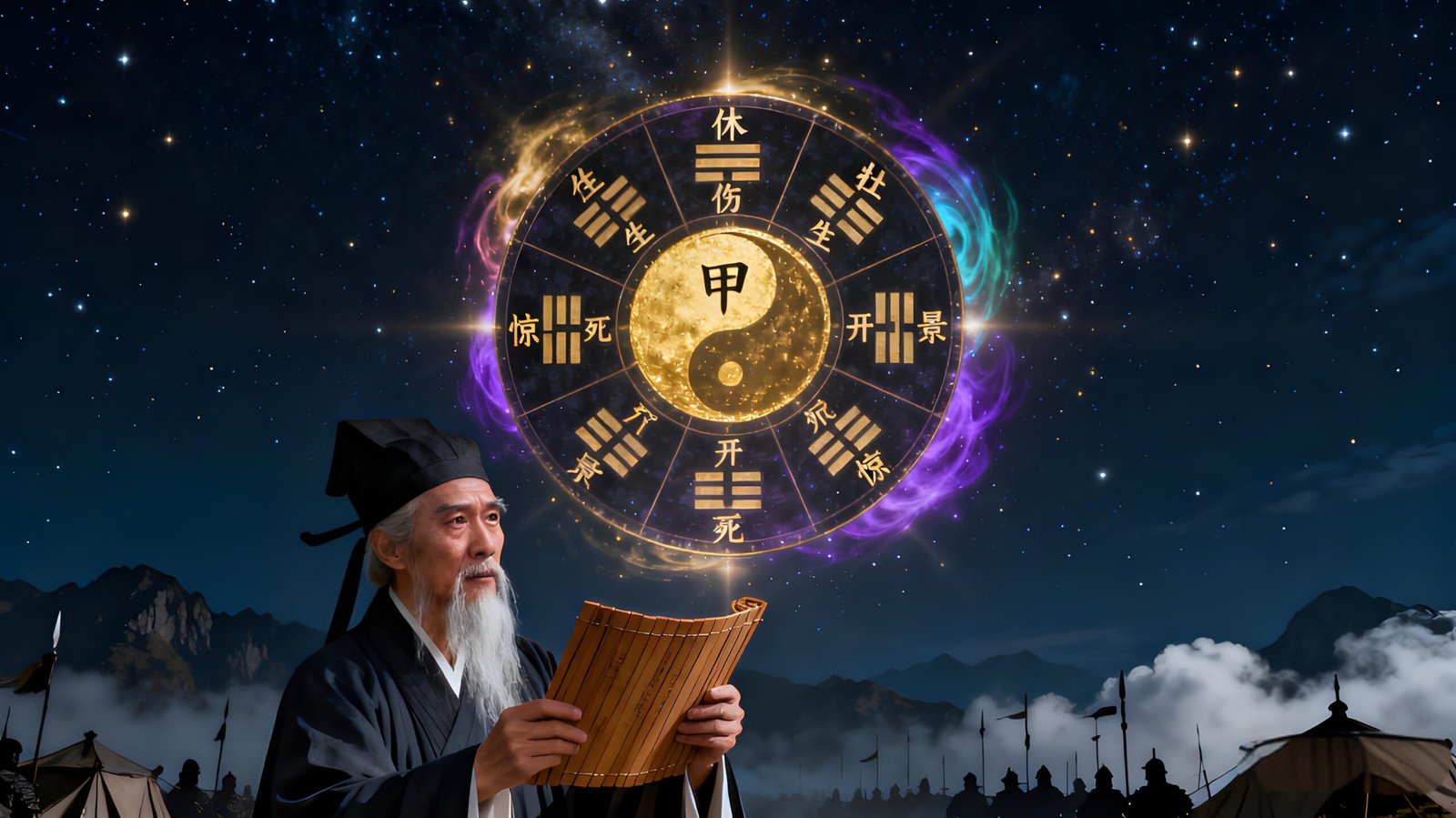
Figure 1: The System Framework of Qi Men Dun Jia. This diagram shows the core components of Qi Men Dun Jia, including the three plates (heaven, earth, and man), the eight trigrams, the nine stars, the eight gates, and the ten heavenly stems, as well as the logical relationship between them. It intuitively reflects the “cosmic microcosm” concept of Qi Men Dun Jia, which is consistent with the traditional Chinese philosophical thought of “the unity of man and nature”.
1. Origin and Cultural Foundation of Qi Men Dun Jia
The origin of Qi Men Dun Jia is closely linked to the origin of Chinese civilization, and its formation and development have always been integrated with the core concepts of traditional culture. Unlike many folk customs with unclear origins, Qi Men Dun Jia has a relatively clear context in historical documents, and its cultural foundation is rooted in the most essential philosophical thoughts of ancient China.
1.1 Historical Origin: From the Sage’s Creation to the Evolution of the Times
The earliest legend about the origin of Qi Men Dun Jia can be traced back to the period of the Yellow Emperor. According to “Huainanzi” and other documents, during the battle between the Yellow Emperor and Chiyou, Chiyou used magical powers to make the sky dark and the earth dark, making the Yellow Emperor’s army lose their way. The Yellow Emperor asked the celestial being Fenghou for advice, and Fenghou presented the “Qi Men Dun Jia Heavenly Book” based on the changes of the sun, moon, and stars. With the guidance of this book, the Yellow Emperor finally defeated Chiyou. Although this is a mythical legend, it reflects the ancient people’s cognition that Qi Men Dun Jia originated from the observation of celestial phenomena and the needs of military warfare.
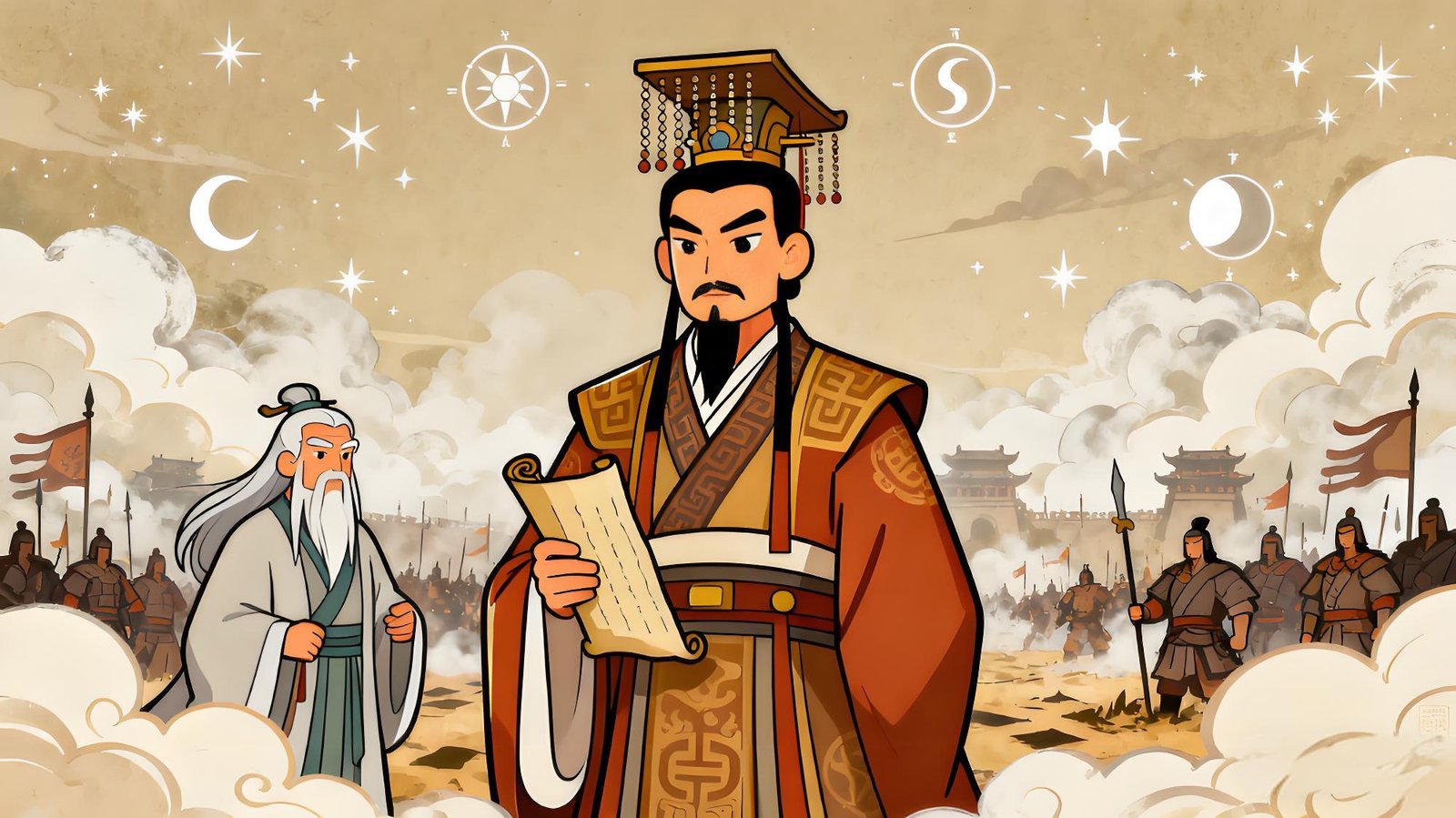
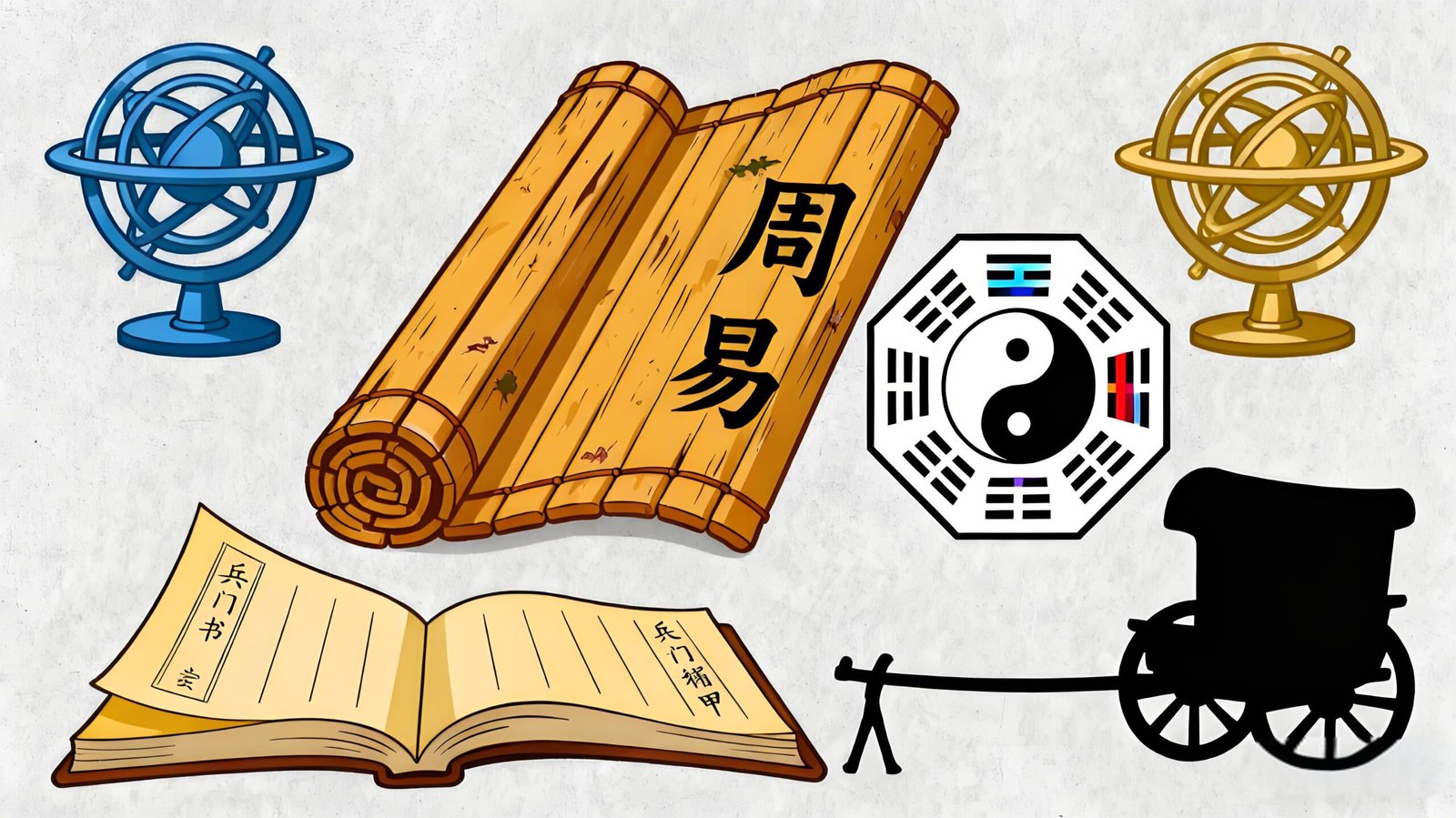
In the pre-Qin period, Qi Men Dun Jia gradually took shape. The “Book of Changes” laid the foundation for its binary thinking and trigram system; the astronomical observations of the Zhou Dynasty provided a basis for its starry sky model; the military strategies of the Spring and Autumn and Warring States periods enriched its application methods. During the Han Dynasty, with the rise of the theory of Yin-Yang and Five Elements, Qi Men Dun Jia absorbed this ideological nutrition and began to form a systematic theoretical framework. By the Wei, Jin, Southern and Northern Dynasties, Qi Men Dun Jia had been widely spread among scholars and military strategists, and many works about it appeared.
The Song Dynasty was a peak period for the development of Qi Men Dun Jia. Scholars represented by Chen Tuan and Shao Yong integrated the theory of the Book of Changes, Tai Chi, and Bagua into Qi Men Dun Jia, making its philosophical connotation more profound. During the Ming and Qing Dynasties, Qi Men Dun Jia gradually moved from the court to the people, and its application scope expanded from military and politics to daily life such as house selection, marriage, and career planning. A large number of annotated works emerged, making this knowledge system more popular.
1.2 Cultural Core: Integration of Multiple Traditional Thoughts
Qi Men Dun Jia is not an independent knowledge system, but a “cultural composite” that integrates multiple traditional Chinese ideological schools. Its core cultural connotation is mainly reflected in three aspects:
First, the thought of “the unity of man and nature” in Taoism. Qi Men Dun Jia believes that the universe is a unified whole, and human beings are a part of the universe. The changes of celestial phenomena (such as the movement of the sun, moon, and stars) will affect the changes of human society and individual destiny. Therefore, when analyzing things with Qi Men Dun Jia, it is necessary to observe the celestial phenomena first, then correspond to the geographical environment, and finally combine human factors to make a comprehensive judgment. This way of thinking is exactly the inheritance and development of the Taoist thought of “the unity of man and nature”.
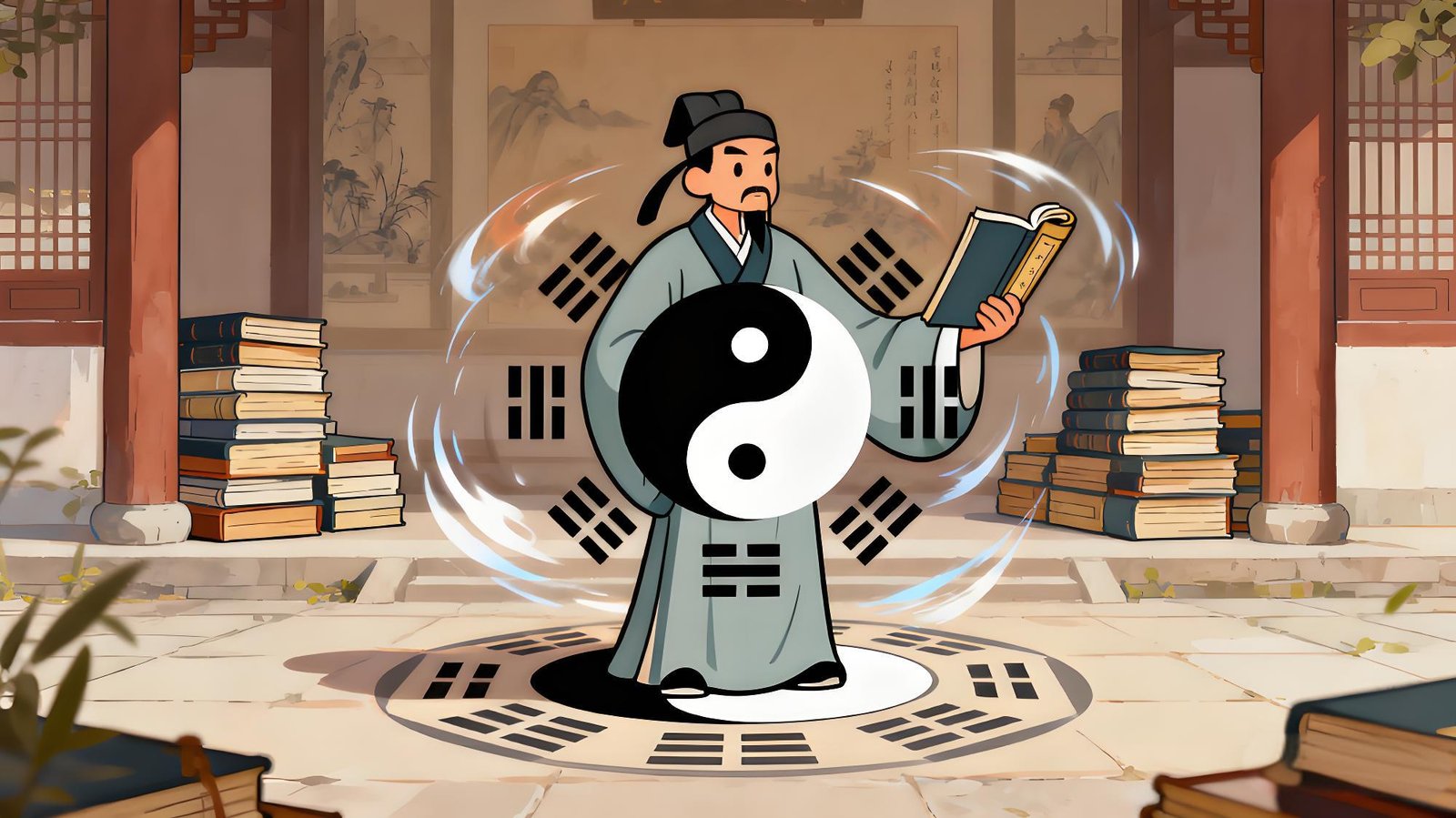
Second, the Yin-Yang and Five Elements theory of ancient philosophy. Yin-Yang and Five Elements (wood, fire, earth, metal, water) are the basic tools for Qi Men Dun Jia to analyze things. The eight gates, nine stars, and ten heavenly stems in Qi Men Dun Jia all correspond to different five elements attributes, and the mutual generation and restraint between the five elements determine the development trend of things. For example, wood generates fire, fire generates earth, earth generates metal, metal generates water, water generates wood; wood restrains earth, earth restrains water, water restrains fire, fire restrains metal, metal restrains wood. This law of mutual generation and restraint runs through the entire application process of Qi Men Dun Jia, and is the core logic for judging good and bad luck.
Third, the strategic thinking of the Book of Changes. The Book of Changes says: “The sage makes the system of the Book of Changes to pass through the gods and understand the changes.” Qi Men Dun Jia inherits this “change” thinking, emphasizing that things are in a state of constant change, and people need to adjust their strategies according to changes in the situation. The “Dun” in its name means concealment and flexibility, which requires people to know how to avoid strengths and avoid weaknesses, and seek opportunities in changes. This strategic thinking is not only reflected in military command, but also in all aspects of life.
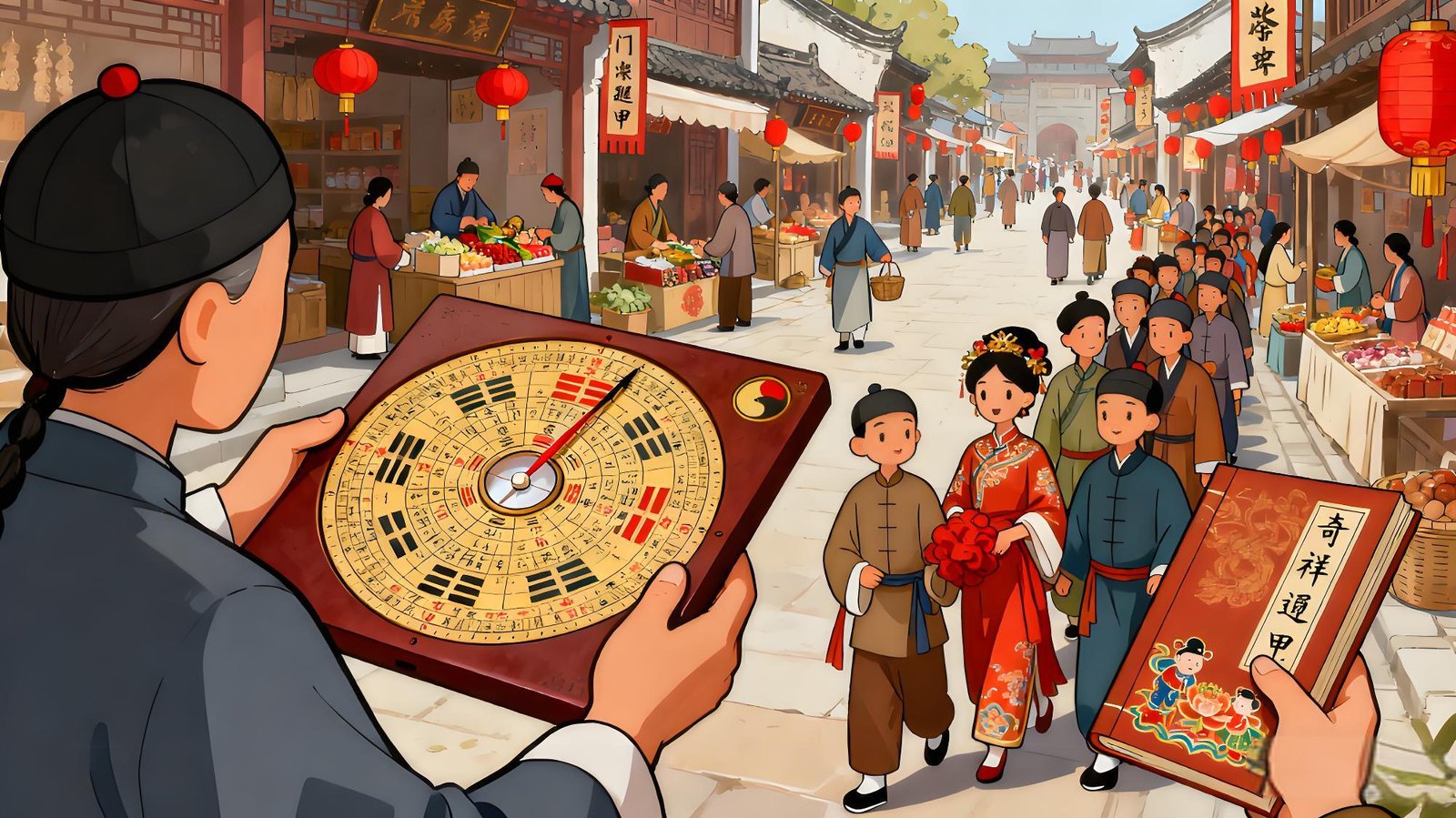
Figure 2: The Corresponding Relationship between Qi Men Dun Jia and Yin-Yang Five Elements. This diagram shows the corresponding attributes of the eight gates, nine stars, and eight trigrams in Qi Men Dun Jia to the five elements and Yin-Yang. For example, the Zhen Gua corresponds to wood and Yang, the Kan Gua corresponds to water and Yin, the Sheng Men corresponds to wood, and the Tianfu Star corresponds to earth. It clearly reflects how Qi Men Dun Jia integrates the Yin-Yang and Five Elements theory.
2. Core Composition of Qi Men Dun Jia: The Three Plates and Their Cultural Connotations
The core of Qi Men Dun Jia is the “three plates” system, namely the Heavenly Plate (representing celestial phenomena and cosmic vitality), the Earthly Plate (representing geographical environment and fixed patterns), and the Human Plate (representing human behavior and life states). These three plates interact with each other, forming a complete “cosmic microcosm” model, which is the basis for analyzing things and predicting changes.
2.1 Heavenly Plate: The Projection of Celestial Phenomena and the Symbol of Vitality
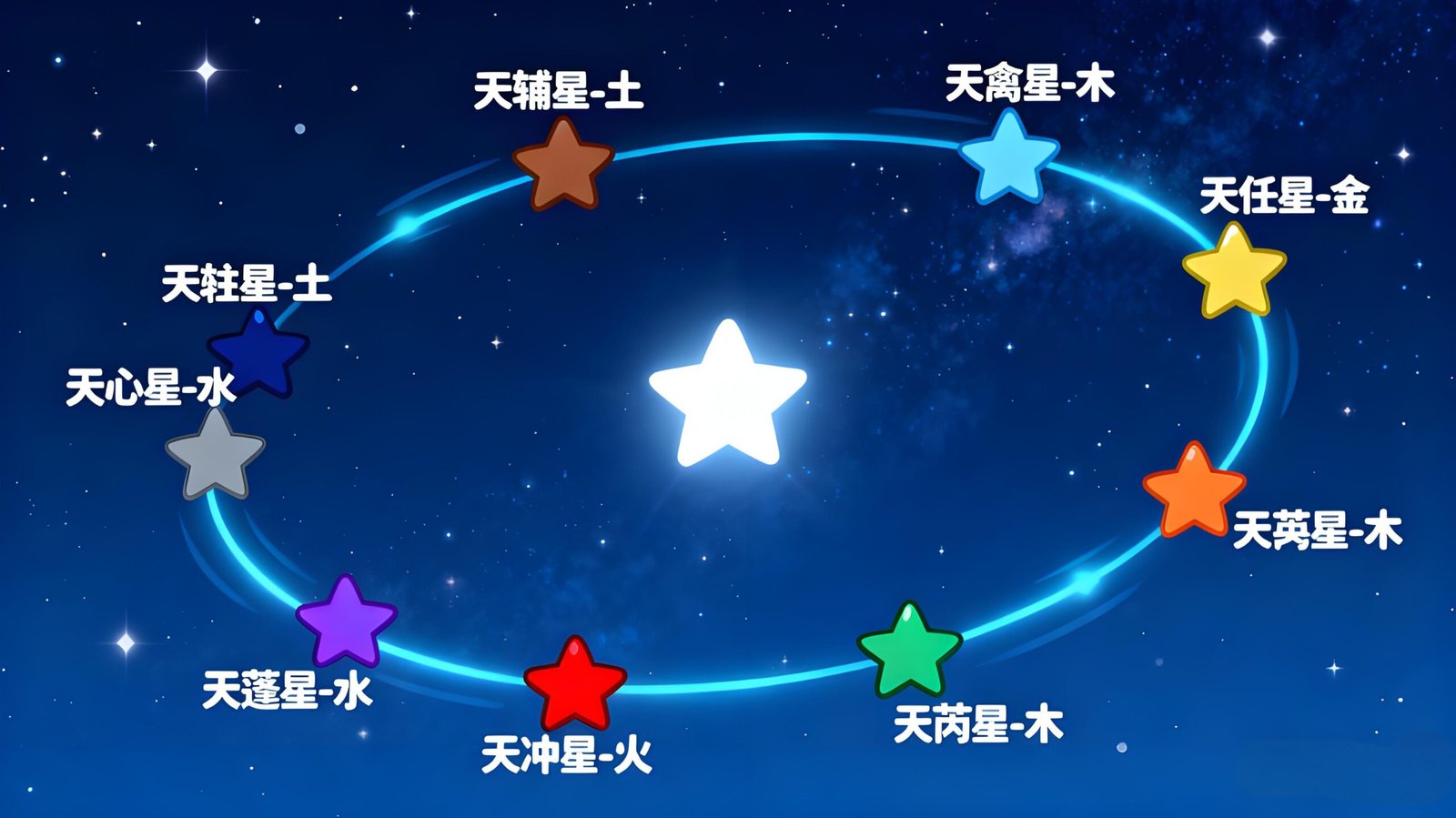
The Heavenly Plate is the core of the three plates, mainly composed of the “Nine Stars”, which correspond to the nine palaces of the Big Dipper and other celestial stars. Each star has its own name, attribute, and symbolic meaning, and its position change reflects the change of cosmic vitality. The nine stars are: Tianfu Star, Tianrui Star, Tianchong Star, Tianfu Star, Tianying Star, Tianzhu Star, Tianxin Star, Tianpeng Star, and Tianqin Star.
Each star in the nine stars has a profound cultural implication. For example, the Tianfu Star is known as the “Noble Star”, corresponding to the earth element, symbolizing wealth, status, and stability. It is the most auspicious star in the nine stars, reflecting the traditional Chinese people’s pursuit of a stable and prosperous life. The Tianpeng Star is called the “Greedy Wolf Star”, corresponding to the water element, symbolizing danger, adventure, and change. It is considered an inauspicious star, reminding people to be cautious in the face of unknown risks. The Tianxin Star is known as the “Wenqu Star”, corresponding to the metal element, symbolizing wisdom, strategy, and medical skills. It is the star of scholars and strategists, reflecting the traditional cultural concept of respecting knowledge and wisdom.
The movement of the nine stars on the Heavenly Plate is not random, but follows the law of the “rotation of the Big Dipper” and the “change of the four seasons”. Ancient Chinese astronomers observed that the Big Dipper rotates around the North Star, and its handle points to different directions in different seasons. This astronomical phenomenon is mapped to the Heavenly Plate of Qi Men Dun Jia, forming the “star movement” rule of the nine stars. This rule not only reflects the ancient people’s accurate observation of celestial phenomena, but also embodies the “heavenly law” thought of traditional culture——everything in the world must follow the laws of nature.
2.2 Earthly Plate: The Carrier of Geographical Environment and the Manifestation of Fixed Patterns
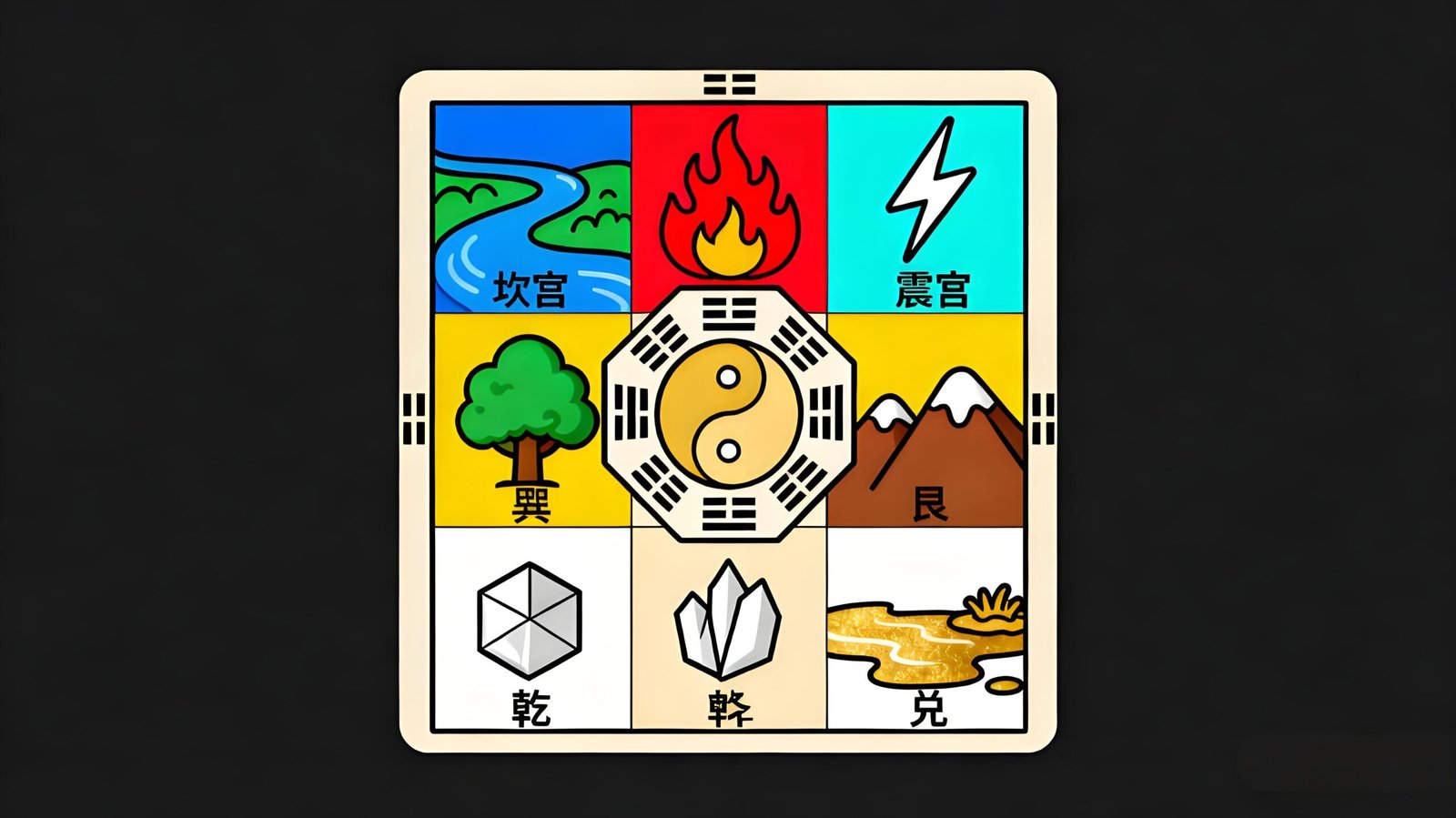
The Earthly Plate is the foundation of the three plates, mainly composed of the “Eight Trigrams” and “Nine Palaces”, which represent the geographical environment and fixed spatial patterns. The Eight Trigrams are Zhen, Kan, Gen, Kun, Xun, Li, Dui, and Qian, which originated from the “Book of Changes” and are the basic symbols of ancient Chinese people’s understanding of the natural world. The Nine Palaces are formed by dividing the Eight Trigrams into the middle palace, namely the Qian Palace (northwest), Kun Palace (southwest), Gen Palace (northeast), Xun Palace (southeast), Zhen Palace (east), Kan Palace (north), Li Palace (south), Dui Palace (west), and Middle Palace (center).
The Earthly Plate of Qi Men Dun Jia has a strong geographical and cultural connotation. Each trigram and palace corresponds to a specific geographical environment and natural phenomenon. For example, the Kan Palace corresponds to the north and water, symbolizing rivers, lakes, and low-lying areas; the Li Palace corresponds to the south and fire, symbolizing mountains, sun, and high-lying areas; the Zhen Palace corresponds to the east and wood, symbolizing forests, vegetation, and vibrant places. This correspondence is not a random setting, but the result of ancient people’s long-term observation of the geographical environment and climate changes in different directions.
In addition, the Nine Palaces of the Earthly Plate also correspond to the “Five Elements” and “Eight Directions”, forming a spatial model that integrates multiple cultural elements. This model is widely used in traditional Chinese culture such as Feng Shui and divination, and has become an important tool for ancient people to understand the geographical environment and choose living places. For example, when building a house in ancient times, people would refer to the position of the Nine Palaces and the attributes of the Five Elements to determine the orientation of the house and the layout of the rooms, in order to achieve the effect of “harmonizing with the geographical environment”.
2.3 Human Plate: The Reflection of Human Behavior and the Embodiment of Life States
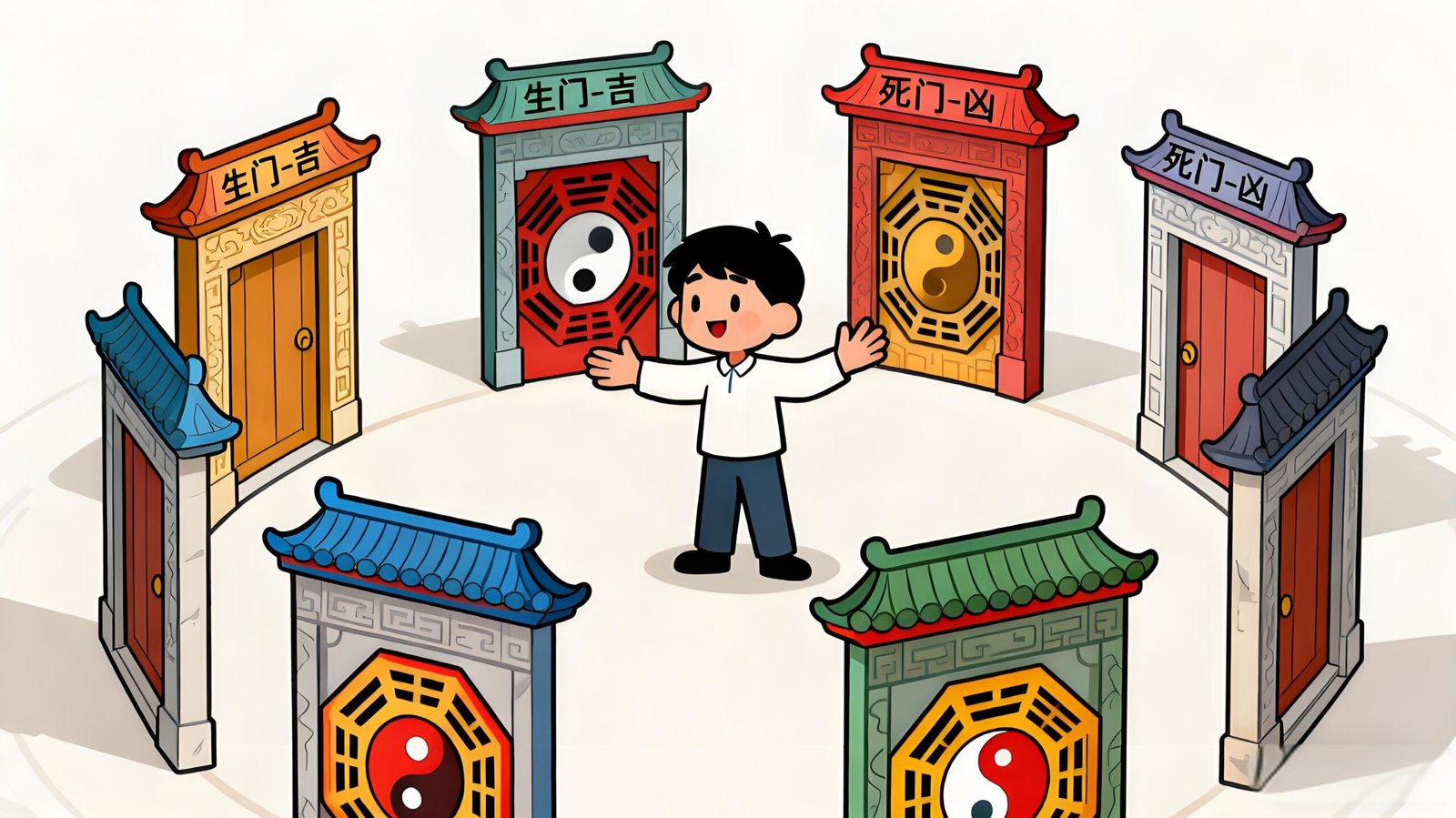
The Human Plate is the link between the Heavenly Plate and the Earthly Plate, mainly composed of the “Eight Gates”, which represent human behavior, life states, and development trends. The eight gates are: Sheng Men (Gate of Life), Xiu Men (Gate of Rest), Shang Men (Gate of Injury), Du Men (Gate of Blockage), Jing Men (Gate of Scenery), Death Gate (Gate of Death), Jing Men (Gate of Shock), and Kai Men (Gate of Opening). Each gate has its own symbolic meaning and good or bad attributes, reflecting the different stages and states of human life.
The eight gates of the Human Plate are full of humanistic care and life wisdom of traditional culture. For example, Sheng Men is the most auspicious gate among the eight gates, symbolizing vitality, growth, and success. It corresponds to the wood element and the east, which is the direction of the rising sun, implying a new beginning and infinite possibilities. This symbolizes the traditional Chinese people’s optimistic attitude towards life and the pursuit of growth. Death Gate is considered an inauspicious gate, symbolizing decline, danger, and termination. It corresponds to the earth element and the southwest, reminding people to respect the laws of life and avoid unnecessary risks.
The opening and closing of the eight gates and the change of positions are closely related to the changes of the Heavenly Plate and the Earthly Plate. Qi Men Dun Jia believes that human behavior can only achieve the best effect if it conforms to the changes of celestial phenomena (Heavenly Plate) and adapts to the geographical environment (Earthly Plate). This idea reflects the traditional Chinese “moderation” thought, which requires people to grasp the balance between man and nature, and between man and society, and not to act arbitrarily.
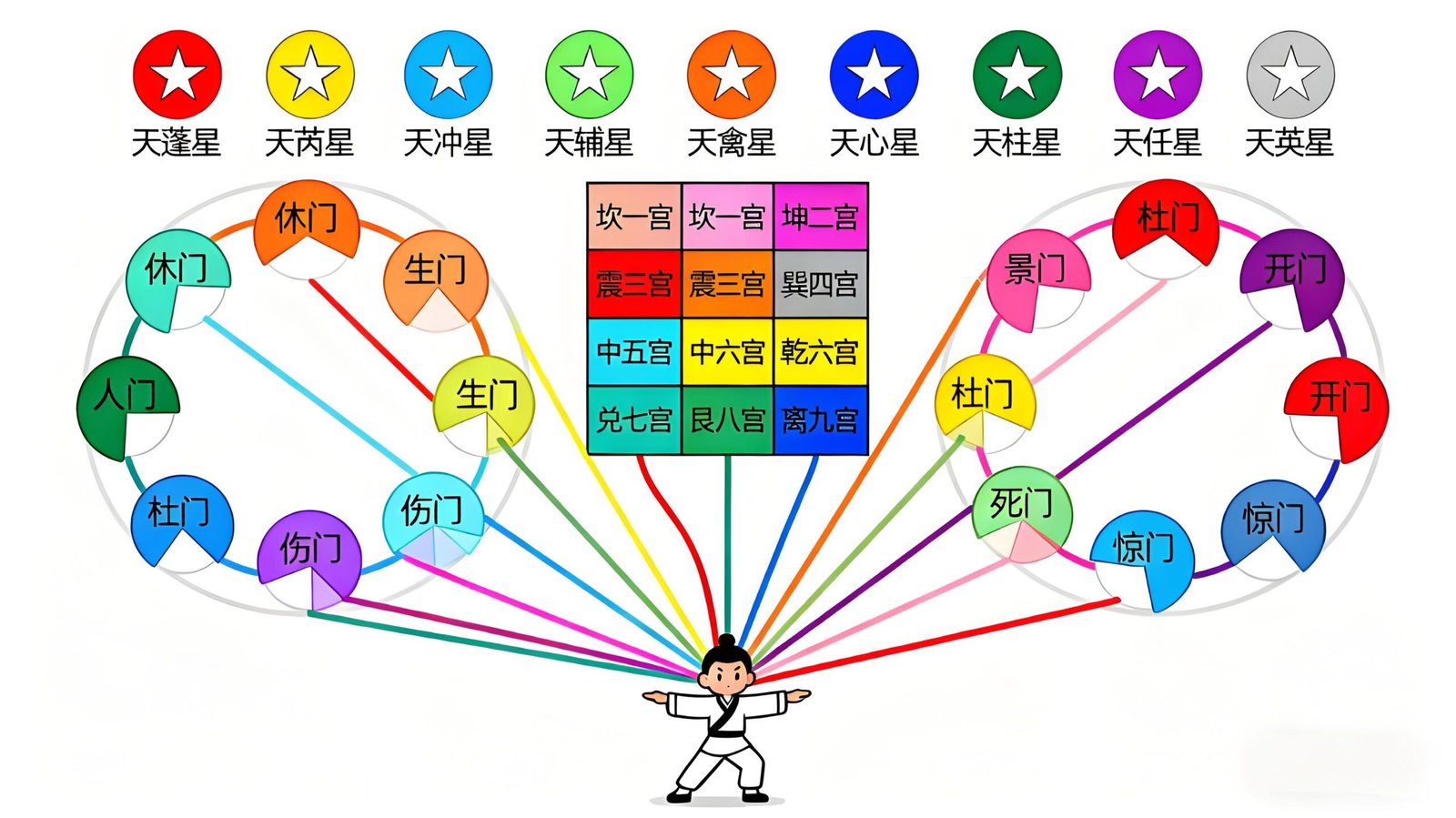
Figure 3: The Three Plates Structure of Qi Men Dun Jia (Heaven, Earth, Human). This diagram shows the superposition relationship of the Heavenly Plate (Nine Stars), Earthly Plate (Nine Palaces and Eight Trigrams), and Human Plate (Eight Gates). The center is the Middle Palace of the Earthly Plate, surrounded by the other eight palaces. The Heavenly Plate and Human Plate rotate around the Earthly Plate, reflecting the traditional philosophical thought of “Heaven, Earth, and Human are integrated”.
3. Key Concepts of Qi Men Dun Jia: From “Dun Jia” to “Good and Bad Luck Judgment”
In addition to the three plates system, Qi Men Dun Jia also has a series of key concepts that are crucial to its application. These concepts not only contain complex calculation rules, but also reflect the profound cultural connotation and life wisdom of traditional China. Among them, “Dun Jia” (concealing Jia) and “good and bad luck judgment” are the most representative.
3.1 “Dun Jia”: The Core Logic of Concealment and Flexibility
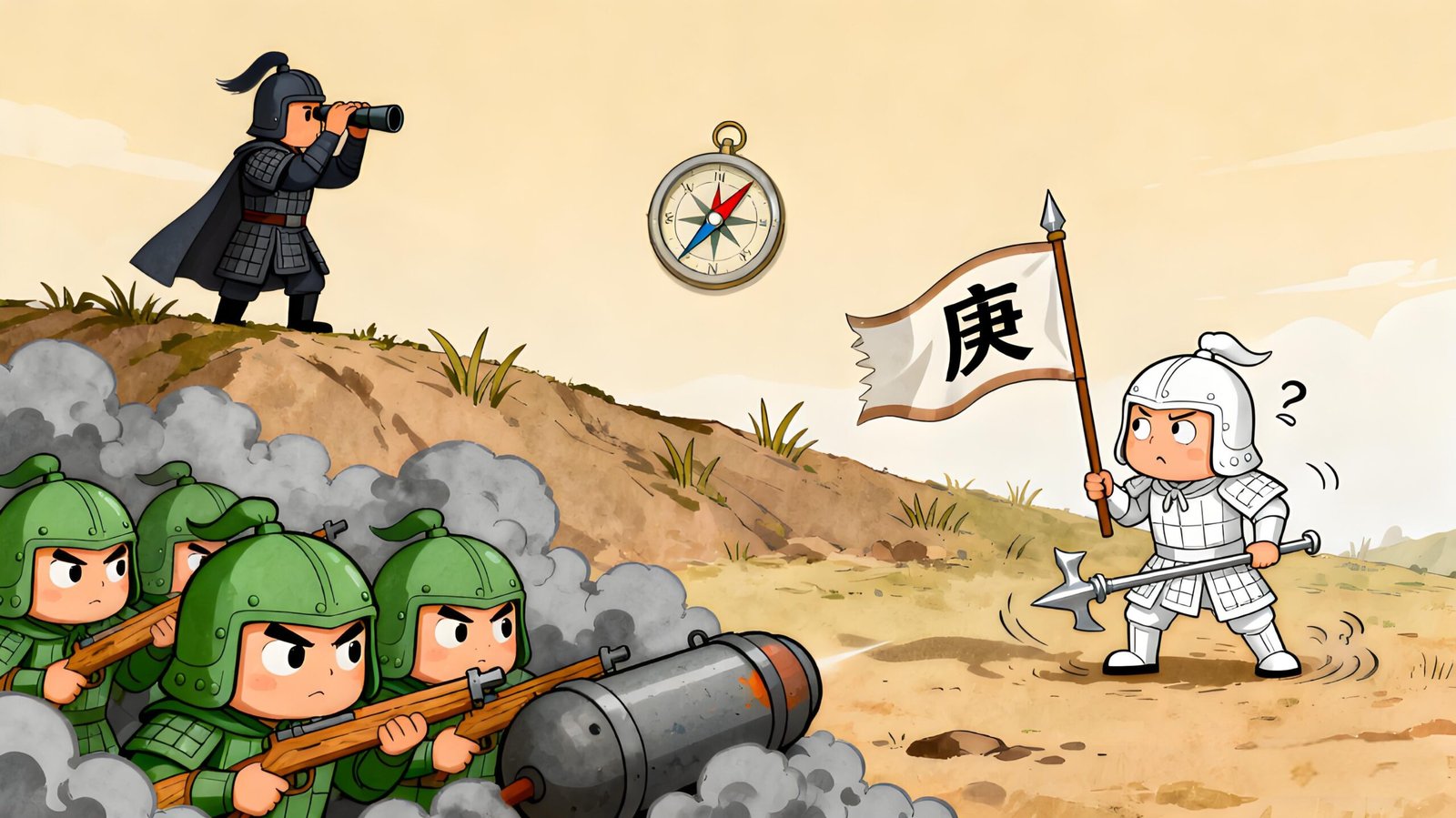
“Dun Jia” is the soul of Qi Men Dun Jia, and its core meaning is to “conceal the Jia wood” to avoid being restrained by other heavenly stems. In the ten heavenly stems (Jia, Yi, Bing, Ding, Wu, Ji, Geng, Xin, Ren, Gui), Jia is the leader and the most noble, so it is called “Tian Di Xuan Huang”. However, Jia is restrained by Geng (metal restrains wood), so it needs to be concealed under the other heavenly stems to avoid danger. This is the origin of “Dun Jia”.
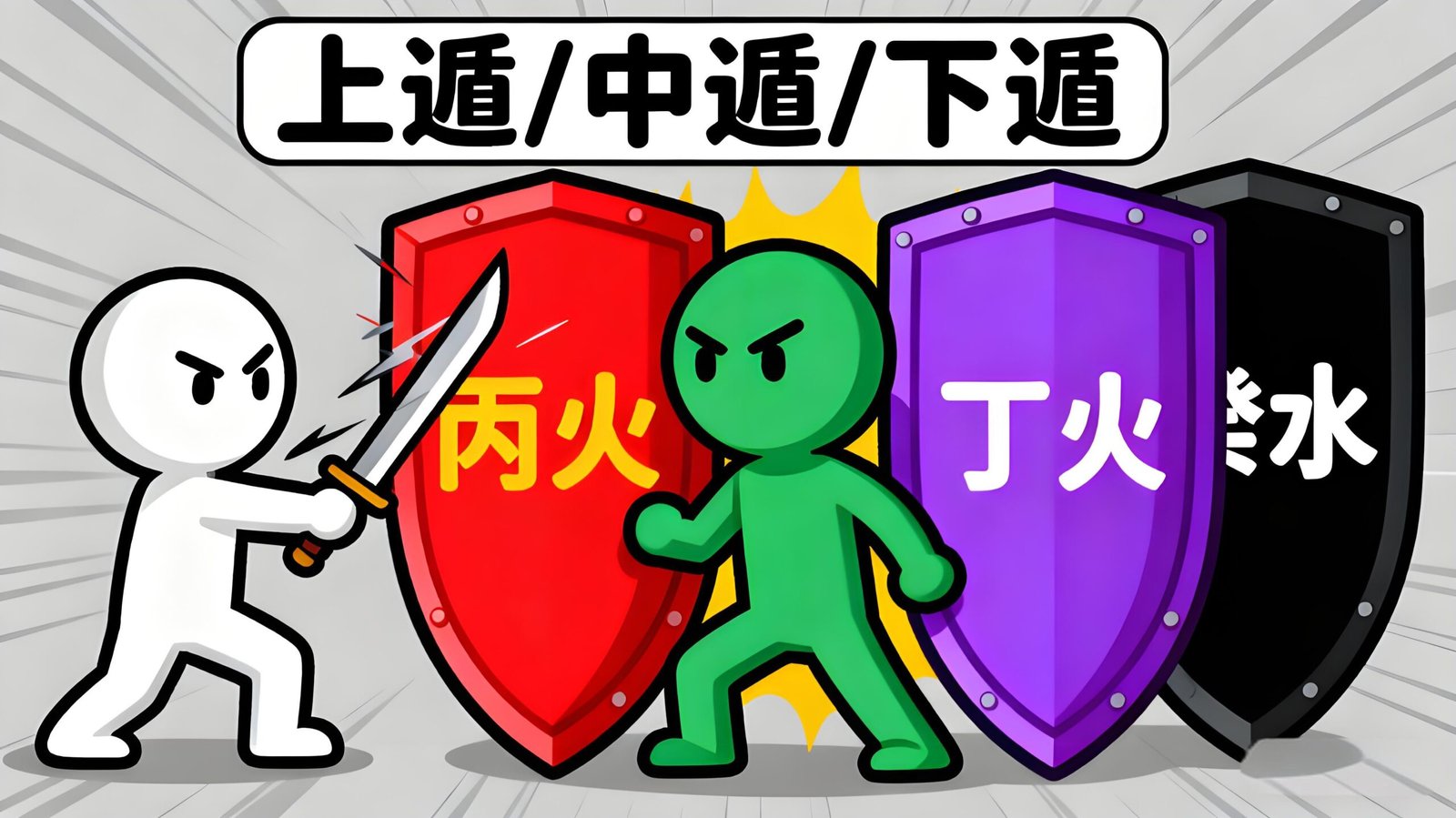
There are three ways to “Dun Jia” in Qi Men Dun Jia: Dun Jia under Bing, Dun Jia under Ding, and Dun Jia under Gui, which are called “Upper Dun”, “Middle Dun”, and “Lower Dun” respectively. The choice of these three ways is determined by the time of the year and the position of the sun and moon, reflecting the ancient people’s accurate grasp of the laws of celestial phenomena. The logic of “Dun Jia” not only contains the strategic thinking of “hiding strengths and avoiding weaknesses” in military affairs, but also embodies the Taoist philosophy of “humility and concealment”.
In traditional Chinese culture, “concealment” is not a negative escape, but a positive way to accumulate strength and wait for opportunities. The “Book of Changes” says: “Hidden dragon does not use”, which means that when the conditions are not ripe, one should hide one’s capabilities and bide one’s time. This thought is fully reflected in “Dun Jia”. For example, in military command, if the enemy is strong and we are weak, the commander can use the method of “Dun Jia” to conceal his own main force, confuse the enemy, and then find an opportunity to counterattack. In daily life, when people encounter difficulties, they can also learn from the thought of “Dun Jia”, adjust their state, accumulate strength, and wait for the opportunity to rise.
3.2 Good and Bad Luck Judgment: The Integration of Natural Laws and Human Behavior
Judging good and bad luck is the practical purpose of Qi Men Dun Jia, and its core method is to comprehensively judge the development trend of things through the interaction between the three plates (Heaven, Earth, Human) and the mutual generation and restraint of the five elements. This judgment is not a random guess, but a systematic analysis based on the laws of nature and human behavior.
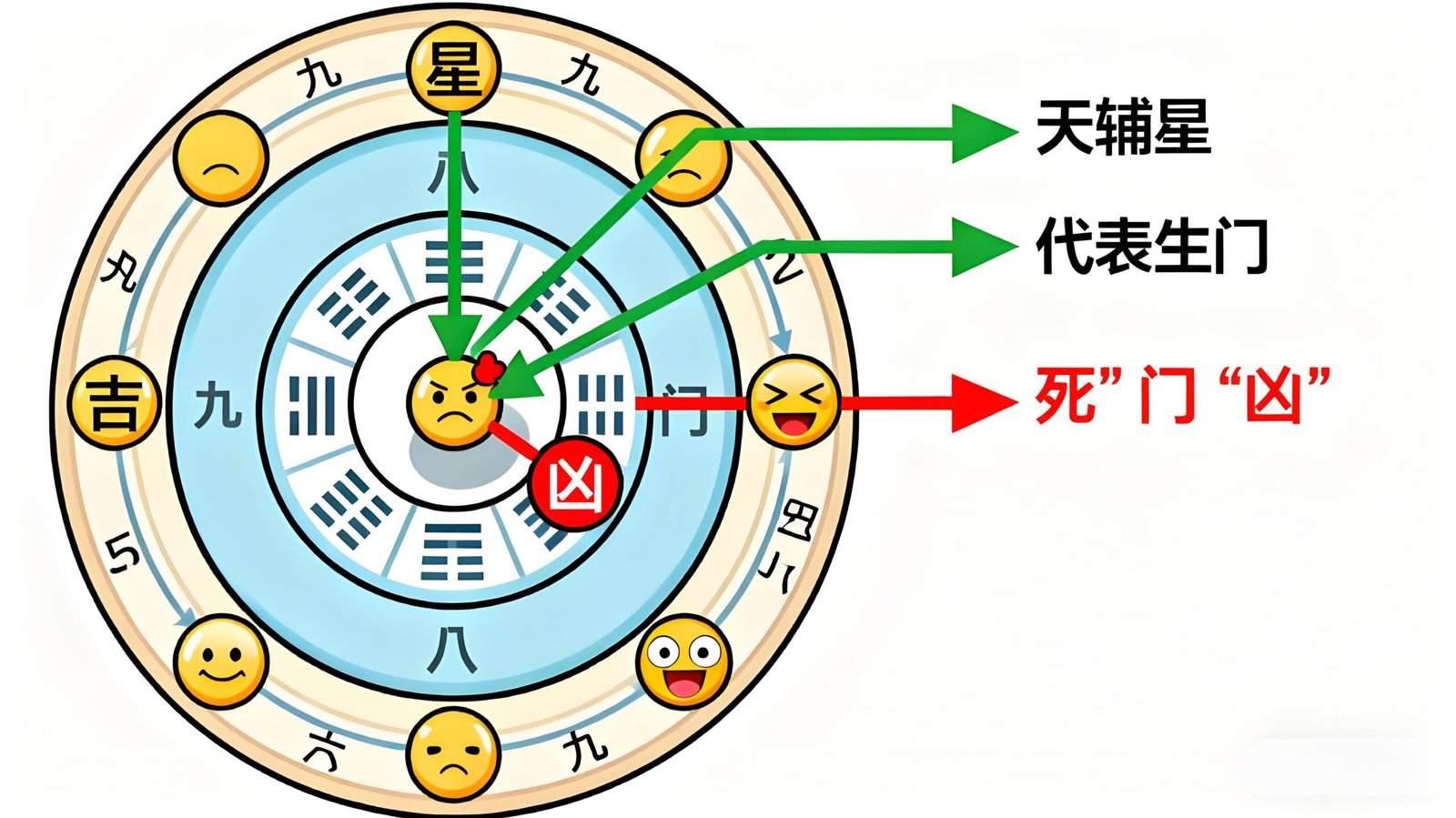
The criteria for judging good and bad luck in Qi Men Dun Jia mainly include the following aspects: First, the position and state of the “Jia” (the core of the ten heavenly stems). If Jia is in a favorable position and is not restrained by other stems, it means that the overall situation is good; if Jia is in a dangerous position and is restrained by Geng, it means that there may be risks. Second, the mutual generation and restraint relationship between the nine stars (Heavenly Plate), eight gates (Human Plate), and eight trigrams (Earthly Plate). If the stars, gates, and trigrams generate each other, it is auspicious; if they restrain each other, it is inauspicious. Third, the correspondence between the things to be judged and the gates, stars, and palaces. For example, if you want to predict career development, you should focus on the state of Kai Men (Gate of Opening) and Tianfu Star (Noble Star); if you want to predict marriage, you should focus on the state of Xiu Men (Gate of Rest) and the corresponding palaces.
It should be emphasized that the good and bad luck judged by Qi Men Dun Jia is not absolute, but relative and changeable. It reminds people to adjust their behavior according to the changes of the situation, so as to turn bad luck into good luck. This thought reflects the traditional Chinese “active adaptation” philosophy, which believes that human beings can change their destiny through their own efforts on the basis of abiding by natural laws. For example, if the judgment result is inauspicious, people can avoid risks by changing their actions, adjusting their direction, or choosing a more favorable time, which is the practical value of Qi Men Dun Jia.
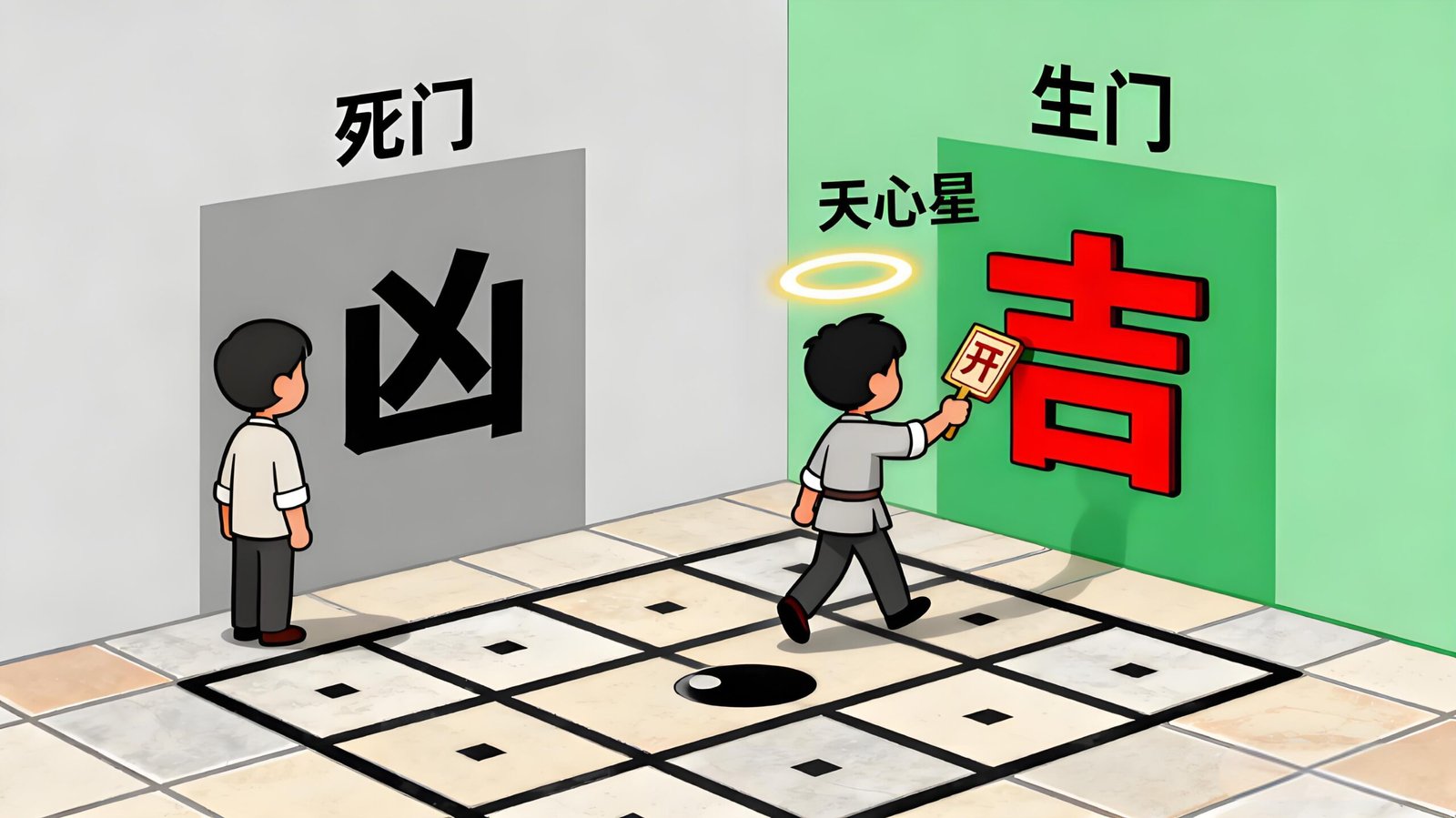
Figure 4: The Judgment Model of Good and Bad Luck in Qi Men Dun Jia. This diagram takes “career development prediction” as an example, showing how to judge good and bad luck through the interaction between Kai Men (Human Plate), Tianfu Star (Heavenly Plate), and Qian Palace (Earthly Plate). The green arrows represent mutual generation (auspicious), and the red arrows represent mutual restraint (inauspicious). It intuitively reflects the logical process of good and bad luck judgment.
4. Application of Qi Men Dun Jia in Traditional Society: From Military to Daily Life
Qi Men Dun Jia has a wide range of applications in traditional Chinese society, and its influence penetrates into military, politics, culture, and daily life. It is not only a tool for military command and political decision-making, but also an important part of folk customs and life wisdom.
4.1 Military Application: The Magic Weapon of Command and Strategy
Military application is the earliest and most important application field of Qi Men Dun Jia. In ancient China, many famous military strategists were proficient in Qi Men Dun Jia and used it to command battles and achieve brilliant victories. The most famous of these is Zhuge Liang, the prime minister of the Shu Han during the Three Kingdoms period. According to “Romance of the Three Kingdoms”, Zhuge Liang used Qi Men Dun Jia to set up the “Eight Arrays” to defeat the enemy’s hundreds of thousands of troops; he also used Qi Men Dun Jia to “borrow the east wind” in the Battle of Chibi, creating a miracle of winning more with less. Although “Romance of the Three Kingdoms” has fictional elements, it reflects the important position of Qi Men Dun Jia in ancient military affairs.
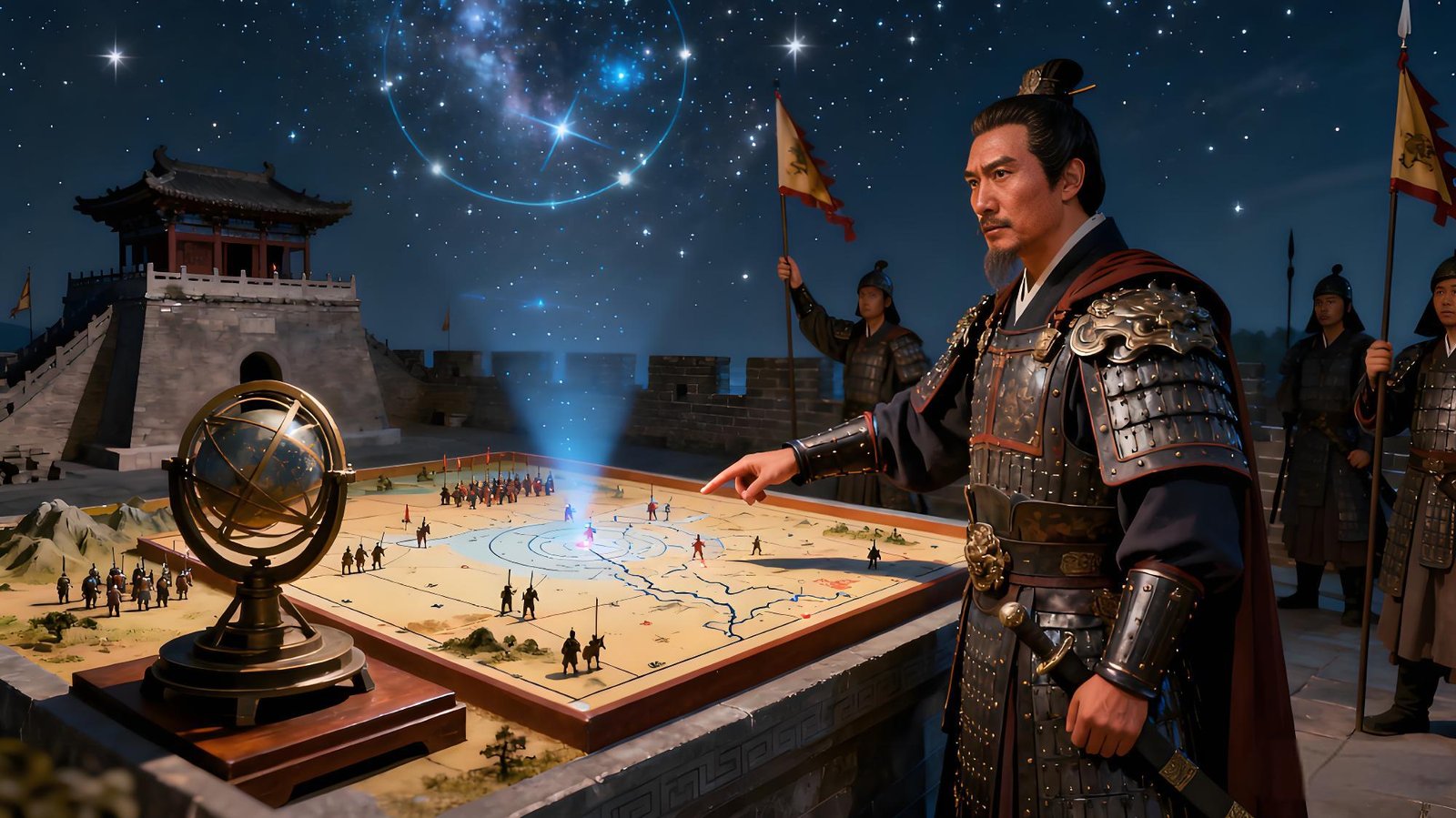
The military application of Qi Men Dun Jia is essentially a combination of astronomical observation, geographical analysis, and strategic thinking. It reflects the ancient Chinese military thought of “knowing the enemy and knowing oneself, and winning a hundred battles”. Although modern military technology has developed by leaps and bounds, the strategic thinking contained in Qi Men Dun Jia, such as “choosing the right time and place”, “hiding strengths and avoiding weaknesses”, and “adapting to changes”, still has important reference value.
4.2 Political and Cultural Application: The Assistant of Decision-Making and the Carrier of Culture
In addition to military affairs, Qi Men Dun Jia was also widely used in political decision-making in ancient China. Emperors and ministers often consulted Qi Men Dun Jia masters when formulating national policies, selecting officials, and holding important ceremonies to ensure that the decisions conformed to the “heavenly will”. For example, during the Ming Dynasty, the court set up a special “Qi Men Dun Jia Bureau” to be responsible for astronomical observation and divination, and its conclusions often became an important basis for the emperor’s decision-making. This practice was not blind superstition, but a way for the ruling class to link political power with cosmic order, which was in line with the traditional Chinese political concept of “the emperor is the son of heaven”.
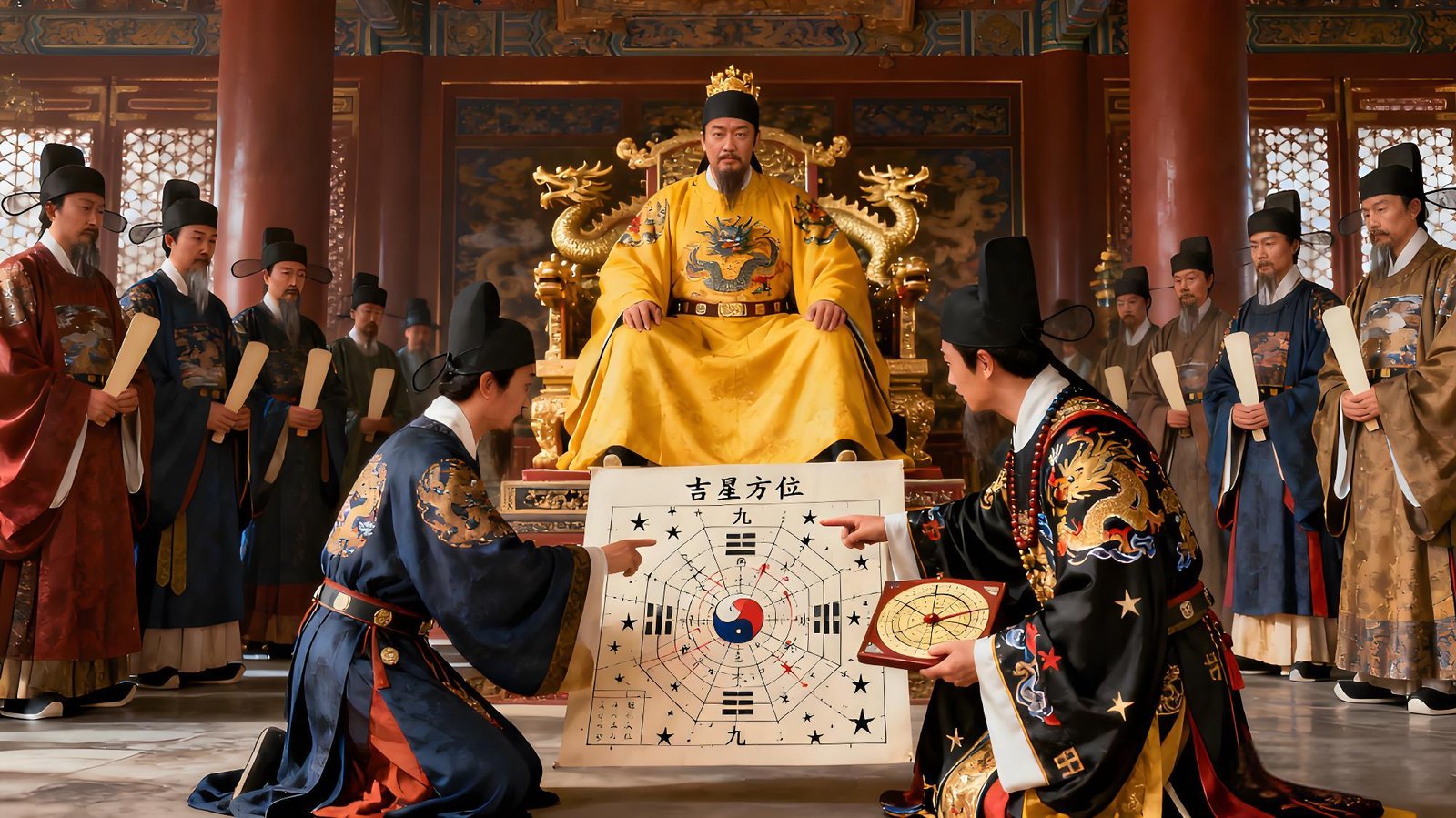
In the field of culture, Qi Men Dun Jia has also had a profound impact. It has become an important theme in ancient novels, operas, and folk stories, and has been endowed with rich literary color. For example, in “Journey to the West”, the Taishang Laojun uses the “Bagua Furnace” to refine the golden elixir, and the layout of the furnace is closely related to the Nine Palaces and Eight Trigrams of Qi Men Dun Jia; in “Water Margin”, Wu Yong, the “Wise Star”, uses divination to formulate strategies for the Liangshan heroes, and his methods contain the core logic of Qi Men Dun Jia’s “adapting to the situation”. In addition, Qi Men Dun Jia has also promoted the development of ancient astronomy, mathematics, and geography. The accurate calculation of the movement of the nine stars and the division of the nine palaces have accumulated a lot of valuable data for ancient scientific research, and even laid a foundation for the later “Shou Shi Calendar” and other important astronomical achievements.
4.3 Daily Life Application: The Guide of Folk Customs and Life Wisdom
With the spread of Qi Men Dun Jia to the people, it has gradually integrated into daily life and become an important part of folk customs. Ancient people would use Qi Men Dun Jia to guide various life matters, such as house selection, marriage, travel, and medical treatment. This integration fully reflects the traditional Chinese concept of “integrating heaven, earth and man into daily life”. For example, when choosing a house, people would refer to the “spatial harmony” concept of the Nine Palaces and Eight Trigrams, avoiding building houses in low-lying areas corresponding to the “Kan Palace” (which symbolizes water and is prone to flooding) and choosing sunny areas corresponding to the “Li Palace” (which symbolizes fire and represents vitality). This practice is not only a manifestation of folk beliefs, but also contains the ancient people’s experience in adapting to the geographical environment.
In terms of marriage customs, the “heavenly stems and earthly branches matching” in Qi Men Dun Jia was once an important part of the pre-marital “eight characters matching”. People would calculate the compatibility of the couple’s birth time through the three plates of Qi Men Dun Jia, and choose an auspicious date when the “Xiu Men” (Gate of Rest, symbolizing marriage and harmony) is in a favorable position to hold the wedding. Although this custom has been simplified in modern times, it still reflects the traditional Chinese pursuit of “harmony between man and heaven” in marriage. In medical treatment, ancient doctors would combine the five elements attributes of Qi Men Dun Jia to diagnose diseases. For example, a patient with symptoms such as dry mouth and red tongue (corresponding to the fire element) would be judged to have excessive “fire qi”, and treatment methods such as using herbs corresponding to the water element to “restrain fire” would be adopted. This combination of divination and medicine reflects the traditional Chinese medical concept of “treating diseases according to the time and place”.
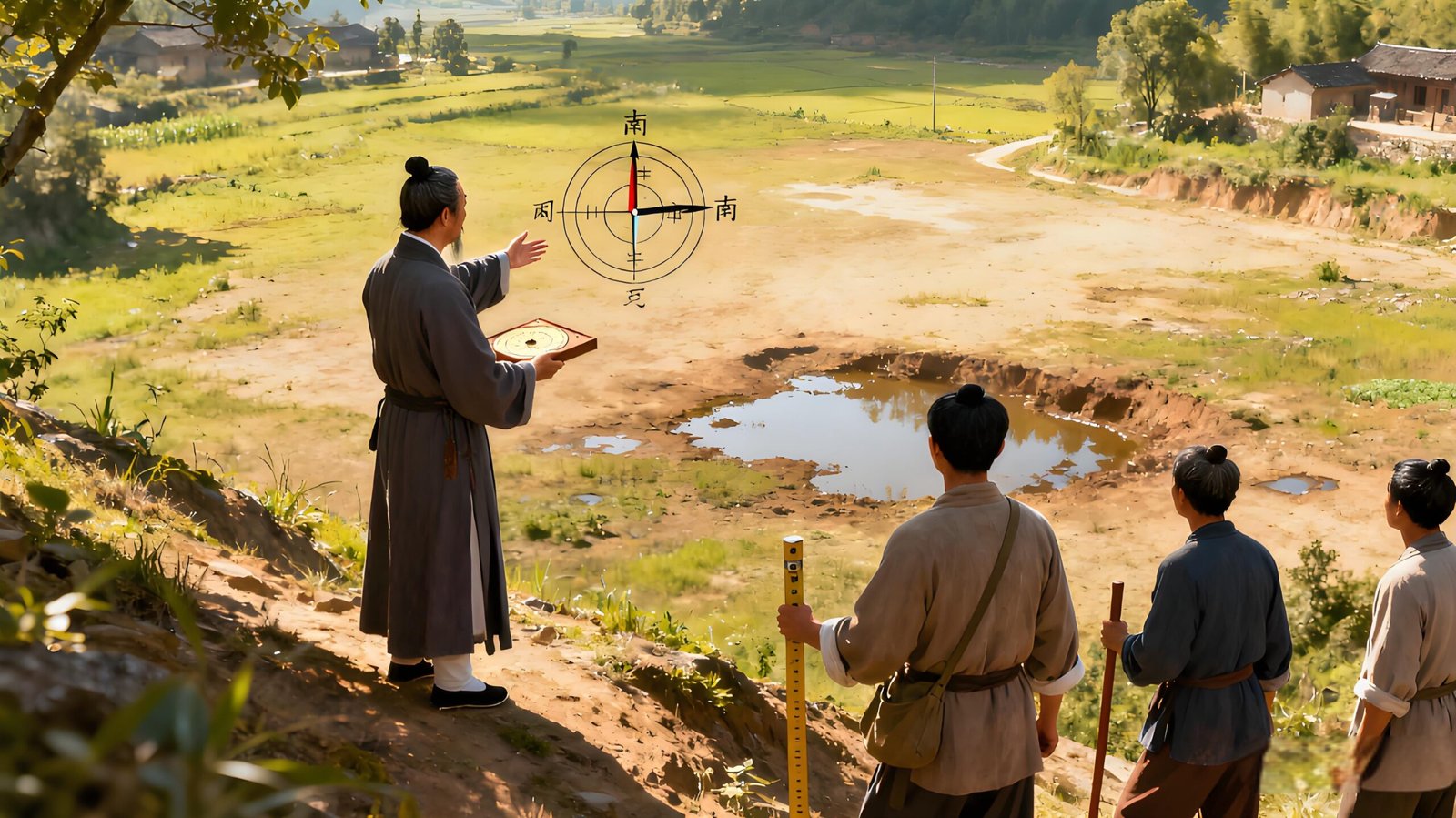
Figure 5: The Application Scenarios of Qi Men Dun Jia in Traditional Society. This diagram shows the three main application fields of Qi Men Dun Jia: military (battle formation, time selection), politics (decision-making, ceremony), and daily life (house selection, marriage, travel). Each field is matched with corresponding cultural symbols, such as the battle formation corresponds to the Eight Arrays, and the house selection corresponds to the Nine Palaces. It reflects the wide influence of Qi Men Dun Jia in traditional society.
5. Cultural Value of Qi Men Dun Jia in Modern Society: Inheritance and Innovation
In modern society, with the development of science and technology and the change of ideology, some people regard Qi Men Dun Jia as “superstition” and ignore its cultural value. However, in fact, Qi Men Dun Jia, as a treasure of traditional Chinese culture, still has important cultural value and practical significance in modern society. Its inheritance and innovation are not only the needs of cultural heritage, but also the needs of absorbing traditional wisdom for modern society.
5.1 The Philosophical Value of “The Unity of Man and Nature”
The core philosophical thought of Qi Men Dun Jia is “the unity of man and nature”, which is highly consistent with the modern concept of sustainable development. In modern society, with the excessive exploitation of natural resources and the deterioration of the ecological environment, people are increasingly aware of the importance of harmonious coexistence between man and nature. The thought of Qi Men Dun Jia that “human behavior must conform to natural laws” can provide important ideological inspiration for modern people.
For example, in the field of urban planning, the “spatial balance” concept of the Nine Palaces and Eight Trigrams can be used to avoid blind expansion. Planners can refer to the corresponding relationship between the eight trigrams and natural elements to reserve green spaces (corresponding to the wood element of Zhen Palace) and water systems (corresponding to the water element of Kan Palace) in the city, realizing the harmonious coexistence of urban construction and natural environment. In the field of agriculture, the “four seasons correspondence” thought of Qi Men Dun Jia can be combined with modern agricultural technology to carry out seasonal planting and ecological breeding, which not only improves the output but also protects the ecological balance. This philosophical value of Qi Men Dun Jia transcends the limitations of the times and becomes a common ideological wealth of human beings.
5.2 The Strategic Value of Flexible Adaptation
The strategic thinking contained in Qi Men Dun Jia, such as “hiding strengths and avoiding weaknesses”, “adapting to changes”, and “choosing the right time and place”, still has important practical value in modern society, especially in the fields of business management and personal development. In the fierce market competition, business managers can learn from the “three plates analysis” method of Qi Men Dun Jia: regarding the market environment as the “Earthly Plate”, the policy trend as the “Heavenly Plate”, and the enterprise’s own strength as the “Human Plate”. By analyzing the mutual relationship between the three plates, they can formulate scientific development strategies.
For example, when a new energy enterprise faces policy adjustments (Heavenly Plate changes), it can use the “Dun Jia” thinking to temporarily adjust its investment direction, focus on technological research and development to accumulate strength, and wait for the policy window to open (corresponding to the “Kai Men” position). In personal development, individuals can use the “five elements matching” theory of Qi Men Dun Jia to analyze their own strengths and weaknesses. For example, a person with a “wood element” personality (flexible and innovative) is suitable for engaging in design and R&D work, while a person with a “metal element” personality (stable and rigorous) is more suitable for financial and management positions. This combination of traditional wisdom and modern career planning provides a new perspective for personal development.
5.3 The Cultural Heritage Value of Traditional Knowledge
Qi Men Dun Jia is an important part of Chinese excellent traditional culture, which carries the ancient people’s knowledge of the universe, nature, and human society. Protecting and inheriting Qi Men Dun Jia is not only to protect a kind of traditional knowledge, but also to inherit the cultural genes and national spirit of the Chinese nation. In recent years, with the rise of national cultural confidence, Qi Men Dun Jia has been included in the intangible cultural heritage protection list in many regions, and relevant research institutions and academic works have emerged continuously.
The inheritance of Qi Men Dun Jia should adhere to the principle of “taking the essence and discarding the dross”. For the superstitious content such as “predicting the future out of thin air”, it should be criticized and abandoned; for the rational components such as astronomical observation records, strategic thinking, and philosophical concepts, it should be deeply excavated and inherited. For example, the ancient astronomical observation data contained in Qi Men Dun Jia can supplement the research on the history of Chinese astronomy; the strategic thinking of “adapting to changes” can be integrated into modern management teaching; the folk customs related to Qi Men Dun Jia can be sorted out to enrich the connotation of traditional cultural tourism. At the same time, modern technology can be used to innovate the inheritance method. For example, digital platforms can be used to display the three plates structure of Qi Men Dun Jia, and virtual reality technology can be used to restore its application scenarios in ancient military and life, making this ancient knowledge more vivid and popular.
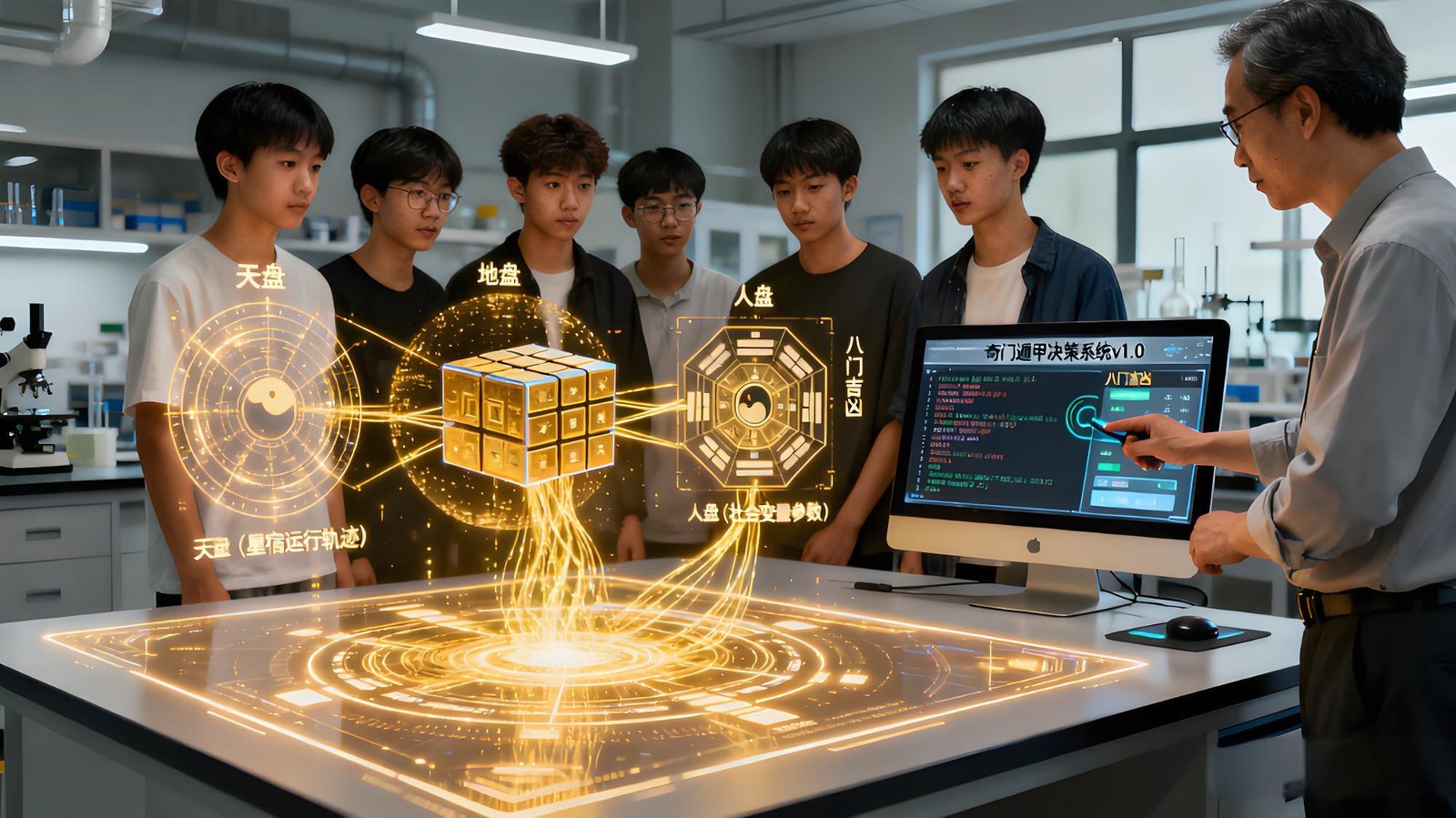
Figure 6: The Modern Value of Qi Men Dun Jia. This diagram shows the three main modern values of Qi Men Dun Jia: philosophical value (unity of man and nature, sustainable development), strategic value (business management, personal development), and cultural value (heritage, innovation). The overlapping parts with modern society reflect its compatibility and practical significance.
Conclusion: Qi Men Dun Jia——A Living Carrier of Chinese Traditional Wisdom
Qi Men Dun Jia, after thousands of years of vicissitudes, is not a rigid ancient document, but a living carrier of Chinese traditional wisdom. It integrates the essence of multiple traditional cultures: the astronomical observation of the Zhou Dynasty laid its “Heavenly Plate” foundation, the Yin-Yang and Five Elements theory of the Han Dynasty constructed its core logic, the strategic thinking of the Spring and Autumn and Warring States periods enriched its application methods, and the humanistic care of Confucianism and Taoism endowed it with spiritual connotation. From military command to political decision-making, from daily life to cultural creation, Qi Men Dun Jia has penetrated into all aspects of traditional Chinese society, reflecting the ancient people’s persistent pursuit of “harmony between man and heaven”.

In modern society, we should view Qi Men Dun Jia with a rational and scientific attitude. We should not be superstitious about its “divination” function, nor should we completely deny its cultural value because of individual feudal dross. Instead, we should excavate its philosophical connotation, strategic thinking, and cultural heritage value, and integrate it with modern society. For example, its “unity of man and nature” thought can provide inspiration for ecological protection; its flexible strategic thinking can provide reference for enterprise management; its rich cultural symbols can become a source of creation for modern culture and art.

As a treasure of Chinese traditional culture, Qi Men Dun Jia’s eternal value lies not in predicting the future, but in teaching people to understand the laws of nature, grasp the rhythm of society, and shape a positive attitude towards life. In the process of inheriting and innovating Qi Men Dun Jia, we are not only inheriting a kind of traditional knowledge, but also inheriting the cultural genes of the Chinese nation that respect nature, advocate wisdom, and pursue harmony. This is the true meaning of Qi Men Dun Jia as a “living cultural heritage”.