
Shu Embroidery: A Brilliant Treasure of Chinese Traditional Embroidery Art
Introduction: Shu Embroidery – The Pearl of Western Sichuan in China’s “Four Great Embroideries”
In the splendid galaxy of Chinese traditional embroidery art, Shu Embroidery shines brightly with its vivid colors, exquisite and flexible stitches, and profound cultural heritage. Together with Su Embroidery (from Jiangsu), Yue Embroidery (from Guangdong), and Xiang Embroidery (from Hunan), it is known as China’s “Four Great Embroideries” and hailed as the “treasure of Western Sichuan”. The core production area of Shu Embroidery is concentrated in Chengdu, Sichuan and its surrounding areas. This fertile land, known as the “Land of Abundance”, has nurtured the sericulture industry with its rich products and mild climate, providing a unique material foundation for Shu Embroidery. The Bashu culture, where Shu Embroidery originates, combines the mysterious grandeur of the Sanxingdui Bronze Civilization, the heroic spirit of the Three Kingdoms (Shu Han) culture, and the vitality of folk life. These cultural genes have jointly forged Shu Embroidery’s unique artistic temperament – “gorgeous but not gaudy, intricate but not chaotic, rich but not heavy, vivid but not frivolous”.
Shu Embroidery is not merely a handicraft, but an externalization of the spiritual world of the Bashu people and a carrier of traditional Chinese culture. From the embroidered fragments with bronze patterns in the Shang and Zhou dynasties to the imperial tributes in the Ming and Qing dynasties; from depicting the pastoral scenery of Sichuan’s forest clusters to showing regional symbols like giant pandas and hibiscus flowers; from carrying auspicious patterns for good fortune to reproducing historical stories in narrative works, every piece of Shu Embroidery is engraved with the marks of the times and conveys the cultural codes of the Chinese nation. Having gone through more than 3,000 years of inheritance and evolution, Shu Embroidery has not only preserved the ancient essence of “neat stitches, bright threads, tight and soft texture, and perfect twisting”, but also integrated modern design concepts in contemporary times, becoming a cultural bridge connecting tradition and modernity, region and the world. This article will explore the historical context, exquisite craftsmanship, cultural connotation and inheritance status of Shu Embroidery, and demonstrate the eternal charm of this traditional art.
I. Historical Evolution of Shu Embroidery: From a Land of Sericulture to a Famous Embroidery Hub
The development trajectory of Shu Embroidery is deeply bound to the historical changes and economic prosperity of the Bashu region. From the simple embroidery initially created to meet the needs of rituals and clothing, to gradually forming an independent art form and reaching its peak, every breakthrough of Shu Embroidery is inseparable from the promotion of the times and the infiltration of culture. Its historical evolution can be roughly divided into four stages: germination, development, prosperity, and transformation. Each stage has left distinct marks of craftsmanship and culture.
1. Germination Period: Shang and Zhou Dynasties to Qin and Han Dynasties (c. 1600 BC – 220 AD) – The First Encounter between Bronze Civilization and Silk Embroidery
The origin of Shu Embroidery can be traced back to the Shang and Zhou dynasties, a conclusion strongly supported by archaeological discoveries. In 1986, a bronze divine tree was unearthed from the No. 2 sacrificial pit of the Sanxingdui site. Traces of silk embroidery remained on its branches. Although carbonized, simple geometric patterns and the structure of interwoven threads could still be identified. According to “Shangshu·Yugong” (Book of Documents·Tribute of Yu), “The tribute from Shu includes jade, iron, silver, carved artifacts, stone arrows, chime stones, bears, badgers, foxes, wild cats, and woven hides.” Although “woven hides” does not explicitly mention embroidery, the archaeological findings at Sanxingdui indicate that the silk weaving and embroidery techniques in Shu at that time had a certain foundation.
From the Warring States Period to the Qin and Han Dynasties, Shu Embroidery entered a preliminary development stage. In 1995, a batch of embroidered fragments was unearthed from the Warring States ship coffin tomb in Commercial Street, Chengdu. The embroidery base was fine silk, and the threads were dyed with mineral pigments such as cinnabar red, azurite blue, and ochre. Simple chain stitches and flat stitches were used, with patterns of cloud and animal motifs. Different from the flexible style of Chu embroidery in the same period, the patterns of the Shu Embroidery fragments were more solid and regular, initially showing regional characteristics. During the Han Dynasty, the sericulture industry in Shu flourished unprecedentedly. “Records of the Grand Historian·Biographies of Merchants” stated, “Shu has a vast expanse of fertile land, a Land of Abundance, and is rich in Shu Brocade and Shu Embroidery.” At that time, Shu Embroidery was not only used for daily clothing but also became a decorative treasure for the noble class. Among the Han Dynasty pottery figurines unearthed from the Tianhui Mountain Han Tomb in Chengdu, there are attendant figurines wearing embroidered clothing, with clear traces of cloud-patterned embroidery on their hemlines, confirming the popularity of Shu Embroidery in the Han Dynasty.
2. Development Period: Wei, Jin, Southern and Northern Dynasties to Tang and Song Dynasties (220 AD – 1279 AD) – The Infiltration of Religious Culture and the Maturation of Craftsmanship
During the Wei, Jin, Southern and Northern Dynasties, Buddhism was introduced to Shu and spread rapidly, injecting new creative inspiration into Shu Embroidery. On the murals and streamers of temples such as Daci Temple and Zhaojue Temple in Chengdu, embroidery works with Buddhist themes began to appear, such as patterns of “flying apsaras”, “lotus flowers”, and “honeysuckle”. During this period, Shu Embroidery craftsmanship innovated, and “sleeve stitch” was developed on the basis of flat stitch, making the color transition of patterns more natural and better reflecting the solemnity and flexibility of Buddhist art. According to “Continued Biographies of Eminent Monks”, during the Liang Dynasty of the Southern Dynasties, the eminent monk Baozhi from Shu presented a Shu Embroidery streamer to Emperor Wu of Liang, whose embroidery was “as delicate as weaving and as colorful as clouds”, indicating that Shu Embroidery had reached a high artistic level at that time.
The Tang Dynasty was a key period for the development of Shu Embroidery. Benefiting from the economic prosperity of the “Zhenguan Reign” and “Kaiyuan Prosperity” and the smooth flow of the Silk Road, Shu Embroidery not only became a tribute to the imperial court but also was exported to Central Asia and even Southeast Asia via land and sea routes. “New Book of Tang·Geography” clearly records that Chengdu Prefecture paid “ten pieces of Shu Embroidery with different patterns” to the imperial court every year, among which “hibiscus patterns” and “carp patterns” were the most common, becoming iconic patterns of Shu Embroidery. The technological breakthrough of Shu Embroidery in the Tang Dynasty was reflected in the invention of “gradient stitch”. This stitch achieved a gradient effect of colors through the arrangement of thread length and density, making the embroidery more three-dimensional. In 1974, a Shu Embroidery leather bag was unearthed from the Tang Dynasty hoard in Hejiacun, Xi’an. It was embroidered with a pattern of mandarin ducks playing in lotus. Combining gradient stitch and flat stitch, the feathers of the mandarin ducks had distinct layers, and the petals of the lotus had a natural color transition, demonstrating the exquisite craftsmanship of Tang Dynasty Shu Embroidery.
Shu Embroidery further flourished in the Song Dynasty, forming an embroidery industry cluster centered in Chengdu and radiating to Meishan, Mianyang, Leshan and other places. At that time, Shu Embroidery not only served the imperial court and religion but also entered folk life, with specialized “embroidery workshops” and “embroidery markets”. According to “Dongjing Meng Hua Lu” (Dreams of Splendor of the Eastern Capital), the Shu Embroidery shops in Bianjing (now Kaifeng) were “lined up like a market with countless patterns”. In addition to traditional themes of flowers, birds and religion, their patterns also added landscape and bamboo-stone themes with literati painting styles, reflecting the integration of literati aesthetics and folk craftsmanship. The stitch system of Song Dynasty Shu Embroidery became more complete, with more than ten basic stitches such as flat stitch, sleeve stitch, gradient stitch and dot stitch, laying the foundation for the maturity of Shu Embroidery craftsmanship in later generations.
3. Prosperity Period: Ming and Qing Dynasties (1368 AD – 1912 AD) – The Prosperity of Imperial Tributes and Folk Schools
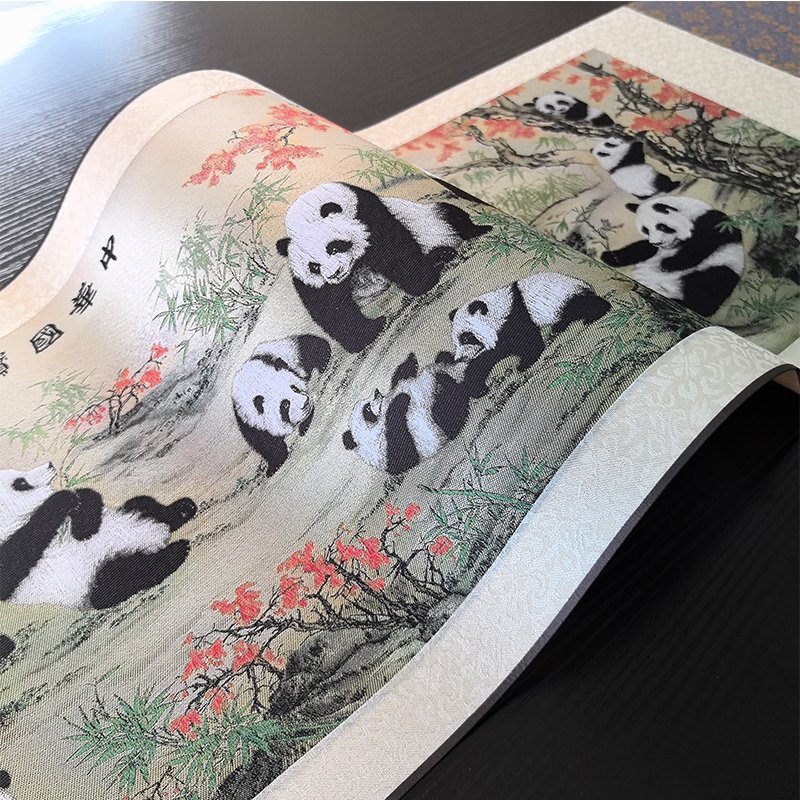
The Ming and Qing dynasties were the peak period of Shu Embroidery, with its craftsmanship reaching the summit. It became an indispensable tribute to the imperial court, while folk embroidery schools also flourished, forming a pattern where “official embroidery” and “folk embroidery” coexisted. In the Ming Dynasty, the imperial court established the “Shu Brocade and Embroidery Bureau” in Chengdu, specifically responsible for making embroidered clothing and furnishings for the royal family. Its works used luxurious materials, had grand patterns, and were represented by “dragon robes”, “phoenix coronets and embroidered capes”, and “imperial screens”, with intricate stitches and rich colors. The Ming Dynasty Shu Embroidery screen “Hundred Birds Paying Homage to the Phoenix” collected in the Palace Museum is 2.8 meters high and 1.5 meters wide. It is embroidered with gold thread, silver thread and colored silk threads. The hundred birds have different postures, and the wings of the phoenix have rich layers. The tail feathers of the phoenix alone used five stitches including gradient stitch, sleeve stitch and rolling stitch, taking three years to complete. It can be called the pinnacle of Ming Dynasty Shu Embroidery.
Folk schools of Shu Embroidery became more prosperous in the Qing Dynasty, forming different styles represented by the “Western Sichuan Embroidery School” and “Eastern Sichuan Embroidery School”. The Western Sichuan Embroidery School, centered in Chengdu and Wenjiang, had a delicate and elegant style and was good at embroidering flowers, birds and figures. The Eastern Sichuan Embroidery School, centered in Chongqing and Wanzhou, had a bold and magnificent style and was skilled in embroidering landscapes and beasts. During this period, Shu Embroidery patterns were more closely related to life. In addition to traditional auspicious patterns, themes reflecting Bashu folk customs also appeared, such as “Sichuan Opera characters”, “teahouse customs” and “farming scenes”, making Shu Embroidery more distinctive in regional culture. According to “Chengdu General Overview”, there were more than 100 embroidery workshops and thousands of embroiderers in Chengdu during the Qing Dynasty. “The embroidery products produced every day are sold inside and outside Sichuan, with an annual income of tens of thousands of taels of silver”, which shows the large scale of its industry.
The technological innovation of Shu Embroidery in the Qing Dynasty was reflected in the maturity of “double-sided embroidery”. This stitch allows the front and back of the embroidery to have the same pattern and color, which is extremely difficult. The Qing Dynasty Shu Embroidery “Double-Sided Hibiscus and Carp” collected in the Sichuan Museum has completely symmetrical hibiscus and carp patterns on both sides. The scales of the carp are embroidered with “sand stitch”, which has a strong three-dimensional effect, as if they are leaping off the fabric. In addition, Shu Embroidery in the Qing Dynasty also made breakthroughs in materials, beginning to inlay pearls, agates, jade and other jewels into embroidery works, enhancing the luxury and artistic value of the embroidery.
4. Transformation Period: Modern Times to the Present (1912 AD – Present) – Ups and Downs and Contemporary Revival
During the Republic of China, affected by wars and modern industry, the Shu Embroidery industry once declined, and many traditional stitches were on the verge of being lost. However, with the persistence of folk embroiderers, Shu Embroidery still maintained a glimmer of hope. During this period, Shu Embroidery works focused more on practicality, mainly embroidering daily necessities such as clothing, handkerchiefs and purses, and the patterns also tended to be simple. In 1937, the “Shu Embroidery Vocational School” was established in Chengdu, enrolling female students to teach embroidery techniques and cultivating a group of outstanding embroiderers, preserving the talent for the inheritance of Shu Embroidery.
After the founding of the People’s Republic of China, Shu Embroidery ushered in an opportunity for revival. In 1951, the “Shu Embroidery Production Cooperative” was established in Chengdu, organizing scattered embroiderers to resume the research and inheritance of traditional stitches. In 1956, the Shu Embroidery work “Hibiscus and Carp” carefully created by Shu Embroidery artists was selected for the “National Arts and Crafts Exhibition”. Its vivid shape and exquisite craftsmanship won wide acclaim and became a landmark work of Shu Embroidery. After the reform and opening up, the Shu Embroidery industry further developed, forming an industrial chain integrating “R&D, production and sales”, and strengthened cooperation with universities and design institutions to promote the integration of Shu Embroidery with modern life. In 2006, Shu Embroidery was included in the first batch of national intangible cultural heritage representative projects, marking that its cultural value has been highly recognized by the state and society.
II. Unique Craftsmanship of Shu Embroidery: The Ingenuity in the Interweaving of Needles and Threads
The core charm of Shu Embroidery lies in its exquisite and unique craftsmanship system. After thousands of years of accumulation and innovation, it has formed distinct characteristics of “strict material selection, flexible design, intricate stitches and bright colors”. Shu Embroidery artists often say, “Every stitch and thread is the work of ingenuity”. From the selection of embroidery bases and threads to the design of patterns and the application of stitches, every link condenses the wisdom and hard work of the artists, jointly creating the artistic brilliance of Shu Embroidery.
1. Material Selection: A Gift from the Land of Abundance – Strict Standards for Embroidery Bases and Threads
Shu Embroidery has extremely strict requirements for material selection, emphasizing “excellent materials and exquisite craftsmanship”. Both the embroidery base and threads are preferably local products from Sichuan, which is an important embodiment of the regional characteristics of Shu Embroidery. The embroidery bases of Shu Embroidery mainly use “Shu Brocade satin” and “Sichuan silk”. Among them, Shu Brocade satin, with its thick texture, soft luster and strong wear resistance, is the first choice for high-end Shu Embroidery. The production history of Shu Brocade satin can be traced back to the Han Dynasty. It has a high warp and weft density, a flat and delicate surface, and can well bear intricate stitches and bright colors, making the embroidery more solid and luxurious. Medium and low-end Shu Embroidery mostly uses Sichuan silk, which is light in texture and good in air permeability, suitable for embroidering daily necessities.
The selection of embroidery threads is a key link in Shu Embroidery craftsmanship. Traditional Shu Embroidery uses threads twisted from “Sichuan silk”, which is made from mulberry silk produced in Sichuan through multiple processes such as reeling, scouring and dyeing. Sichuan silk is characterized by uniform thickness, strong toughness and good luster. It can absorb a large amount of dye, making the embroidery thread color full and durable. Shu Embroidery artists have extremely precise control over the thickness of the embroidery thread. According to different parts of the embroidery, mulberry silk is divided into “single-strand thread”, “double-strand thread” and “multi-strand thread”. The thinnest embroidery thread can split a single strand of mulberry silk into 1/16, which is used for embroidering delicate parts such as human faces and animal fur.
Dyeing technology is the core guarantee for the bright colors of Shu Embroidery. Traditional Shu Embroidery uses a combination of mineral dyes and plant dyes for dyeing. Mineral dyes such as cinnabar, azurite and ochre have long-lasting colors that are not easy to fade. Plant dyes such as safflower, indigo and gardenia have soft and natural colors. The dyeing of Shu Embroidery emphasizes “bright but not gaudy, colorful but not vulgar”. Artists will prepare hundreds of colors according to the needs of the pattern, among which “Shu red”, “Shu green” and “Shu blue” are the most classic, becoming the iconic colors of Shu Embroidery. In addition, Shu Embroidery also uses techniques such as “tie-dyeing” and “gradient dyeing” to make the color transition of the embroidery thread natural, laying the foundation for the subsequent gradient stitch technique.
2. Design: The Externalization of Bashu Culture – Themes and Connotations of Patterns
The design of Shu Embroidery is rooted in the soil of Bashu culture. Its patterns are rich and diverse, including not only the auspicious symbols shared by the Chinese nation but also distinct regional characteristics, forming the characteristics of “broad themes, profound connotations and flexible shapes”. The patterns of Shu Embroidery can be roughly divided into four categories: auspicious flowers and birds, regional symbols, historical stories and folk customs. Each category of themes carries a unique cultural connotation.
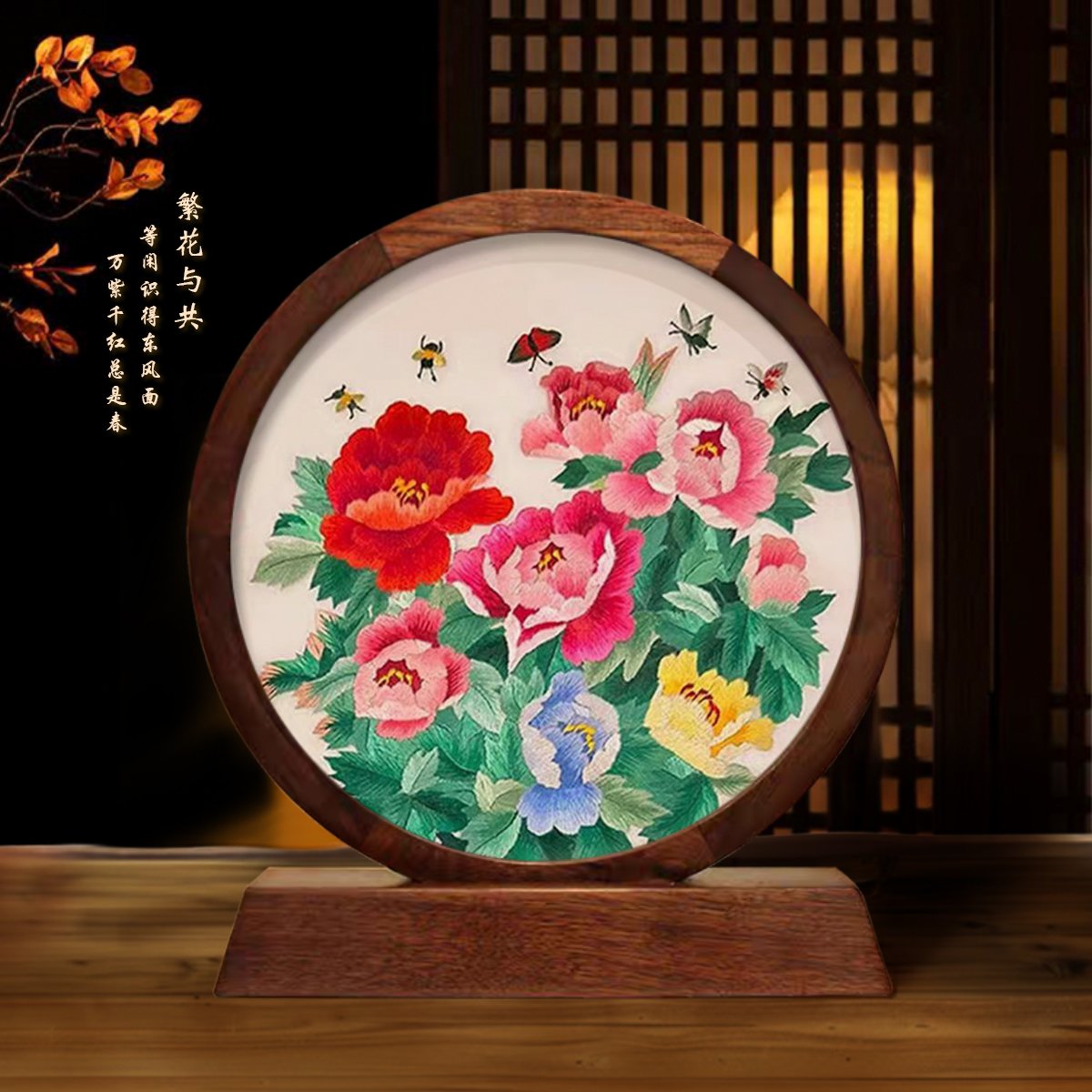
Auspicious flowers and birds are the most common themes in Shu Embroidery, reflecting the Chinese nation’s yearning for a better life. Among them, “hibiscus and carp” is the iconic pattern of Shu Embroidery. Hibiscus is the city flower of Chengdu, symbolizing prosperity. Carp symbolizes “surplus every year” and “promotion step by step” in traditional Chinese culture. The combination of the two not only reflects the regional characteristics of Bashu but also conveys auspicious meanings. In addition, patterns such as “mandarin ducks playing in lotus” (symbolizing conjugal love), “pine and crane for longevity” (symbolizing longevity and health), and “peony for wealth” (symbolizing prosperity and wealth) are also widely used in Shu Embroidery. The flower and bird patterns in Shu Embroidery focus on the “unity of form and spirit”. Through careful observation, artists accurately reproduce the postures and charms of flowers and birds in the embroidery. For example, the carp embroidered has layers of scales and a vivid posture of swinging its tail, as if about to leap out of the water.
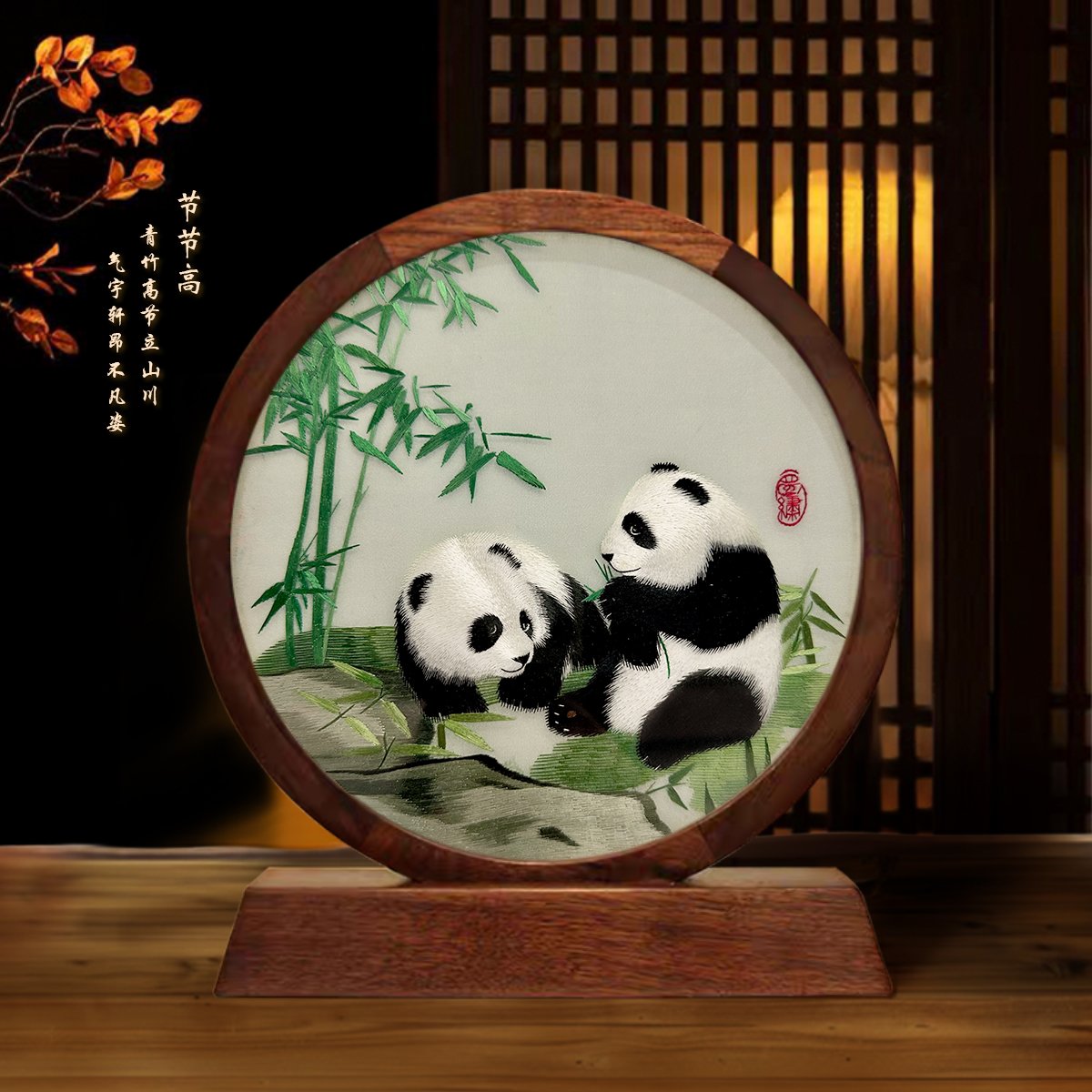
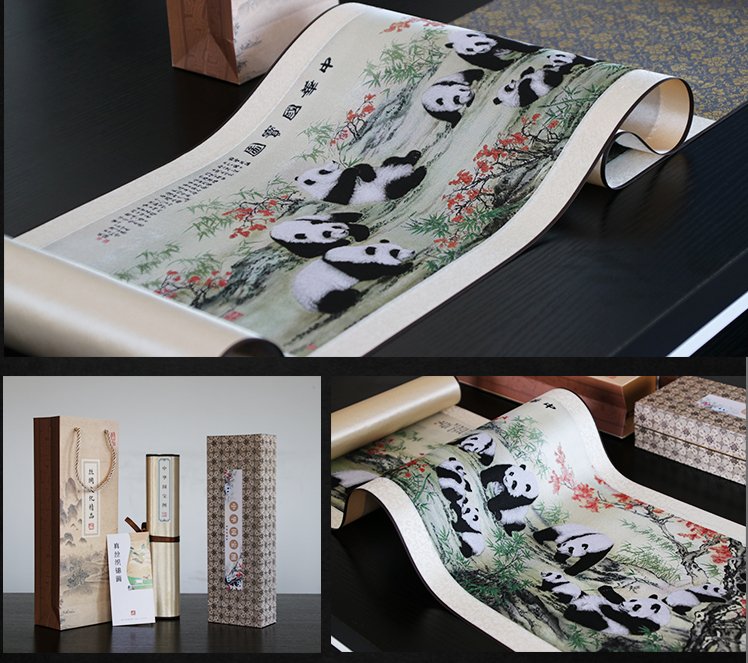
Regional symbol themes are the key to distinguishing Shu Embroidery from other embroidery styles, concentrating on reflecting the unique charm of Bashu culture. The most representative is the “giant panda” pattern. The giant panda is a unique animal in Sichuan, known as the “national treasure”. Shu Embroidery artists have created a large number of works with giant pandas as the theme, showing the cuteness of giant pandas through delicate stitches. In addition, regional themes such as “Sichuan Opera masks”, “Sanxingdui patterns” and “Dujiangyan scenery” are also common in Shu Embroidery works. For example, the Shu Embroidery “Sichuan Opera Masks” reproduces the mystery and boldness of Sichuan Opera art through bright colors and exaggerated shapes; “Dujiangyan” shows the grandeur of this water conservancy project with a realistic approach.
Themes of historical stories and folk customs make Shu Embroidery a “living history textbook”. Historical story themes are mostly derived from the Three Kingdoms culture and the history of Shu Han, such as “Oath of the Peach Garden”, “Zhuge Liang’s Northern Expedition” and “Battle of Jiangyou Pass”, reproducing the historical events of the Bashu region. Folk custom themes focus on the daily life of the Bashu people, such as “listening to stories in teahouses”, “face-changing on the street” and “farming work”, showing the vitality and vividness of Bashu folk customs. These patterns not only have artistic value but also provide important visual materials for the study of Bashu history and folk customs.
3. Stitches: The Soul of Shu Embroidery – Intricate and Diverse Needlework Art
Stitches are the core of Shu Embroidery craftsmanship. After thousands of years of development, Shu Embroidery has formed more than 12 categories and 130 kinds of stitches, including “gradient stitch”, “sleeve stitch”, “rolling stitch”, “sand stitch”, “dot stitch” and “seed stitch”, making it one of the embroidery styles with the most abundant stitches in Chinese embroidery. Shu Embroidery artists flexibly use different stitches according to the different needs of the pattern, realizing the artistic effect of “needles following the shape and threads changing with colors”, making the embroidery both three-dimensional and layered.
“Gradient stitch” is the most representative stitch of Shu Embroidery and the core technique for the gradient color effect of Shu Embroidery. Gradient stitch is divided into three types: “full gradient stitch”, “half gradient stitch” and “local gradient stitch”. Its core principle is to realize the natural transition of different colors of embroidery threads through the arrangement of thread length and density, forming an effect of “appropriate shades and distinct layers”. For example, when embroidering the petals of hibiscus flowers, artists use full gradient stitch, gradually transitioning from dark pink at the root of the petal to light pink at the edge, and then to white. The color transition is smooth and natural, as if the light and shadow change on the petals. When embroidering the back of a carp, local gradient stitch is used, transitioning from dark gray on the back to silver white on the belly, showing the three-dimensional sense of the carp.
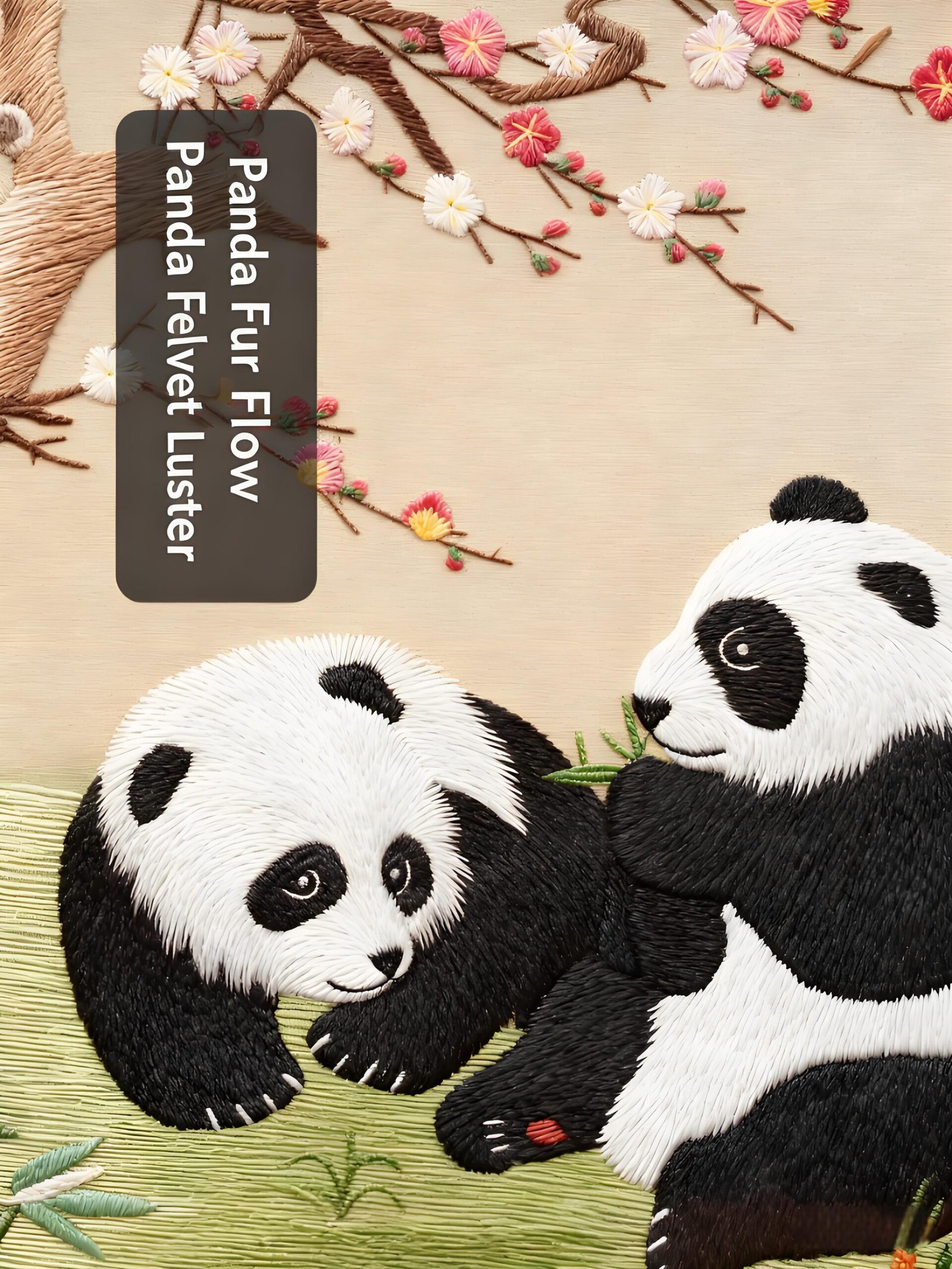
“Sand stitch” is a unique stitch of Shu Embroidery used to show texture, mainly used for embroidering parts such as animal fur and plant leaves. The characteristic of sand stitch is that the stitches are sparse, and the threads are arranged in a “sand-like” shape. The texture of the object is shown through the direction and density of the threads. For example, when embroidering giant panda fur, artists use sand stitch, embroidering the panda’s eye circles and ears with black threads, and the body with white threads. The threads are arranged sparsely and neatly, showing the softness and fluffiness of the panda’s fur. When embroidering lotus leaves, a combination of sand stitch and gradient stitch is used, which not only shows the texture of the lotus leaves but also reflects the luster of dewdrops on the leaves.
“Rolling stitch” and “dot stitch” are often used to show the outline and details of patterns. Rolling stitch, also known as “wandering stitch”, has a “curved” stitch shape. It outlines the outline of the pattern through continuous rolling of threads, such as embroidering the body outline of a carp and the stem of a hibiscus flower, making the outline smooth and natural. Dot stitch shows the details of the pattern through dense dot-like stitches, such as embroidering flower stamens and bird eyes, making the details more delicate. In addition, “seed stitch” is often used to embroider decorative patterns. By knotting the thread to form “seed-like” protrusions, it increases the three-dimensional sense and texture of the embroidery, such as embroidering patterns on clothing and the borders of screens.
The application of Shu Embroidery stitches is “subject-specific and part-specific”. An excellent Shu Embroidery work often requires the combination of multiple stitches. For example, the classic work “Hibiscus and Carp” uses gradient stitch for the carp’s body, sand stitch for the scales, rolling stitch for the tail, dot stitch for the eyes, gradient stitch for the petals of the hibiscus flower, and seed stitch for the stamens. The integration of multiple stitches makes the work vivid and layered, demonstrating the exquisiteness and diversity of Shu Embroidery stitches.
4. Color Matching: The Aesthetics of Brightness and Vividness – Regional Aesthetics and Color Philosophy
The color matching of Shu Embroidery is characterized by “bright and vivid, strong contrast but harmonious unity”, reflecting the boldness and enthusiasm of Bashu culture, which is in sharp contrast to the elegance of Su Embroidery and the calmness of Xiang Embroidery. The color matching of Shu Embroidery does not blindly pursue brightness but follows the color philosophy of “coloring according to category, clear primary and secondary, and coordinated cold and warm”, making the embroidery not only visually striking but also harmonious and beautiful.
“Coloring according to category” is the core principle of Shu Embroidery color matching, that is, coloring according to the natural color of the pattern, while integrating the artist’s subjective aesthetics. For example, when embroidering hibiscus flowers, pink and red are used as the main colors, with green leaves to reproduce the natural shape of hibiscus flowers. When embroidering giant pandas, black and white are the main colors, with a small amount of gray transition to show the cuteness of pandas. When embroidering Sichuan Opera masks, strong contrasting colors such as red, black, white and blue are used to highlight the exaggeration and mystery of the masks. The color matching of Shu Embroidery emphasizes the “unity of authenticity and artistry of color”, respecting the natural color while enhancing the artistic appeal of the embroidery through color exaggeration and harmony.
“Clear primary and secondary” is another important principle of Shu Embroidery color matching. By clarifying the relationship between the main color and the auxiliary color, the theme of the embroidery is highlighted. Shu Embroidery works usually use one or two colors as the main colors, occupying the main visual space of the embroidery. Other colors are used as auxiliary colors to set off and embellish. For example, “Hibiscus and Carp” uses red (hibiscus flowers) and silver white (carp) as the main colors, with green (leaves) and black (carp eyes) as auxiliary colors. The main colors are bright and prominent, and the auxiliary colors are appropriate, making the theme of the work clear and the visual effect coordinated. “Giant Panda Playing with Bamboo” uses black and white (giant panda) and green (bamboo) as the main colors, with yellow (bamboo shoots) as the auxiliary color. The primary and secondary colors are distinct, showing the harmonious scene of giant pandas and bamboo forests.
In addition, the color matching of Shu Embroidery also pays attention to “coordination of cold and warm”. Through the matching of cold and warm colors, the layering and sense of space of the embroidery are enhanced. For example, when embroidering landscape works, cold colors such as blue and green are used to represent distant mountains and water surfaces, and warm colors such as brown and yellow are used to represent near mountains and rocks. The contrast between cold and warm colors makes the picture more spatial. When embroidering flower and bird works, warm colors such as red and pink are used to represent flowers, and cold colors such as green are used to represent leaves. The coordination of cold and warm makes the work more vivid. The color matching of Shu Embroidery is also adjusted according to the purpose of the embroidery. For example, imperial tributes mostly use luxurious colors such as gold, silver and red, while daily necessities mostly use bright and fresh colors, reflecting the design concept of “unity of practicality and aesthetics”.
III. Cultural Connotation of Shu Embroidery: Bashu Spirit and National Feelings in Needles and Threads
As an important carrier of Bashu culture, the artistic value of Shu Embroidery lies not only in its exquisite craftsmanship but also in its profound cultural connotation. From the connotation of patterns to the inheritance of craftsmanship, from the creative concept to the aesthetic pursuit, every detail of Shu Embroidery reflects the life wisdom, spiritual beliefs and national feelings of the Bashu people, becoming an important window to interpret traditional Chinese culture.
1. The Manifestation of Regional Spirit: The Boldness and Flexibility of Bashu Culture
The artistic style of Shu Embroidery is highly consistent with the regional spirit of Bashu, showing both the richness and warmth of the Land of Abundance and the boldness and flexibility of the Bashu people. The Sichuan Basin has dangerous terrain and rich products, forming a regional character of “contentment and optimism”. At the same time, the Bashu region has been a hub of cultural exchanges many times in history, forming a cultural spirit of “inclusiveness and innovation”. These characteristics are all integrated into the creation of Shu Embroidery.
The “bright colors” of Shu Embroidery reflect the boldness and enthusiasm of the Bashu people. Different from the elegance of Su Embroidery and the calmness of Xiang Embroidery, Shu Embroidery uses bright colors such as red, green and blue without hesitation, showing the Bashu people’s love for life and pursuit of beauty. This color preference is closely related to the climate and folk customs of the Bashu region. Sichuan has a humid climate with many rainy days, and bright colors can bring a bright visual experience. At the same time, Bashu folk customs pay attention to “liveliness and celebration”. On occasions such as the Spring Festival and weddings, bright Shu Embroidery clothing and furnishings can create a festive atmosphere, reflecting the optimistic character of the Bashu people.
The “flexible shape” of Shu Embroidery reflects the flexibility and innovation of Bashu culture. The flower, bird and animal patterns in Shu Embroidery are vivid and full of movement. For example, the embroidered carp has a vivid posture of swinging its tail and distinct layers of scales, accurately reproducing the moment when the carp swims. The embroidered giant panda has a cute expression and a lazy posture, showing the flexibility and cuteness of the giant panda. This pursuit of “dynamic beauty” comes from the Bashu people’s careful observation of nature and respect for life, and also reflects the “innovative spirit” in Bashu culture. Shu Embroidery artists are not satisfied with simple imitation of nature, but through artistic processing, accurately reproduce the charm of natural objects and endow the embroidery with vitality.
In addition, the “inclusiveness” of Shu Embroidery also reflects the openness of Bashu culture. In the process of development, Shu Embroidery has continuously absorbed the essence of other art forms, such as absorbing the patterns and techniques of Buddhist art in the Tang Dynasty, absorbing the aesthetic concepts of literati paintings in the Song Dynasty, and absorbing the vivid themes of folk art in the Ming and Qing Dynasties, forming an artistic style of “absorbing the strengths of others and forming its own school”. This inclusive characteristic is inseparable from the historical status of the Bashu region as an important node of the “Silk Road”, and also highlights the inclusiveness and grandeur of Bashu culture.
2. The Carrier of Auspicious Culture: Yearning for a Better Life
Auspicious culture is a core part of traditional Chinese culture. As a representative of folk craftsmanship, Shu Embroidery concentrates on carrying the Chinese nation’s yearning for a better life. The patterns of Shu Embroidery are mostly full of auspicious meanings. Through techniques such as “homophony, symbolism and metaphor”, abstract auspicious concepts are transformed into specific visual symbols, making the embroidery not only have artistic value but also a carrier of conveying blessings.
“Homophonic implication” is the most commonly used expression technique in Shu Embroidery patterns. Using the homophonic relationship of Chinese characters, the patterns convey auspicious meanings. For example, the “hibiscus and carp” pattern, “carp” is homophonic with “surplus” in Chinese, implying “surplus every year”. “Hibiscus” is homophonic with “prosperity and glory”, implying “prosperity and wealth”. The combination of the two implies “prosperity and surplus”, becoming the most classic auspicious pattern of Shu Embroidery. In addition, patterns such as “magpie on plum branch” (magpie is homophonic with “joy”, implying “joyful events”), and “bat presenting longevity” (bat is homophonic with “blessing”, implying “blessings as deep as the sea and longevity as long as the mountains”) are also widely used in Shu Embroidery, reflecting the linguistic wisdom and auspicious concepts of the Chinese nation.
“Symbolic implication” conveys auspicious meanings through the natural attributes of patterns. Shu Embroidery artists integrate natural objects with good qualities into patterns, symbolizing people’s pursuit of certain qualities or living conditions. For example, the “pine and crane for longevity” pattern, pine trees are evergreen all year round, symbolizing longevity. Cranes have an elegant posture and also symbolize longevity. The combination of the two symbolizes “longevity and health”. The “peony for wealth” pattern, peonies have large flowers and bright colors, symbolizing “prosperity and wealth”. The “lotus for integrity” pattern, lotus grows out of mud but is not stained, symbolizing “integrity and incorruptibility”. These patterns not only show the beauty of natural objects but also convey profound auspicious meanings, realizing the “unity of natural beauty and humanistic beauty”.
The auspicious patterns of Shu Embroidery also have the characteristics of “scenarioization”. Different patterns are designed according to different usage scenarios, making the blessings more targeted. For example, patterns such as “mandarin ducks playing in lotus” and “dragon and phoenix presenting auspiciousness” are used on wedding occasions, implying conjugal love and happy marriage. Patterns such as “pine and crane for longevity” and “peach presenting longevity” are used on birthday banquets, implying longevity and health. Patterns such as “surplus every year” and “abundant grain harvest” are used on festivals, implying a prosperous life. This scenario-based design integrates Shu Embroidery into people’s daily life, becoming an important medium for conveying emotions and expressing blessings.
3. The Crystallization of Women’s Wisdom: Artistic Expression and Value Realization of Traditional Women
In traditional Chinese society, women’s social activity space was relatively limited, and embroidery became an important way for women to show their wisdom, express their emotions and realize their value. As a craft mainly inherited by women, Shu Embroidery carries the artistic talents and life experiences of Bashu women in past dynasties, becoming the “crystallization of women’s wisdom”.
The inheritance of Shu Embroidery craftsmanship is mostly carried out in the way of “mother teaching daughter, master teaching apprentice”. In the process of embroidery, women integrate their own observations, emotions and aesthetics into the works, making Shu Embroidery have the artistic characteristics of “delicacy and gentleness”. For example, the flower and bird patterns they embroider are often more delicate in emotion than those created by male artists, with extremely delicate handling of petal layers and bird feather textures. The folk custom themes they embroider can better capture the subtle moments in daily life, showing a unique female perspective. In addition, women also place their emotions in the works during the embroidery process. For example, unmarried women would embroider “mandarin ducks playing in lotus” handkerchiefs and give them to their sweethearts to express their love. Married women would embroider clothing with patterns of “many children and grandchildren” to place their hopes for a happy family.
Shu Embroidery also provided traditional women with a way to realize their social value. In Chengdu during the Ming and Qing Dynasties, many women made a living by embroidery, improving their family’s living conditions through their exquisite embroidery skills, and even becoming famous embroiderers. For example, Chen Jiugu, a famous embroiderer in Chengdu during the Qing Dynasty, was good at embroidering flower and bird patterns. Her works were “lifelike and well-known far and wide”, and were selected as tributes by the government, becoming a model for women at that time. During the Republic of China, the establishment of Shu Embroidery vocational schools provided women with the opportunity to systematically learn embroidery skills, enabling women to obtain an independent social status through mastering a craft.
In contemporary Shu Embroidery inheritance, women are still the core force. National intangible cultural heritage inheritors such as Hao Shuping and Meng Dezhi are all female artists. They not only adhere to traditional craftsmanship but also actively innovate, integrating modern design concepts into Shu Embroidery creation to make Shu Embroidery more adaptable to the needs of modern life. Through their efforts, these female artists have not only realized their personal value but also promoted the inheritance and development of Shu Embroidery art, demonstrating the wisdom and strength of contemporary women.
4. National Cultural Identity: Inheritance and Sharing of Traditional Culture
As a common cultural treasure of the Chinese nation, Shu Embroidery is not only a representative of Bashu regional culture but also carries the cultural identity of the Chinese nation. Many patterns and techniques in Shu Embroidery are common cultural symbols of the Chinese nation. For example, themes such as auspicious flowers and birds and historical stories are widely recognized nationwide. Stitches such as gradient stitch and sleeve stitch are also used for reference by other embroidery styles, becoming the common wealth of Chinese embroidery art.
The inheritance and development of Shu Embroidery have promoted the exchange and integration of national culture. In history, Shu Embroidery was sold to various places through the Silk Road, exchanging and integrating Bashu culture with Central Plains culture, Western Regions culture and overseas culture. In contemporary times, as a representative of Chinese culture, Shu Embroidery has been exhibited in many international exhibitions, such as the 2010 Shanghai World Expo and the 2019 Beijing International Horticultural Exhibition, showing the charm of traditional Chinese embroidery art to the world and enhancing the influence of national culture. In addition, Shu Embroidery has also become an important carrier of Sino-foreign cultural exchanges. Many foreigners have learned about traditional Chinese culture through learning Shu Embroidery, promoting cultural communication and sharing.
Shu Embroidery also plays an important role in enhancing national cohesion. On important festivals and celebrations, Shu Embroidery works are often displayed as symbols of national culture. For example, Shu Embroidery decorative paintings at the National Day anniversary celebrations show the cultural confidence of the Chinese nation. In overseas Chinese communities, Shu Embroidery is also regarded as a “symbol of hometown”, carrying the nostalgia and national identity of overseas Chinese. This cultural identity makes Shu Embroidery transcend regional and temporal limitations and become a common spiritual treasure of the Chinese nation.
IV. Classic Works of Shu Embroidery: Artistic Monuments Forged by Needles and Threads
After thousands of years of inheritance and development, countless classic works have been created in the history of Shu Embroidery. These works include not only luxurious imperial tributes serving the court but also daily necessities close to the people; not only narrative works reproducing history but also flower and bird works showing nature. Each classic work is a perfect integration of craftsmanship and culture, representing the highest artistic level of Shu Embroidery in different eras and becoming an artistic monument of traditional Chinese craftsmanship.
1. “Hibiscus and Carp”: A Symbolic Work of Contemporary Shu Embroidery
“Hibiscus and Carp” is a symbolic work of contemporary Shu Embroidery. Created collectively by Shu Embroidery artists such as Hao Shuping and Meng Dezhi in 1956, it is now collected in the National Museum of China. The work is 1.2 meters long and 0.8 meters wide. With the city flower of Chengdu (hibiscus) and the auspicious carp as the theme, it shows the natural beauty and auspicious implications of the Bashu region. The work uses more than ten stitches such as gradient stitch, sand stitch and rolling stitch, accurately reproducing the brightness of hibiscus flowers and the flexibility of carp, becoming a masterpiece that integrates the essence of Shu Embroidery craftsmanship.
The artistic value of “Hibiscus and Carp” lies in its creative concept of “unity of form and spirit”. The six carps in the work have different postures: some dive into the water, some jump out of the water, and some play around. The scales are embroidered with sand stitch, layer upon layer, with a strong three-dimensional sense. The fish tails are embroidered with rolling stitch, with smooth lines, showing the dynamic beauty of the fish tails swinging. The fish eyes are embroidered with dot stitch, black and bright, as if they have life. The hibiscus flowers are embroidered with gradient stitch, with colors transitioning from dark pink to light pink and then to white, natural and smooth. The stamens are embroidered with seed stitch, full of particles, showing the delicate and beautiful appearance of hibiscus flowers. The background is set off by light green lotus leaves, which form a sharp contrast with the hibiscus flowers and carp, making the theme of the picture prominent and layered.
The cultural value of “Hibiscus and Carp” lies in its perfect integration of regional culture and auspicious implications. As the city flower of Chengdu, hibiscus symbolizes the prosperity of the Bashu region. Carp symbolizes “surplus every year”, conveying people’s yearning for a better life. Created in the early days of the founding of the People’s Republic of China, the work not only shows the revival of Shu Embroidery craftsmanship but also reflects the people’s pursuit of a happy life in the new era. In 1959, “Hibiscus and Carp” was presented to foreign heads of state as a fine Chinese arts and crafts, becoming an important carrier of Sino-foreign cultural exchanges and enhancing the international reputation of Shu Embroidery.
2. “Double-Sided Embroidered Giant Panda”: A Pinnacle Work of Shu Embroidery Double-Sided Embroidery Craftsmanship
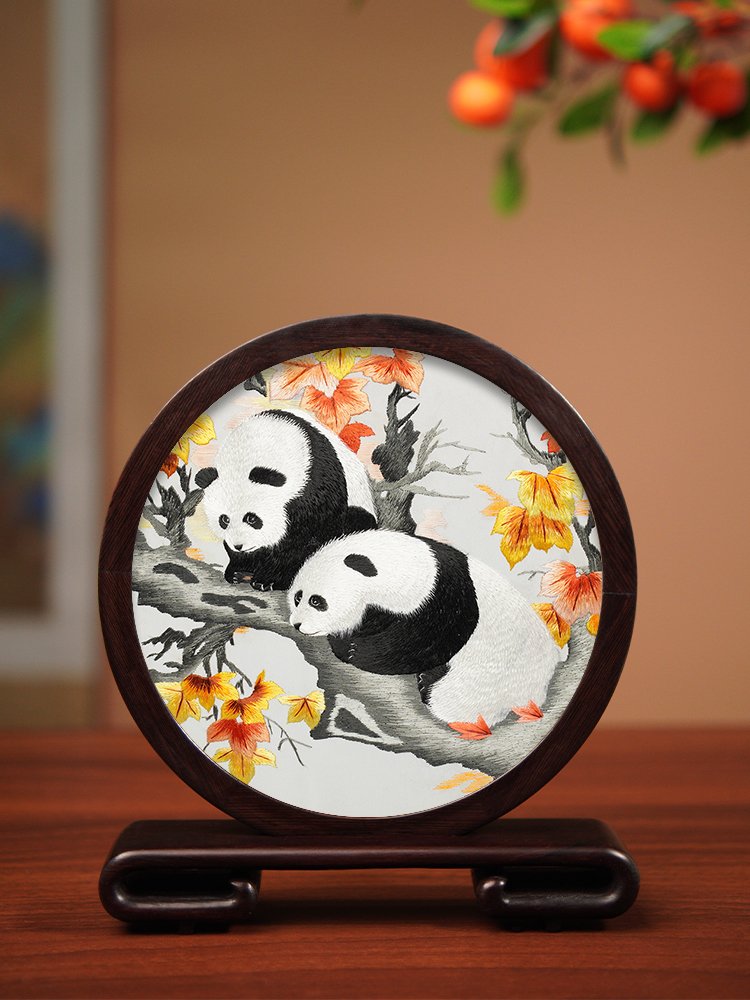
“Double-Sided Embroidered Giant Panda” is a pinnacle work of Shu Embroidery double-sided embroidery craftsmanship. Created by national intangible cultural heritage inheritor Meng Dezhi in 2008, it is now collected in the Sichuan Museum. The work is 0.6 meters long and 0.4 meters wide. Using double-sided embroidery techniques, both the front and back sides are embroidered with two cute giant pandas playing in a bamboo forest. The patterns and colors on both sides are completely consistent, demonstrating the exquisite double-sided embroidery craftsmanship of Shu Embroidery.
The technical difficulty of “Double-Sided Embroidered Giant Panda” lies in “synchronous double-sided embroidery and precise symmetry”. Double-sided embroidery requires artists to take into account the patterns and colors on both sides during the embroidery process. The density of stitches and the direction of threads must be accurately controlled. A slight deviation will lead to inconsistency between the two sides. During the creation process, Meng Dezhi used the technique of “double-thread synchronous embroidery”, threading two threads of the same color and thickness into the needle, and embroidering from the front and back of the embroidery base at the same time to ensure the consistency of the two sides. The giant pandas in the work are embroidered with a combination of sand stitch and gradient stitch. The black fur is embroidered with sparse sand stitch, showing the softness of the fur. The white fur is embroidered with delicate gradient stitch, showing the fluffiness of the fur. The eyes of the giant pandas are embroidered with a combination of black and white threads, black and bright, cute and lovely. The bamboo forest is embroidered with green threads, with clear textures of bamboo leaves, forming a harmonious picture with the giant pandas.
The cultural value of “Double-Sided Embroidered Giant Panda” lies in its artistic reproduction of the “national treasure” symbol. Giant pandas are China’s national treasures and are universally recognized as symbols of peace and friendship. “Double-Sided Embroidered Giant Panda” takes giant pandas as the theme, not only showing the unique animals in the Bashu region but also conveying the Chinese people’s concept of loving peace and being friendly to others. In 2010, the work was exhibited at the Shanghai World Expo, attracting the attention of millions of viewers and becoming an important business card for Shu Embroidery to go to the world.
3. Ming Dynasty “Dragon Robe Embroidery”: A Pinnacle Work of Court Shu Embroidery
The Ming Dynasty “Dragon Robe Embroidery” is a pinnacle work of court Shu Embroidery. Created during the Wanli period of the Ming Dynasty, it is now collected in the Palace Museum. The screen is 2.8 meters high and 1.5 meters wide. Using Shu Brocade satin as the embroidery base and gold thread, silver thread and colored silk thread as the embroidery threads, it is embroidered with a grand scene of a phoenix and hundreds of birds paying homage. It shows the luxury and exquisiteness of court Shu Embroidery in the Ming Dynasty.
The artistic value of “Dragon Robe Embroidery” lies in the “unity of grand narrative and delicate details”. The center of the work is a phoenix spreading its wings to fly. The wings of the phoenix are embroidered with interwoven gold threads and colored silk threads. The scales are embroidered with sleeve stitch layer by layer, golden and shining, showing the dignity and majesty of the phoenix. The head of the phoenix is embroidered with dot stitch, with bright crests and eyes, full of charm. Surrounding the phoenix are hundreds of different birds, including peacocks, cranes, mandarin ducks and magpies. Each bird has a different posture and color, but all face the phoenix, forming a grand scene of “hundreds of birds paying homage to the phoenix”. The background of the work is embroidered with patterns of auspicious clouds and peonies. The auspicious clouds are embroidered with rolling stitch, with smooth lines. The peonies are embroidered with gradient stitch, with bright colors, forming a harmonious whole with the phoenix and hundreds of birds.
The cultural value of “Dragon Robe Embroidery” lies in its display of court culture and auspicious implications. “Hundreds of birds paying homage to the phoenix” is an auspicious pattern in traditional Chinese culture that symbolizes “wise monarch and submission of the world”. It is often used in court decorations, reflecting the hierarchical concept and political ideals of the Ming court. The work uses luxurious materials such as gold thread and silver thread, and took three years to complete, showing the court’s attention and investment in Shu Embroidery, and also reflecting the highest level of Shu Embroidery craftsmanship at that time.
4. Qing Dynasty “Sichuan Opera Mask” Hanging Screen: Artistic Reproduction of Folk Culture
The Qing Dynasty “Sichuan Opera Mask” hanging screen is a classic work of folk culture themes in Shu Embroidery. Created during the Guangxu period of the Qing Dynasty, it is now collected in the Sichuan Museum. The hanging screen is 1 meter high and 0.6 meters wide. With Sichuan Opera masks as the theme, it is embroidered with classic Sichuan Opera characters such as “Guan Yu”, “Zhang Fei”, “Cao Cao” and “Sun Wukong”, showing the unique charm of Bashu folk culture.
The artistic value of the “Sichuan Opera Mask” hanging screen lies in the “exaggerated reproduction of colors and shapes”. Sichuan Opera masks are famous for their bright colors and exaggerated shapes. Shu Embroidery artists perfectly reproduce the characteristics of the masks through accurate color matching and stitch application. For example, Guan Yu’s mask uses red as the main color, symbolizing “loyalty”. The red threads are layered, full of color. Zhang Fei’s mask uses black as the main color, symbolizing “bravery”. The combination of black and white threads forms a strong contrast. Cao Cao’s mask uses white as the main color, symbolizing “treachery”. The transition between white and gray threads is natural. Sun Wukong’s mask uses yellow as the main color, with red and black patterns, showing his “smart and flexible” character. The work uses stitches such as flat stitch, sleeve stitch and dot stitch. The lines of the masks are clear and smooth, and the patterns are accurately symmetrical, reproducing the artistic charm of Sichuan Opera masks.
The cultural value of the “Sichuan Opera Mask” hanging screen lies in its inheritance and reproduction of Bashu folk culture. Sichuan Opera is an important representative of Bashu culture, and masks are the core elements of Sichuan Opera art. The “Sichuan Opera Mask” hanging screen combines Sichuan Opera art with Shu Embroidery craftsmanship, enabling Sichuan Opera culture to be inherited and spread through the carrier of embroidery. Created in the Qing Dynasty, when Sichuan Opera had become the most popular opera form in the Bashu region, the emergence of the “Sichuan Opera Mask” hanging screen not only satisfied people’s love for Sichuan Opera art but also showed Shu Embroidery artists’ attention and expression of folk culture.
V. Contemporary Inheritance and Development of Shu Embroidery: Integration and Symbiosis of Tradition and Modernity
In contemporary society, with the acceleration of modernization and the deepening of globalization, traditional crafts are facing challenges in inheritance and development. As a national intangible cultural heritage, Shu Embroidery has achieved the integration and symbiosis of tradition and modernity through a series of measures such as “protection and inheritance, innovative development and brand promotion” under the joint efforts of the government, artists, scholars and the market, radiating new vitality and vitality.
1. Construction of Inheritance System: From “Oral Instruction and Heart-to-Heart Teaching” to “Systematic Training”
The traditional inheritance of Shu Embroidery was mostly carried out in the way of “oral instruction and heart-to-heart teaching” of “mother teaching daughter and master teaching apprentice”. Although this method can ensure the authenticity of the craftsmanship, the inheritance scope is limited and it is vulnerable to the impact of talent loss. Contemporary Shu Embroidery inheritance has built a systematic training system of “government-led, college-supported and artist-participated”, expanding the inheritance scope and ensuring the living inheritance of craftsmanship.
At the government level, Sichuan Province and Chengdu City have incorporated Shu Embroidery inheritance into their cultural development strategies and introduced a series of support policies. After Shu Embroidery was included in the national intangible cultural heritage in 2006, the government established a special fund for Shu Embroidery inheritance to fund